
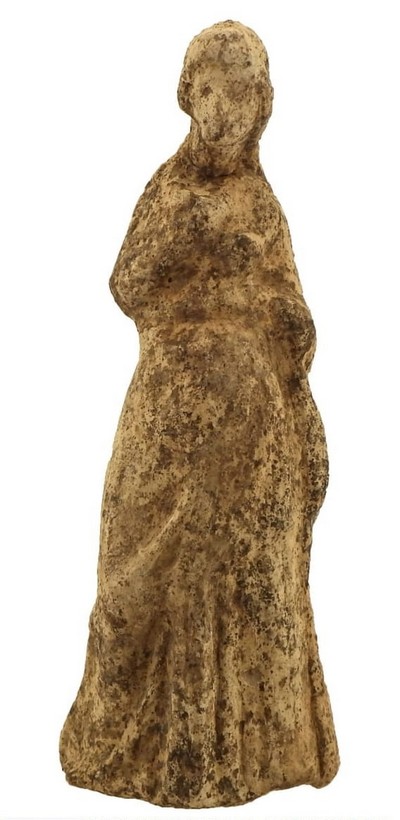
Ancient sanctuary of Demeter in Italy reopened as excavations revealed roots in protohistory
Rome: An ancient sanctuary dedicated to Demeter, the Greek goddess of agriculture, grain and harvest, reopened to the public near Vetralla in central Italy following a major programme of archaeological excavations, conservation and site improvements that shed new light on the location’s remarkably long history.
The Sanctuary of Demeter at Macchia delle Valli reopened after work led by Italy’s Superintendency for Archaeology, Fine Arts and Landscape for the Province of Viterbo and Southern Etruria. The project was supported by funding from Italy’s National Recovery and Resilience Plan (NRRP).
A presentation and opening ceremony were held on October 24, marking a new chapter in the public appreciation of an archaeological site whose origins extended much further back than previously established.
The latest excavations significantly expanded archaeologists’ understanding of the sanctuary, revealing evidence of human activity dating to protohistory — a period preceding the emergence of written historical records. The discoveries suggested that people had frequented the area long before the religious complex took shape, adding an important new dimension to its archaeological significance.
The findings established a broader historical timeline, tracing the site’s development from its earliest known use through the Late Etruscan period and into the Roman era. They also provided fresh evidence of the continuity of religious activity associated with Demeter, whose worship was closely linked to agriculture, fertility and the cycles of cultivation.
A key objective of the archaeological campaign was to clarify how the sanctuary evolved over successive centuries. By examining previously unexplored areas and studying the surviving architectural remains, researchers gained a clearer understanding of its Late Etruscan and Roman phases.
The discoveries helped reconstruct the transformation of the complex and provided further evidence of the site’s enduring religious importance. The sanctuary appeared to have remained a place of devotion across different historical periods, reflecting the persistence of cult practices even as the surrounding society and its political circumstances changed.
The excavations also reached the natural bedrock in several locations, enabling archaeologists to investigate the physical foundations of the site and identify activities that preceded or accompanied its religious use.
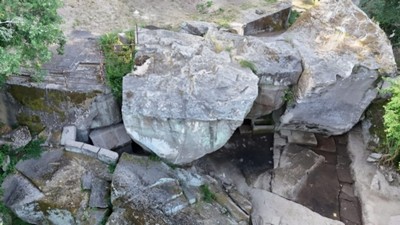
In areas that had not previously been investigated, researchers discovered evidence of quarrying. The traces indicated that stone had been extracted directly from the terrain, revealing another dimension of the site’s history and illustrating how the landscape served both practical and religious purposes.
Among the important discoveries were an ancient fountain, associated structures and terraces extending across the hillside.
These remains offered insights into how the sanctuary’s occupants managed and used the area’s natural resources, particularly water. The fountain and its related infrastructure pointed to the practical arrangements that helped shape activity at the site, while the terraces demonstrated how the hillside had been adapted and maintained over time.
Evidence that the slope continued to be used into the modern period further highlighted the site’s long relationship with the surrounding landscape. Rather than representing an isolated ancient monument, the sanctuary formed part of a setting that had been occupied, modified and used across successive generations.
The combination of archaeological remains, water infrastructure and terraced terrain also enhanced understanding of how the sanctuary functioned within its natural environment.
Alongside the archaeological investigations, the project included conservation measures and improvements designed to make the sanctuary more accessible while safeguarding its historic fabric.
Particular attention was given to the visitor route, with planners seeking to establish a pathway connecting the ancient structures with the surrounding landscape. The approach was intended to allow visitors to appreciate the ruins in their original geographical context and understand the relationship between the sanctuary, the hillside and the natural resources that influenced its development.
The conservation programme aimed to protect the remains for future generations while improving the experience of visitors. The reopening therefore represented not only an opportunity to display newly investigated archaeological features but also an effort to integrate heritage preservation with public access.
The sanctuary’s significance lay in the long chronology that emerged from the excavations. Evidence of early human activity, followed by the development of the religious complex and its subsequent use during the Etruscan and Roman periods, provided an opportunity to examine how sacred places evolved over time.
Demeter, associated with grain, harvest and agricultural fertility, occupied an important place in the religious traditions of the ancient Mediterranean. The evidence uncovered at Macchia delle Valli reinforced the site’s connection with her worship and offered a setting in which to explore the relationship between religious belief, agriculture and the landscape.
The discovery of quarrying traces and water-related structures added further depth to this picture, demonstrating that the sanctuary’s history encompassed not only ritual practices but also the management and transformation of its physical surroundings.
The reopening brought renewed attention to the archaeological heritage of central Italy. The excavation and conservation work expanded knowledge of the site’s origins, clarified its architectural development and strengthened efforts to ensure its long-term preservation.
Together, the discoveries offered a more complete picture of a historic landscape whose story stretched from protohistory through the Etruscan and Roman worlds and into more recent times.