
Kazakhstan unveils $1 billion climate investment opportunity at COP31, targets 10GW renewable energy capacity
Newswire
Astana: Kazakhstan has unveiled an ambitious climate investment initiative at the 31st United Nations Climate Change Conference (COP31) in Antalya, Türkiye, seeking to mobilise billions of dollars in financing to accelerate its transition towards clean energy, modernise its power infrastructure and strengthen environmental sustainability.
The launch of the Just Energy Transition Investment Platform (QaJET) marks a significant step in Kazakhstan’s efforts to turn its climate commitments into tangible investment opportunities, with the European Bank for Reconstruction and Development (EBRD) offering up to $100 million in concessional financing and grants, alongside the possibility of up to $1 billion in direct financing on a non-committal basis.
The initiative reflects Kazakhstan’s growing ambition to position itself as a regional leader in the green energy transition while attracting international financial institutions, development partners and private investors to support its long-term environmental and economic objectives.
Developed in cooperation with the Kazakh government, QaJET is designed to accelerate renewable energy development, modernise electricity transmission and distribution networks, introduce energy storage systems and expand electrification across the country. A key objective is to commission at least 10 gigawatts of renewable energy capacity by 2035.
The platform is intended to bridge the gap between climate policy commitments and the practical financing required to implement large-scale energy projects. By bringing together public-sector institutions, international development banks and private investors, Kazakhstan hopes to create a more coordinated investment environment capable of delivering sustainable infrastructure and long-term economic benefits.
The EBRD’s proposed financial support is particularly significant, offering the prospect of concessional resources and grants to help advance priority projects, reduce investment barriers and encourage further private-sector participation. However, the potential $1 billion financing remains non-binding and does not constitute a confirmed funding commitment.
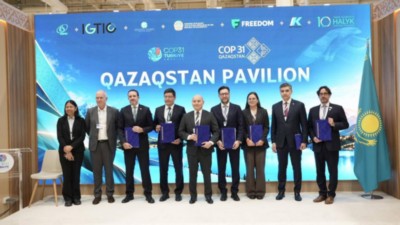
The launch was announced at Kazakhstan’s National Pavilion at COP31, where international partners highlighted the importance of transforming climate ambitions into bankable projects and stronger investment partnerships.
QaJET forms part of the broader Kazakhstan Country Climate Investment Platform (QCIP), a comprehensive framework aimed at mobilising domestic and international capital for priority climate and environmental projects.
Operating under the Ministry of Ecology and Natural Resources, the initiative brings together government agencies, international financial institutions, climate funds and private investors. The International Center for Green Technologies and Investment Projects (IGTIC) serves as its secretariat, coordinating institutional cooperation and supporting the development of investment proposals.
The launch was accompanied by the signing of two memorandums of understanding to strengthen institutional cooperation. One agreement was concluded between IGTIC and the Development Bank of Kazakhstan, while another brought together the Ministries of Energy and Ecology and QaJET partners led by the EBRD.
These arrangements are expected to strengthen coordination between national institutions and international financial partners, helping create a pipeline of projects capable of attracting investment and accelerating Kazakhstan’s green transformation.
Green ambitions take centre stage
Beyond the investment platform, Kazakhstan’s presence at COP31 has provided an opportunity to showcase its broader environmental priorities, technological innovations and commitment to sustainable development.
Operating under the theme Continuity of Times: Past, Present and Future, the country’s 250-square-metre National Pavilion presents a wide-ranging exhibition of environmental conservation programmes, green technologies and investment opportunities.
The exhibition combines Kazakhstan’s natural heritage with its ambitions for a technologically advanced and environmentally responsible future. Among its distinctive features are artificial intelligence-powered digital guides representing the Turan tigers Umit and Amur, highlighting efforts to protect biodiversity and restore endangered wildlife populations.
Visitors are also introduced to initiatives aimed at restoring the Northern Aral Sea, recovering saiga antelope populations and planting saxaul forests across the dried seabed of the former Aral Sea. These projects reflect the country’s determination to address environmental challenges that have affected ecosystems, livelihoods and regional development for decades.
The pavilion further highlights the Central Asian Green Shield programme, which focuses on regional environmental protection and combating land degradation.
Another important initiative is KazMethane, a digital monitoring, reporting and verification platform designed to improve the measurement of methane emissions and detect potential leaks. The technology is intended to strengthen transparency in emissions monitoring and support efforts to reduce the environmental footprint of industrial activities.
Industrial waste recycling, the adoption of best available technologies and the promotion of resource-efficient production methods also feature prominently in the exhibition.
Traditional Kazakh craftsmanship has been incorporated into the pavilion’s environmental message through a quraq korpe, a traditional patchwork quilt mattress. The installation symbolises the principles of resource efficiency, reuse and responsible consumption, reinforcing the global Zero Waste concept through an expression of the country’s cultural heritage.
38 events to advance climate cooperation
Kazakhstan’s COP31 programme also includes 38 thematic events bringing together government representatives, international organisations, financial institutions, businesses and environmental experts.
The discussions cover a broad range of issues, including climate finance, industrial decarbonisation, energy transition, carbon markets, water security, biodiversity conservation and technological innovation.
Particular attention is being given to environmental challenges requiring regional cooperation, including the protection of the Caspian Sea ecosystem, restoration of the Northern Aral Sea, combating desertification and expanding renewable energy production.
These priorities underline Kazakhstan’s recognition that climate change and environmental degradation transcend national borders and require coordinated responses involving neighbouring countries and international partners.
For a country seeking to diversify its energy mix while modernising its economy, the transition towards renewable energy also represents an opportunity to attract new investment, encourage technological innovation and strengthen long-term economic resilience.
The launch of QaJET at COP31 therefore carries significance beyond the announcement of potential financing. It represents an effort to establish a structured mechanism through which climate objectives can be translated into investment-ready projects, supported by international expertise and financial partnerships.
With its 2035 renewable energy target, expanded cooperation with the EBRD and a wider programme of environmental initiatives, Kazakhstan is seeking to demonstrate that the green transition can serve both as an environmental imperative and a driver of economic development.
As climate negotiations increasingly focus on implementation, financing and measurable outcomes, Kazakhstan’s message at COP31 is clear: the next phase of climate action must move beyond declarations and commitments towards practical projects, stronger partnerships and investments capable of delivering lasting results.