
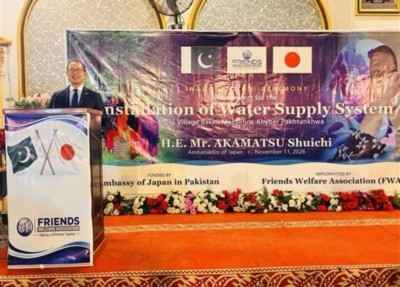
Japan funds $59,764 water supply project to provide clean drinking water to 6,000 people in Mansehra
Liaquat Ali
Islamabad: Japan has financed a major community water supply project in Mansehra, providing safe drinking water to more than 6,000 residents of Village Bakki in Khyber Pakhtunkhwa and easing the daily hardships faced by women and children in accessing this essential resource.
Japanese Ambassador to Pakistan Akamatsu Shuichi inaugurated the project this week, marking another milestone in Japan’s efforts to support grassroots development, improve public health and strengthen people-to-people ties with Pakistan.
The project, titled “Installation of Water Supply System in Village Bakki, Mansehra, Khyber Pakhtunkhwa”, was implemented by Friends Welfare Association (FWA) Pakistan with financial assistance of $59,764 from the Government of Japan under its Grant Assistance for Grassroots Human Security Projects (GGP) programme.
Member of the Khyber Pakhtunkhwa Assembly Sardar Shahjehan Yousaf, Additional Deputy Commissioner of Mansehra Asad Mehmood Lodhi, officials of the Japanese Embassy, FWA representatives, members of the local Water, Sanitation and Hygiene (WASH) Committee and community members attended the inauguration ceremony.
The initiative addresses the longstanding shortage of safe drinking water in Village Bakki, where residents, particularly women and girls, have traditionally faced considerable difficulties in collecting water for their households.
Under the project, FWA successfully constructed a gravity-flow water supply system comprising 6,013 metres of galvanised iron main supply pipelines and a water intake tank, ensuring a more reliable supply of clean water to the local population.
The Japanese-funded initiative was supplemented by contributions from FWA and the local community, which provided additional resources for excavation, transportation of construction materials and water quality testing to ensure the safety and reliability of the system.
Recognising that the sustainability of water infrastructure depends on effective local management, FWA also established a 20-member WASH Committee and arranged specialised training for its members.
The training covered water quality management, hygiene awareness and the operation and maintenance of the newly installed system, enabling the community to take an active role in preserving the facility and ensuring its continued functioning.
The project is expected to bring significant improvements to the daily lives of more than 6,000 residents by reducing the time and physical effort required to collect water, particularly for women and girls, who traditionally shoulder much of this responsibility.
Improved access to safe drinking water is also expected to contribute to better public health, reduce the risk of waterborne diseases, provide children with greater opportunities to concentrate on their education and improve the overall living standards of the community.
Addressing the inauguration ceremony, Ambassador Akamatsu congratulated FWA on the successful completion of the project and underscored the importance of access to safe drinking water as a fundamental requirement for improving people’s lives and promoting sustainable societal development.
He observed that the availability of clean water closer to households would significantly ease the daily burden on women and girls, allowing them more time for education and other productive activities.
The ambassador also highlighted the wider benefits of the initiative, saying improved water access would contribute to better community health, create greater educational opportunities for children and enhance the overall quality of life.
Emphasising the importance of maintaining the newly established infrastructure, Akamatsu called for continued community participation and proper management to ensure that the water supply system remained functional and benefited residents over the long term.
He reaffirmed Japan’s commitment to supporting Pakistan’s sustainable development through grassroots initiatives that directly address the basic needs of vulnerable communities.
The ambassador expressed the hope that the newly inaugurated water supply system would not only improve living conditions in Village Bakki but also serve as a lasting symbol of friendship and cooperation between Japan and Pakistan.
Japan’s Grant Assistance for Grassroots Human Security Projects has supported community-level initiatives in Pakistan, focusing on essential sectors such as healthcare, education, water supply, sanitation and social development.
The Mansehra project reflects the importance of development cooperation that goes beyond large-scale infrastructure by directly addressing the everyday needs of local populations.
By combining Japanese financial assistance, the expertise of a local development organisation and community participation, the initiative has established a sustainable water supply facility that is expected to benefit thousands of people for years to come.
For the residents of Village Bakki, the project represents more than the installation of pipelines and a water tank. It promises easier access to a basic necessity, better health prospects and a future in which children, particularly girls, can devote more time to education rather than spending hours collecting water.
The initiative also reinforces the longstanding partnership between Japan and Pakistan through practical cooperation aimed at improving human security and the well-being of ordinary citizens.