
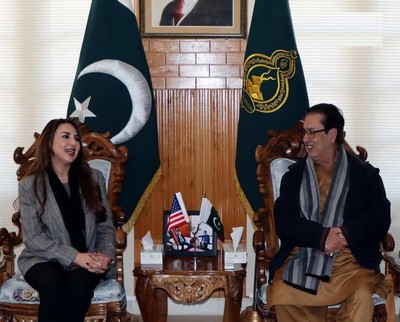
US CdA Natalie A. Baker visits Gilgit-Baltistan, reviews Satpara Dam and explores wider development cooperation
Newswire
Skardu: US Chargé d’Affaires Natalie A. Baker this week visited Gilgit-Baltistan and held talks with Governor Syed Mehdi Shah on development, education, water resources, energy, tourism and other areas of mutual interest, with the future of Satpara Dam emerging as a central focus of the discussions.
Baker called on Governor Mehdi Shah at the Governor House in Skardu, where the two sides reviewed a range of issues relevant to the mountainous region and discussed opportunities to strengthen cooperation between Pakistan and the United States.
The meeting also provided an opportunity for the visiting US diplomat to gain a broader understanding of the region’s development priorities and the challenges associated with water and energy resources in Gilgit-Baltistan.
Welcoming the US delegation, Governor Mehdi Shah highlighted what he described as the longstanding and friendly relationship between Pakistan and the United States. He also pointed to the cooperation between the two countries in a number of fields, particularly education and development.
The governor said the people of Gilgit-Baltistan were peaceful and hospitable and valued relations with people from different parts of the world. He welcomed continued engagement with international partners in support of development in the region.
A substantial part of the meeting was devoted to Satpara Dam, a strategically important development project for the people of Skardu.
The governor highlighted the dam’s role in electricity generation, irrigation and water supply, describing it as an important example of development cooperation between Pakistan and the United States.
He called for a technical assessment of the project’s present condition, including water availability and operational performance, so that its future potential could be evaluated on a sound technical basis.
The discussions also examined the possibility of increasing water availability through additional sources.
One potential source mentioned during the meeting was Shatung Nullah. The proposal was discussed in the context of assessing the region’s available water resources and determining whether additional supplies could help improve the performance and utility of Satpara Dam.
The governor also referred to a recent local initiative involving the diversion of water from the relatively small Phialong tributary towards Satpara Dam.
The initiative, undertaken by local communities with assistance from the Government of Gilgit-Baltistan, was presented as an example of community participation and local support for efforts aimed at strengthening the project’s water resources.
Baker welcomed the opportunity to learn more about Gilgit-Baltistan and expressed appreciation for the information shared during the discussions on Satpara Dam and other development issues.
Given the historical US engagement with the project, particular interest was expressed in better understanding the available technical information, the current condition of the dam and the challenges affecting its operation.
The visit therefore brought the focus beyond the historical significance of Satpara Dam to the practical question of its present and future performance.
The subsequent visit to the dam site allowed the US delegation to receive a detailed briefing from the relevant authorities.
Later in the day, Governor Mehdi Shah and Baker, accompanied by their respective delegations, visited the Satpara Dam project.
Officials at the site briefed the delegation on the history and design of the project as well as its current operational status.
The briefing covered water availability, electricity generation and irrigation-related aspects of the dam. The delegation was also given information about the technical aspects of the project and its present operational situation.
The officials responded to questions from the visiting delegation, followed by an exchange of views on the challenges and opportunities associated with the project.
The site visit gave Baker and the US delegation an opportunity to see first-hand the infrastructure that had been discussed earlier at the Governor House and to engage directly with officials responsible for its operation.
Education emerged as another important area of discussion during the visit.
The two sides discussed ways of increasing awareness among students in Gilgit-Baltistan about educational opportunities available through US programmes and improving access to such initiatives.
Particular attention was given to programmes including the Fulbright and Humphrey programmes, which provide opportunities for advanced study, professional development and academic exchange.
The discussions reflected a wider interest in strengthening links between educational institutions in the United States and Gilgit-Baltistan.
Baker also said the United States was actively working to build partnerships between American and local universities, including support for vocational training in areas such as critical minerals and mining.
For a region with significant mineral potential and a growing interest in developing its natural resources, such educational and vocational links could provide opportunities to develop specialised skills alongside broader academic cooperation.
The discussions extended beyond Satpara Dam to wider questions of water and environmental sustainability.
Climate change, water resources and renewable energy were identified as potential areas for further cooperation, reflecting the particular importance of these issues for mountainous regions such as Gilgit-Baltistan.
Water availability remains closely connected to agriculture, energy generation and the livelihoods of communities across the region, while climate-related changes are adding new pressures to water systems in mountain environments.
Renewable energy also presents an important area of potential cooperation as Gilgit-Baltistan seeks to address electricity requirements while making use of its considerable natural resources.
Tourism was another subject discussed during the meeting, with both sides exchanging views on the potential for sustainable tourism and development in mountainous areas.
Gilgit-Baltistan’s landscape, mountains and natural environment have made it an important destination for domestic and international visitors.
Baker noted the region’s natural beauty and peaceful environment, as well as the hospitality of its people, during her visit.
The discussion placed tourism within the wider context of sustainable development, suggesting that future cooperation could focus not simply on increasing visitor numbers but also on protecting the region’s environment and supporting local communities.
The visit demonstrated that engagement between the United States and Gilgit-Baltistan extends across a number of sectors, from infrastructure and water management to education, renewable energy, tourism and climate-related challenges.
For the regional government, the discussions provided an opportunity to highlight local development priorities and seek greater international understanding of the challenges faced by a mountainous region with limited infrastructure and complex water and energy requirements.
For the US side, the visit offered an opportunity to gain a closer understanding of Gilgit-Baltistan and explore areas where existing cooperation could be expanded.
The Satpara Dam discussions were particularly significant because they connected a major historical development project with current questions about water availability, energy production and technical performance.
The focus on education and skills development added another dimension, particularly with discussions about university partnerships and vocational training in critical minerals and mining.
As the visit concluded, the emphasis remained on practical cooperation and a better understanding of the region’s development needs.
The discussions in Skardu and the subsequent inspection of Satpara Dam thus brought together several of the issues likely to shape Gilgit-Baltistan’s development in the years ahead: water security, energy, education, climate resilience, tourism and the sustainable use of natural resources.