
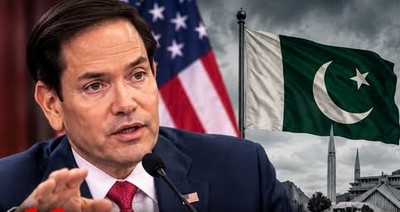
Rubio says US must maintain ties with nuclear-armed Pakistan, cites strategic geography
Newswire
Washington: US Secretary of State Marco Rubio said this week that Washington needs to maintain relations with Pakistan because of its geographical significance and nuclear capabilities, describing engagement with Islamabad as an essential component of American foreign policy despite differences between the two countries.
In an interview, Rubio said Pakistan was a country with which the United States needed to maintain diplomatic relations, pointing to its possession of nuclear weapons and its strategic location.
“It’s a country that we have to have a relationship with. It’s a country that possesses nuclear weapons,” Rubio said, stressing the importance of maintaining communication with Islamabad.
He drew a comparison with India’s own diplomatic engagement with Iran, arguing that countries must maintain working relationships with strategically important neighbours and regional actors, even when their interests do not always align.
Rubio’s remarks came as Washington and New Delhi continued discussions on bilateral trade, defence cooperation and regional security, underscoring the complexities of US diplomacy in South Asia, where its relationships with India and Pakistan remain important to regional stability.
The US secretary of state acknowledged that maintaining relations with countries that have competing interests can be challenging. However, he suggested that continued American engagement with Pakistan could also serve India’s security interests by giving Washington an opportunity to communicate its concerns directly to Islamabad.
“And I think in a way it could be a positive thing, because if we have a relationship and we can speak to them, it could perhaps put us in a position to help discourage the kinds of things that India is worried about,” he said.
Rubio’s comments indicated that Washington views diplomatic engagement with Pakistan as a means of retaining communication channels that could potentially help manage regional tensions. His remarks also highlighted the distinction between maintaining relations with a country and agreeing with all its policies or actions.
Explaining his responsibilities as America’s top diplomat, Rubio said his approach had changed since leaving the US Senate and assuming responsibility for managing the country’s foreign relations.
“In my new role, I’m no longer a senator. I’m the secretary of state. I have to manage the foreign policy of the US, and that does require us to have relationships with countries, including those that we may have some disagreements with,” he said.
His statement comes amid renewed diplomatic engagement between Washington and Islamabad following President Donald Trump’s involvement in efforts to broker a ceasefire between Pakistan and India during their brief military confrontation.
Since then, Pakistani and American leaders have exchanged cordial messages and publicly acknowledged their engagement. Prime Minister Shehbaz Sharif nominated Trump for the Nobel Peace Prize in recognition of his mediation efforts, while the US president has repeatedly praised Pakistan’s political and military leadership.
Trump has also referred to Pakistan’s Chief of Defence Forces, Field Marshal Asim Munir, as his “favourite field marshal”, a remark that attracted considerable attention in diplomatic and political circles.
Islamabad has sought to build on the improved atmosphere to advance its economic interests, particularly by pursuing more favourable trade arrangements with Washington. Pakistan is looking for tariff concessions, greater access to the American market and expanded opportunities for Pakistani exporters.
For Pakistan, stronger engagement with the United States could provide opportunities to improve trade, attract investment and broaden economic cooperation at a time when Islamabad is seeking to strengthen its external economic position.
The relationship also carries implications for regional security, given Pakistan’s nuclear status, its geographical position and its role in South Asian and wider regional affairs. Maintaining communication with Islamabad allows Washington to engage directly with Pakistani leaders on issues ranging from security and counterterrorism to regional stability.
Pakistan has also sought a more active diplomatic role in efforts to reduce tensions in West Asia. Islamabad’s reported mediation efforts between Washington and Tehran, including the announcement of a two-week ceasefire on April 8 and subsequent talks in Islamabad on April 11 and 12, have added another dimension to its regional diplomacy.
These developments have placed Pakistan in contact with multiple regional and international stakeholders, including the United States and Iran, at a time when diplomatic channels are particularly important for managing competing security interests.
Rubio’s remarks, therefore, underline Washington’s stated need to maintain a working relationship with Pakistan while continuing its strategic partnership with India. Rather than presenting the two relationships as mutually exclusive, his comments suggest that the United States considers engagement with both countries necessary to pursue its broader diplomatic and security objectives.
For Islamabad, the challenge will be to translate renewed political engagement into lasting economic cooperation, sustained diplomatic contact and a more predictable relationship with Washington. While cordial exchanges can create opportunities, progress on trade, investment and security cooperation will ultimately depend on concrete agreements and the continued alignment of interests.
———————————-
Japan-backed school in Tarnol to expand education opportunities for 250 girls
Abdullah Jan
Islamabad: Up to 250 girls in Tarnol, Islamabad, will have access to improved educational facilities following the completion of a Japan-funded primary school, as the two countries step up community-level cooperation to promote girls’ education and human development.
Japanese Ambassador to Pakistan Akamatsu Shuichi inaugurated the Tine Girls Model Primary School this week, marking the completion of a project financed through the Japanese government’s Grant Assistance for Grassroots Human Security Projects (GGP) programme.
The Government of Japan provided $44,025 for the initiative, which was implemented by the Community Services Programme (CSP), a non-governmental organisation working in education, healthcare, clean water provision and women’s empowerment.
The school currently has 240 enrolled students and can accommodate up to 250 children, offering local families an expanded opportunity to educate their daughters in a purpose-built learning environment.
The project comes amid continuing efforts to improve access to quality education for girls, particularly in communities where inadequate facilities can create obstacles to school attendance and learning. By providing dedicated classrooms and essential amenities, the new facility aims to create a safer and more supportive environment for students.
The school features eight classrooms, a principal’s office, washrooms, a levelled playground and 250 student chairs. Additional facilities provided through CSP’s contribution include a solar power system, an underground water storage tank, an electric water cooler and an interactive smart board to support digital learning.
These facilities are intended to improve the daily learning experience while providing students and teachers with better educational resources. The solar power system and water facilities will also help address basic infrastructure needs, while the smart board introduces an additional tool for classroom instruction.
Speaking at the inauguration ceremony, Ambassador Akamatsu congratulated CSP on completing the project despite challenging weather conditions. He emphasised that education was a fundamental human right and a central pillar of human security, describing it as essential to building a better and more prosperous society.
He particularly highlighted the importance of girls’ education to Pakistan’s future, reaffirming that education remained a major priority of Japan’s development cooperation with the country.
The ambassador also reiterated Japan’s commitment to supporting Pakistan’s sustainable development, expressing hope that the school would become a lasting symbol of friendship and cooperation between the two countries.
Representatives of the Japanese Embassy and CSP, along with teachers, students, parents and community members, attended the inauguration ceremony.
The project reflects Japan’s approach of supporting community-level initiatives that address essential human needs through its grassroots assistance programme. Rather than focusing solely on large-scale infrastructure, the programme also finances projects designed to deliver direct benefits to local communities.
For Tarnol, the new school represents an investment in educational access and the future prospects of young girls. With capacity for 250 students and facilities for both conventional and digital learning, it is expected to support local efforts to provide girls with better opportunities to acquire knowledge and develop the skills needed for their future.
The initiative also highlights the role of international development partnerships in strengthening Pakistan’s education sector, particularly through targeted support for underserved communities and projects that promote equal opportunities for children.