
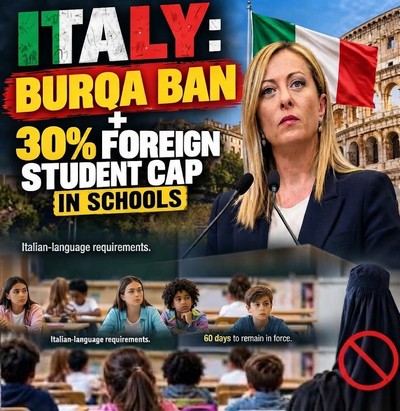
Italy tightens school rules with 30% language cap and face-covering ban
Newswire
Rome: Italy’s government this week approved new school regulations limiting the number of students with insufficient Italian-language skills in individual classrooms and banning full-face coverings such as burqas and niqabs in schools, in a move Prime Minister Giorgia Meloni’s government says is aimed at strengthening integration and ensuring equal educational opportunities.
The decree, approved by the Cabinet, introduces a 30 percent ceiling for certain students who lack adequate Italian-language proficiency. The measures take effect immediately but require parliamentary approval within 60 days. Meloni’s governing coalition currently holds a majority in Parliament.
Under the new rules, the 30 percent threshold applies to students who meet specific criteria concerning nationality, language proficiency and previous education in Italy.
In primary schools, the provision applies to pupils without Italian citizenship who were not born in Italy or who have not attended at least two years of preschool. In lower and upper secondary schools, the same limit applies to students without Italian citizenship who have not attended the Italian school system for at least three years.
The government has presented the measure as an attempt to prevent excessive concentrations of students with limited Italian proficiency in particular classrooms and to give schools greater scope to provide language support.
Meloni described the measures as “common-sense” steps that would, in the government’s view, promote integration rather than division. She said the rules were intended to prevent the emergence of what she called “ghetto classes” and ensure that students have equal educational opportunities.
Education Minister Giuseppe Valditara said the language-related measures would affect around 1,000 classrooms, representing approximately 0.3 percent of classrooms nationwide.
Official figures cited by the government show that pupils without Italian citizenship accounted for 11.2 percent of Italy’s school population during the 2022-23 academic year, while classrooms with more than 30 percent foreign students represented 7.6 percent of the national total.
The decree also prohibits the wearing of burqas and niqabs in schools, while the hijab remains permitted because it does not cover the face.
The government has framed the restriction on full-face coverings as a security and integration measure. Meloni has argued that when a woman or girl is forced to conceal her face, this can interfere with fundamental rights and the process of integration.
The government’s position is that schools require direct communication and interaction between students and teachers, making the visibility of students’ faces an important consideration in the educational environment.
The measure has nevertheless generated criticism from opposition parties and civil society groups, with concerns focusing on its potential impact on Muslim students and families and the way the ban would be implemented by schools.
The new regulations have also raised practical questions for schools, particularly in areas with large migrant populations.
Opponents have warned that applying the 30 percent limit could result in some students being assigned to schools outside their neighbourhoods if nearby institutions cannot meet the new requirements.
School authorities have also raised concerns about the practical challenges of distributing students among different schools while ensuring that children continue to have reasonable access to education.
Child-rights organisation Save the Children has cautioned that the measure could have discriminatory effects, arguing that students should not be divided into different categories on the basis of the criteria established by the decree.
Opposition leader Elly Schlein has strongly criticised the government’s decision, accusing it of launching what she described as a new “witch hunt” at the expense of children.
The government rejects the characterisation that the measures are designed to exclude foreign students. Instead, officials say the objective is to strengthen language education, facilitate integration and prevent schools from becoming concentrated around particular linguistic or social groups.
The new school rules come amid a broader political debate in Italy over immigration, integration and national identity.
Meloni leads Italy’s conservative government, and migration-related policies have remained an important part of its political agenda. The emergence of a new right-wing movement led by former army general Roberto Vannacci has also added another dimension to political debate on immigration and cultural issues ahead of the next general election, expected in 2027.
The school decree has consequently attracted attention beyond the education sector, with supporters presenting it as an integration policy and critics arguing that it risks placing additional restrictions on immigrant and Muslim communities.
For Italian schools, however, the immediate issue will be implementation. Authorities will have to determine how students affected by the language cap are distributed, how additional language support is provided and how the face-covering prohibition is applied in individual institutions.
The decree now enters a period of parliamentary scrutiny, with lawmakers required to approve it within 60 days for it to become permanent legislation. The debate is therefore likely to continue over how Italy should balance integration, equal access to education, cultural practices and the practical needs of schools.