
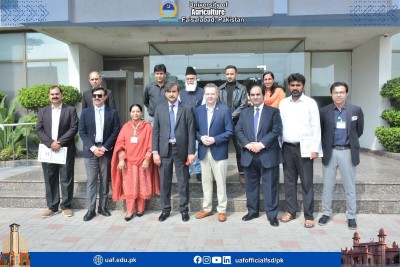
Pakistan, Canada explore cooperation to modernise agriculture and strengthen food security
Faisalabad: Pakistan and Canada this week explored opportunities to expand agricultural trade, modernise dairy and poultry production, and strengthen food security through research collaboration, technology transfer and knowledge sharing.
The areas of potential cooperation were discussed during a meeting between University of Agriculture Faisalabad (UAF) Vice Chancellor Prof Dr Zulfiqar Ali and a high-level delegation from the Canadian High Commission in Pakistan, comprising Political, Economic and Commercial Counsellor Daniel Arsenault and Trade Commissioner Zohaib Khan.
According to a UAF spokesperson, the discussions focused on climate-smart agriculture, modern dairy farming, poultry-sector innovation, agro-food processing and improving supply-chain efficiency to reduce post-harvest losses and ensure the availability of safe, quality food.
Speaking during the meeting, Arsenault appreciated UAF’s role in addressing agricultural challenges, particularly food security and food safety. He emphasised the importance of stronger links between researchers and industry to translate scientific discoveries and laboratory findings into practical solutions and commercially viable technologies for farmers and businesses.
Highlighting bilateral agricultural trade, Arsenault said Canada was a major supplier of canola seed to Pakistan and welcomed Islamabad’s decision to lift restrictions on imports of genetically modified canola. He said the decision, following engagement between the two governments, had paved the way for the resumption of Canadian canola exports to Pakistan.
He noted that canola was among Canada’s significant agricultural exports to Pakistan, adding that Canadian research, technical expertise and agricultural technologies could help improve productivity and support the country’s food and nutritional requirements.
The Canadian delegation was also engaging with Pakistani importers to explore opportunities for supplying pulses and lentils from Canada. Arsenault said diversifying food imports could help strengthen supply chains and support Pakistan’s food security needs.
Dairy development emerged as another potential area of collaboration, with Arsenault highlighting the benefits Pakistan could gain from Canadian expertise in modern dairy farming and livestock nutrition.
He referred to the experience of institutions such as the University of Guelph, which could provide opportunities for knowledge sharing, research partnerships and the adoption of improved farming practices.
Arsenault noted that incorporating canola into animal feed could increase daily milk production by up to one litre under appropriate feeding conditions, potentially benefiting small-scale dairy farmers. Such improvements, alongside better animal nutrition and farm management, could contribute to higher productivity and improved returns for farmers.
The discussions also covered the modernisation of poultry production, agro-processing and measures to improve efficiency throughout agricultural supply chains. Greater collaboration in these areas could help reduce food losses, improve product quality and expand market opportunities for Pakistani agricultural businesses.
UAF Vice Chancellor Prof Dr Zulfiqar Ali stressed the need for Pakistan to transition towards a modern, research-driven and climate-resilient agricultural system to meet rising food demand, increase farmers’ incomes and improve food safety.
“Agriculture is central to Pakistan’s food security and economic stability, but rising production costs, climate change and pressure on natural resources require us to adopt innovative and sustainable farming practices. Cooperation with Canada can help us turn scientific research into practical solutions that benefit farmers, strengthen the dairy and poultry sectors, and improve the quality and competitiveness of our agri-food products,” he said.
Prof Dr Zulfiqar Ali said UAF was committed to expanding international research partnerships, promoting technology transfer and strengthening industry-academia collaboration to address emerging challenges in the agricultural sector.
He emphasised that bilateral cooperation should prioritise the development of technologies suited to local conditions, the professional training of farmers and researchers, and opportunities for Pakistani students and scientists to benefit from international expertise.
The vice chancellor also highlighted the potential for closer collaboration between Pakistani and Canadian universities, research institutions and private-sector stakeholders to promote sustainable farming practices, increase productivity and minimise losses across the food supply chain.
The meeting underscored the scope for deeper Pakistan-Canada engagement in agricultural research, trade, education and technology transfer. Both sides identified research-based innovation and knowledge sharing as important avenues for supporting sustainable food production, improving agricultural competitiveness and addressing Pakistan’s long-term food security challenges.