
Pakistan, Kazakhstan push strategic partnership towards $1bn trade target
Celina Ali
Islamabad: Pakistan and Kazakhstan are accelerating efforts to translate their newly established Strategic Partnership into stronger economic and connectivity ties, with both sides pursuing a $1 billion bilateral trade target and exploring new transport routes linking Central Asia with Pakistani seaports.
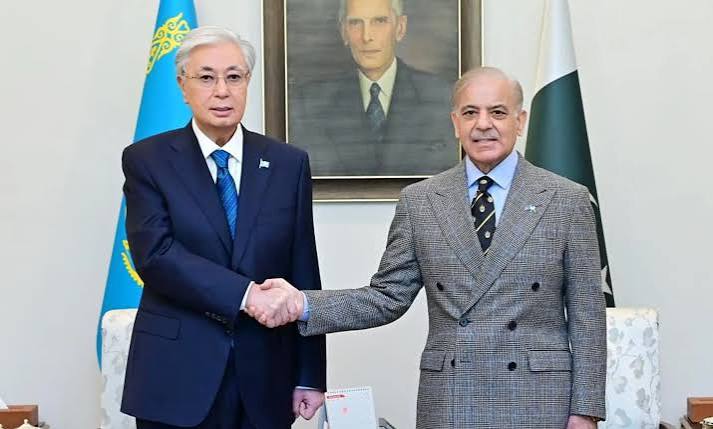
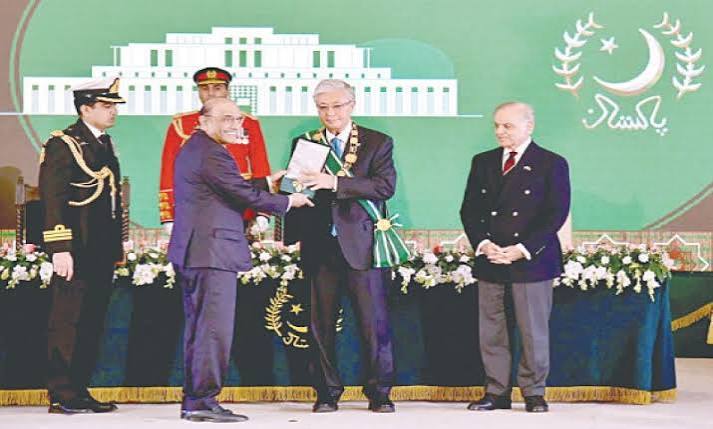
The two countries have significantly broadened their bilateral agenda since Kazakh President Kassym-Jomart Tokayev’s landmark state visit to Islamabad in February, when the two sides elevated their relations to the level of a Strategic Partnership.
The partnership has placed trade, investment, transport and logistics at the centre of the Pakistan-Kazakhstan relationship, with Islamabad and Astana seeking to turn longstanding political ties into commercially meaningful cooperation.
The two sides have reaffirmed their ambition to raise bilateral trade to $1 billion, from current levels of around $250 million, while encouraging businesses from both countries to pursue joint ventures and investment opportunities.
For Kazakhstan, deeper engagement with Pakistan carries particular importance because of Pakistan’s strategic location on the Arabian Sea. Astana sees Pakistani ports, particularly Karachi and Gwadar, as potential gateways for Central Asian trade to international maritime markets.
Transport connectivity has consequently emerged as one of the most promising areas of bilateral cooperation. Pakistan and Kazakhstan are working on road, rail and multimodal routes designed to connect their markets through Afghanistan and other regional corridors.
The Strategic Partnership framework specifically identifies several potential routes, including Kazakhstan–Turkmenistan–Afghanistan–Pakistan, Kazakhstan–Uzbekistan–Afghanistan–Pakistan and Kazakhstan–Kyrgyzstan–China–Pakistan corridors.
The two countries have also agreed to evaluate a Trans-Afghan railway connection, reflecting Kazakhstan’s interest in establishing more efficient southern trade routes and Pakistan’s ambition to become a gateway for Central Asian economies to the Arabian Sea.
The connectivity agenda is being accompanied by efforts to strengthen maritime cooperation. The two sides have welcomed cooperation between Kazakhstan’s Aktau International Commercial Sea Port and Pakistan’s Karachi port authorities, creating another institutional link between Central Asian and Pakistani transport networks.
Economic cooperation is also expanding beyond transit and logistics. Pakistan and Kazakhstan have identified agriculture, energy, pharmaceuticals, machinery, textiles, technology, chemicals and other sectors as areas with potential for increased trade and investment.
The two countries signed a broad package of agreements during President Tokayev’s visit, covering trade, investment, transit, customs, agriculture, energy, security, education and other areas. The agreements are intended to provide an institutional framework for expanding bilateral commercial activity.
The Strategic Partnership also gives greater political weight to cooperation in security and defence. Islamabad and Astana have agreed to strengthen counter-terrorism and law-enforcement cooperation while continuing military exercises, training and professional exchanges.
People-to-people relations form another component of the expanding partnership, with the two sides working to promote tourism, education, cultural exchanges and business contacts. They have also discussed the possibility of restoring direct air connectivity between the two countries.
For Kazakhstan, the deepening relationship with Pakistan offers access to one of South Asia’s key economies and a potential maritime outlet, while Pakistan views closer ties with Astana as an important component of its broader Central Asia connectivity strategy.
The emerging Pakistan-Kazakhstan partnership therefore goes beyond traditional diplomatic engagement. With trade, investment, transport and maritime connectivity moving to the forefront, Islamabad and Astana are seeking to build a more commercially integrated relationship that could link Kazakhstan’s Central Asian markets with Pakistan’s Arabian Sea ports and, ultimately, wider global trade routes.