
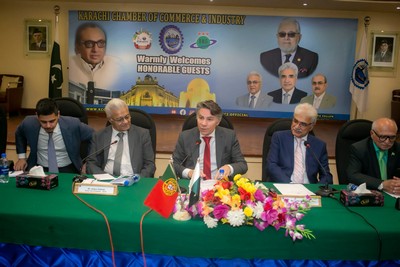
Portugal’s ambassador Paulo Domingues urges Pakistan to unlock untapped trade, investment potential
Celina Ali
Islamabad: Portugal and Pakistan need to move beyond their traditionally friendly diplomatic relations and develop a more ambitious economic partnership built on expanded trade, investment, technological cooperation and joint ventures, Portugal’s Ambassador to Pakistan, Paulo Domingues, has said, underscoring the enormous untapped commercial potential between the two countries.
Addressing a meeting this week at the Karachi Chamber of Commerce and Industry (KCCI), the Portuguese ambassador called for a concerted effort to bring the business communities of the two countries closer, stressing that stronger economic ties would require sustained engagement between entrepreneurs, investors, manufacturers and exporters.
Despite cordial political relations and complementary economic strengths, bilateral trade remains considerably below its potential, he observed, arguing that both countries needed to make more determined efforts to identify new commercial opportunities and translate goodwill into tangible economic benefits.
“My message today is very simple: Portugal and Pakistan have much more to offer each other. We must work together to turn our friendly relations into real business opportunities,” Domingues said, pointing out that the existing level of trade did not reflect the breadth of opportunities available to the two economies.
He said the challenge was no longer simply to maintain positive diplomatic relations but to build a stronger commercial framework that could encourage companies on both sides to explore new markets, establish long-term partnerships and invest in mutually beneficial ventures.
According to the ambassador, considerable potential remains unexplored because Portuguese businesses have not yet developed sufficient awareness of Pakistan’s market opportunities. Greater interaction between the two business communities, he suggested, could help overcome this gap by providing investors and entrepreneurs with a clearer understanding of each other’s commercial environments, industrial capabilities and consumer markets.
At the same time, Pakistani businesses have increasingly begun exploring Portugal, with business delegations visiting the European country to assess potential opportunities across different sectors. Domingues expressed optimism that these initiatives would gradually strengthen commercial engagement and contribute to an increase in bilateral trade.
“Portugal and Pakistan may be geographically far apart, but geography should never limit our ambitions. We have a strong foundation for cooperation, and what we need now is greater engagement between our companies,” he said.
The ambassador emphasised that regular exchanges between business leaders, targeted trade missions and direct contact between prospective buyers and suppliers could help convert existing opportunities into practical commercial arrangements. He also highlighted the importance of building confidence among companies that might be interested in entering unfamiliar markets but lacked the necessary information or reliable business contacts.
He said the Portuguese Embassy was prepared to facilitate this process by helping businesses identify potential buyers, suppliers, distributors and dependable long-term commercial partners. Such assistance, he added, could make it easier for companies to assess market conditions, establish business relationships and explore opportunities for cooperation.
Renewable energy, technology and agriculture offer promising avenues
Domingues identified trade and industry, renewable energy, technology, agriculture, fruit cultivation and innovation as particularly promising areas for strengthening Pakistan-Portugal economic cooperation.
These sectors, he indicated, offered opportunities not only to increase the volume of existing trade but also to diversify the economic relationship and create new avenues for investment, technical collaboration and knowledge-sharing.
Renewable energy emerged as one of the most significant areas in which Portugal’s experience could be relevant to Pakistan. The ambassador noted that approximately 70 per cent of Portugal’s electricity generation came from renewable sources, reflecting the country’s substantial experience in developing and integrating clean energy into its power system.
For Pakistan, which has considerable scope to expand its renewable energy capacity, Portugal’s experience could provide opportunities for cooperation in technology, technical expertise, investment and the exchange of best practices.
Closer engagement between companies and relevant institutions could help identify projects in which Portuguese expertise and Pakistani market opportunities complement each other. Such collaboration could also encourage joint ventures and facilitate the transfer of knowledge in areas related to clean energy development and innovation.
Agriculture and fruit cultivation were other sectors highlighted by the ambassador, suggesting that the two countries could explore opportunities to strengthen commercial exchanges, develop business partnerships and expand cooperation in related industries.
Technology and innovation could further broaden the scope of bilateral engagement, particularly if companies from both countries were encouraged to identify common interests and pursue practical projects rather than relying exclusively on traditional trading relationships.
The ambassador’s emphasis on sectoral diversification reflected the need to build a more resilient economic partnership capable of generating benefits for a wider range of businesses. Expanding cooperation beyond established export categories would allow the two countries to explore emerging industries, develop new markets and create more sustainable commercial links.
Business forum to provide fresh impetus to economic ties
In a significant step towards advancing this agenda, Domingues announced that Portugal’s Minister for Foreign Affairs would visit Pakistan on November 22 and 23. A business forum would be organised in Islamabad during the visit to bring together representatives of the two countries’ foreign ministries, trade and investment agencies, and Portuguese companies.
The proposed forum is expected to provide a platform for business leaders and institutional representatives to discuss commercial prospects, identify areas of mutual interest and explore opportunities for trade, investment and joint projects.
By bringing relevant stakeholders together, the initiative could help businesses establish direct contacts, exchange information about their respective markets and develop a clearer understanding of the opportunities available in both countries.
The ambassador urged the Karachi Chamber of Commerce and Industry to participate actively in the initiative and mobilise Pakistani business leaders and entrepreneurs for engagement with the visiting delegation.
Given its extensive network of businesses and industrial stakeholders, the KCCI could play an important role in identifying companies with an interest in Portugal, determining priority sectors and ensuring that discussions at the forum address the practical needs of the private sector.
Domingues stressed the importance of making such engagements commercially meaningful, with a focus on identifying potential partners and developing projects that could produce concrete outcomes.
The business forum, therefore, offers an opportunity to move bilateral economic relations from general expressions of interest towards a more focused programme of commercial engagement. Its effectiveness will depend on the ability of participating institutions and companies to follow up on discussions and convert promising ideas into sustainable