
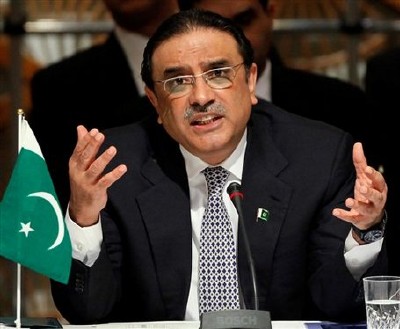
President Zardari urges US, Iran to honour Islamabad MoU, pursue dialogue amid Gulf tensions
Liaquat Ali
Islamabad: President Asif Ali Zardari this week urged the United States and Iran to exercise restraint, uphold their commitments under the Islamabad Memorandum of Understanding (MoU) and pursue dialogue to resolve escalating tensions in the Gulf, warning that continued hostilities could threaten regional stability, global energy security and international trade.
During a meeting with visiting Russian Interior Minister Vladimir Kolokoltsev in Islamabad, the president expressed deep concern over attacks on maritime traffic and energy installations, emphasising the need to protect vital shipping routes and ensure safe navigation through the Strait of Hormuz and the Red Sea.
Zardari stressed that dialogue remained the only viable way to address the conflict and prevent further escalation. He also underscored the importance of respecting the sovereignty and territorial integrity of all states amid growing regional tensions.
The president’s remarks highlighted Pakistan’s emphasis on diplomatic engagement and restraint as concerns mount over the security of strategic maritime corridors, which are critical to global energy supplies and international commerce.
The Islamabad MoU, signed in June, provides a framework for efforts to resolve the Middle East conflict. Zardari called on Washington and Tehran to honour their obligations under the understanding and work towards a peaceful resolution.
The meeting with Kolokoltsev also provided an opportunity to review Pakistan-Russia relations, with both sides acknowledging considerable potential to expand bilateral trade and economic cooperation.
Kolokoltsev earlier arrived in Islamabad for a four-day official visit, marking the first visit by a Russian interior minister to Pakistan. The visit is expected to provide further opportunities for engagement between the two countries on security, law enforcement and bilateral cooperation.
During the meeting, the two sides discussed bilateral trade, which stood at $243.4 million in the 2025 financial year. Both acknowledged that the current volume remained below the potential of their relationship.
Kolokoltsev observed that existing trade figures did not fully reflect the strength of bilateral ties and pointed to significant opportunities for further expansion. He also extended an invitation to President Zardari to visit Russia, according to a statement issued by the President’s Secretariat.
The discussions reflected a shared interest in strengthening engagement and exploring avenues for closer cooperation in areas of mutual interest.
Separately, Interior Minister Mohsin Naqvi held talks with Kolokoltsev on enhancing cooperation between the law enforcement agencies of the two countries to combat organised crime, terrorism, extremism and the illicit trafficking of arms and drugs.
The discussions also covered emerging security threats, including cybercrime, telephone scams, phishing schemes and fraudulent cryptocurrency pyramid schemes.
According to an official statement by the Russian Embassy in Islamabad, Kolokoltsev said cooperation between the law enforcement agencies was rooted in friendly and mutually beneficial relations between Pakistan and Russia.
The two sides discussed the importance of closer coordination and information-sharing to address traditional and emerging security challenges that increasingly extend beyond national borders.
Kolokoltsev is scheduled to hold further meetings with senior Pakistani security officials during his four-day visit, providing an opportunity to advance discussions on law enforcement cooperation and bilateral relations.
The visit comes as Pakistan continues to engage international partners on regional stability, economic cooperation and transnational security challenges.
The meetings with President Zardari and Interior Minister Naqvi brought diplomatic engagement, trade expansion and security cooperation into focus, reflecting the range of issues shaping Pakistan-Russia relations.