
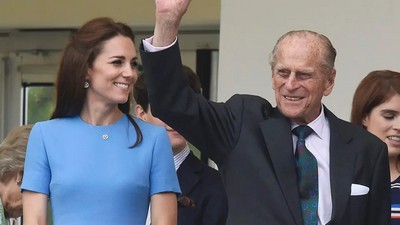
Kate Middleton follows Prince Philip’s ‘golden rule’ for royal life
London: The Princess of Wales, Kate Middleton, has reportedly embraced a piece of advice from the late Prince Philip that was regarded within royal circles as an important rule for members of the British royal family carrying out public duties.
According to royal sources, Kate has followed Philip’s approach of keeping her attention on the people she is meeting rather than the cameras surrounding her during official engagements.
The advice, described by insiders as a “golden rule” for royal life, reflects Prince Philip’s long-standing view that members of the monarchy should remain focused on their responsibilities rather than personal attention or celebrity.
Royal author and commentator Gyles Brandreth discussed the advice in his book Philip: The Final Portrait, recalling how the Duke of Edinburgh had advised Kate not to allow the presence of photographers and cameras to distract her from the people she was speaking with during royal engagements.
Philip’s message, as quoted by Brandreth, was that the attention surrounding a member of the royal family should be understood as being directed towards the role they represent and the causes they support, rather than towards them personally.
“If you believe the attention is for you, for you personally, you’re going to end up in trouble,” Philip was quoted as telling the future queen. “The attention is for your role, what you do, what you’re supporting.”
The principle was closely associated with Philip’s own approach to royal life. Having spent more than seven decades as a working member of the British royal family, he was familiar with the intense media attention that accompanied public appearances and the importance of maintaining a distinction between personal celebrity and official responsibility.
Brandreth has suggested that Kate has demonstrated this principle in her own public appearances. Recalling an occasion when he accompanied her on a walkabout, he observed that she did not appear preoccupied with the cameras around her.
The royal commentator also noted a similar quality during interviews, saying that Catherine generally concentrates on the subject being discussed rather than directing the conversation towards herself.
The approach has become particularly relevant to Kate’s role as Princess of Wales, one of the most prominent positions within the modern British monarchy. Her public engagements frequently involve meeting members of the public, supporting charitable organisations and highlighting causes associated with her official work.
Rather than treating such appearances as opportunities for personal publicity, the philosophy attributed to Prince Philip places emphasis on the people and issues at the centre of each engagement.
Philip’s advice also reflects a broader tradition within the royal family that places duty ahead of personal recognition. The idea is that public attention comes with the position itself and should be used to draw attention to the institution, charitable causes and public service rather than the individual royal.
For Kate, who has become one of the most recognisable members of the younger generation of the monarchy, maintaining that distinction can be particularly important. Her public appearances routinely attract photographers and extensive media coverage, making the ability to remain focused on the people she meets a visible part of her role.
Brandreth’s account suggests that the late Duke of Edinburgh saw this as more than simply a matter of handling cameras. It was, instead, a lesson about understanding what it means to be a member of the royal family: the public attention comes with the position, while the responsibility lies in how that attention is used.
Kate’s reported adherence to the principle offers a glimpse into the informal guidance passed between generations of the royal family and illustrates how some of Prince Philip’s approach to public service continues to influence the younger generation.