
Pakistan-EU economic ties offer room for deeper trade, investment and business partnerships
Newswire
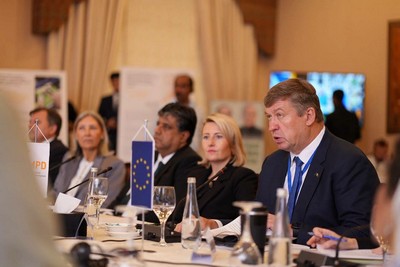
Lahore: Pakistan and the European Union have considerable room to broaden their economic relationship by moving beyond traditional trade and placing greater emphasis on investment, technology transfer, value-added exports and direct business-to-business partnerships, European Union Ambassador to Pakistan Raimundas Karoblis said this week.
Speaking during a meeting with a delegation of the All Pakistan Business Forum (APBF), led by its President Syed Maaz Mahmood, the EU ambassador highlighted the potential for a more diversified and commercially oriented relationship between Pakistan and the European bloc.
The meeting brought together representatives of the business community to discuss a wide range of issues affecting Pakistan-EU economic relations, including bilateral trade and investment, joint ventures, GSP+ market access, the development of small and medium-sized enterprises, technical and vocational education and training, and evolving regulatory and compliance requirements in the European market.
Karoblis said Pakistan had derived substantial benefits from the European Union’s Generalised Scheme of Preferences Plus (GSP+) arrangement, which provides preferential access to the European market. He suggested that Pakistan could further strengthen the benefits of the scheme by continuing to implement relevant International Labour Organisation conventions, diversifying its export base, increasing value addition and developing a workforce equipped with skills required by modern industries.
The importance of the European market to Pakistan’s export economy is reflected in the latest trade figures. According to the European Commission’s assessment, Pakistan’s exports to the EU stood at around €8.3 billion, representing approximately 28 percent of the country’s total exports. The EU continues to be Pakistan’s largest export destination, while textiles and clothing account for roughly three-quarters of Pakistan’s exports to the bloc.
Overall bilateral trade in goods reached €12.2 billion in 2025, underlining the scale of the economic relationship and the potential for further expansion.
However, the discussion in Lahore also pointed towards the challenges Pakistan faces in translating its existing market access into a broader and more diversified export presence. Heavy reliance on textiles and clothing leaves considerable space for Pakistani businesses to explore other sectors and increase the share of higher-value products entering European markets.
For Pakistani exporters, the European market also presents increasingly demanding standards relating to quality, certification, documentation, sustainability and regulatory compliance. Meeting these requirements can be particularly challenging for small and medium-sized enterprises, which often have fewer financial and technical resources than larger companies.
Karoblis stressed the importance of bringing Pakistani and European businesses into closer contact so that companies on both sides can identify areas of mutual interest and develop practical commercial partnerships. Such engagement, he indicated, could help create opportunities not only in conventional trade but also in investment, technology cooperation and joint ventures.
APBF President Syed Maaz Mahmood called for a more practical and business-oriented approach to Pakistan-EU economic engagement. He emphasised the need for stronger business-to-business contacts, greater investment and joint ventures, arguing that direct interaction between companies could help identify commercially viable opportunities more effectively.
Mahmood also drew attention to the difficulties faced by Pakistani SMEs in complying with European market requirements. The cost of international certifications, along with increasingly stringent standards and documentation requirements, can create significant barriers for smaller exporters seeking access to European supply chains.
He called for greater technical assistance and easier access to information so that Pakistani SMEs can better understand European regulations and prepare their products and production processes accordingly.
The APBF also offered to facilitate direct interaction between Pakistani and European companies through business-to-business meetings, sector-specific contacts and joint-venture initiatives. Such mechanisms, the business forum indicated, could help move bilateral economic relations from broad discussions towards concrete commercial partnerships.
Another important area discussed during the meeting was skills development. The delegation appreciated European Union support for technical and vocational education and training programmes, noting that a workforce equipped with market-relevant skills could contribute both to Pakistan’s domestic economic development and to employment opportunities for Pakistanis in international markets.
EU-supported programmes in Pakistan have focused on demand-driven skills and employment opportunities, linking vocational training more closely with labour-market requirements. For Pakistani businesses, the availability of a better-trained workforce is also relevant to productivity, competitiveness and the ability to meet international production and quality standards.
The emphasis on skills development therefore adds another dimension to the Pakistan-EU economic relationship. While trade remains central to bilateral economic ties, investment in human capital, technology and productive capacity could also influence Pakistan’s ability to expand its presence in international markets.
The Lahore meeting highlighted a broader challenge and opportunity for Pakistan: converting its established access to the European market into deeper participation in European value chains. Greater export diversification, higher value addition, stronger compliance capacity and closer business-to-business engagement could provide avenues for Pakistani companies to expand their presence beyond traditional export categories.
With the EU already representing Pakistan’s largest export market, the focus of future engagement is likely to remain not only on maintaining existing trade flows but also on identifying new products, investment opportunities and partnerships that can broaden the economic relationship.
The meeting was attended by senior representatives of business and industrial associations, including Mian Faheem Qamar, Haroon Ali Khan, Shahzad Azam, Brigadier (R) M Sajid Khokhar, Nasir Ali Zia, Aziz Ullah Goheer, M Naeem and Zohaib Butt.