
Where Kazakhstan’s Islamic heritage meets Astana’s modern skyline
Asrsna:: In a city known for futuristic towers, striking contemporary structures and an ever-changing skyline, the Nursultan Mosque offers a powerful reminder of another dimension of Kazakhstan’s identity, its deep Islamic heritage and centuries-old spiritual traditions.
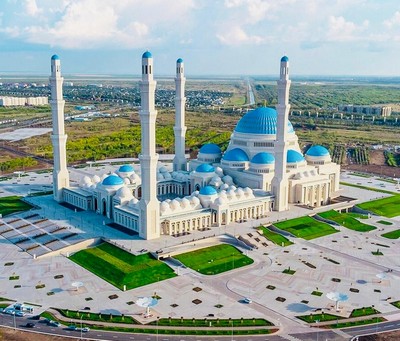
Standing prominently in Astana, the Nursultan Mosque, also known as the Astana Grand Mosque, has become one of the capital’s defining landmarks since its inauguration in 2022.
Its significance, however, extends beyond its enormous dimensions.
The mosque represents the meeting of tradition and modernity in a city that has developed into Kazakhstan’s political and architectural centre within a relatively short period. Its monumental form places an unmistakably Islamic landmark within the modern urban landscape of Astana.
The scale of the structure is immediately striking.
The mosque can accommodate up to 235,000 worshippers across its prayer halls and expansive outdoor areas, giving it the capacity to host vast congregations during major religious occasions.
At the centre of the complex rises an enormous dome measuring 62 metres in diameter and reaching 83.2 metres in height. Its proportions give the mosque a commanding presence and create a vast interior space dedicated to prayer.
Four minarets rise 130 metres above the complex, forming another defining feature of its architecture. Their five-section design carries a symbolic reference to the five pillars of Islam, incorporating religious meaning into the building’s monumental architecture.
The result is a structure that can be viewed from different perspectives — as a place of worship, an architectural landmark and a reflection of the cultural traditions that continue to shape Kazakhstan.
The story of the mosque is closely connected with the transformation of Astana itself.
The foundation stone was laid in March 2019 by then-President Nursultan Nazarbayev, and the project was completed with its inauguration in August 2022.
Its emergence added a major Islamic architectural presence to a capital already famous for its distinctive contemporary buildings.
Astana’s urban landscape has developed around a mixture of monumental government buildings, cultural institutions, modern commercial structures and ambitious architectural projects. Within that environment, the mosque provides a different visual and cultural reference point.
Its design draws attention to Islamic architectural traditions while its extraordinary scale reflects the ambitions of a modern capital seeking to establish itself as an international city.
The mosque was officially named Nursultan Mosque in July 2026, further connecting the landmark with Kazakhstan’s recent political and urban history.
For worshippers, the mosque is first and foremost a religious institution. For visitors, however, it has also become an important point of cultural interest.
The building provides an opportunity to observe Islamic architectural traditions on an exceptional scale, from the monumental dome and minarets to the expansive prayer spaces and decorative elements incorporated into the complex.
Its enormous dimensions also underline the continuing importance of communal religious life in Kazakhstan, where Islam forms an important part of the country’s cultural heritage.
At the same time, the mosque’s position in Astana demonstrates how religious architecture has been incorporated into the visual identity of a modern capital.
Rather than standing apart from the city’s contemporary character, the mosque forms part of it.
The Nursultan Mosque is also part of a broader collection of Islamic landmarks that have helped shape Astana’s architectural character.
The Hazrat Sultan Mosque, with its white marble exterior, large dome and traditional Kazakh decorative motifs, represents another prominent expression of Islamic architecture in the capital.
The Abu Nasr Al-Farabi Mosque, widely known as Nur-Astana Mosque, is another recognizable religious landmark. Completed in 2008, its white-and-gold design and distinctive dome have made it a familiar feature of the city’s left bank.
Together, these buildings demonstrate the diverse architectural vocabulary of Astana, where religious structures coexist with futuristic towers, monumental public buildings and contemporary cultural landmarks.
The Nursultan Mosque ultimately tells a broader story about Kazakhstan itself.
The country has undergone profound political, economic and social transformation since independence, while retaining cultural traditions rooted in centuries of history.
Its traditional religious purpose connects it with Kazakhstan’s Islamic heritage, while its unprecedented scale and prominent position in Astana reflect the aspirations of a contemporary state and a rapidly developing capital.
The building therefore offers visitors more than an imposing architectural spectacle. It provides a visible connection between Kazakhstan’s historical identity and its modern urban ambitions.
Against Astana’s distinctive skyline, the Nursultan Mosque stands as a reminder that the capital’s modern identity has not replaced its cultural past.
Instead, the two exist side by side — with Islamic heritage forming an important part of the architectural and cultural landscape of the modern Kazakh capital.