
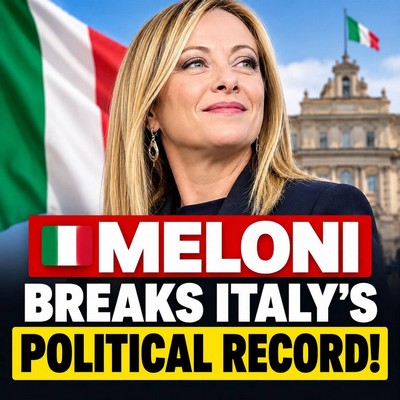
Meloni coalition wins Calabria by-election as Vannacci’s new party falls short
Newswire
Rome: Italy’s ruling coalition this week secured the parliamentary by-election in the southern region of Calabria, in a closely watched contest that provided an early electoral test of the government’s strength against a new political force led by former army general Roberto Vannacci.
The vote in the Reggio Calabria-Locri constituency had attracted national attention because Vannacci’s newly established National Future party sought to challenge the established right-wing parties from their own political territory. The contest was also being closely followed ahead of Italy’s next general election, expected in 2027.
Fabio Roscioli, the candidate backed by the centre-right coalition, won the vacant seat in the Chamber of Deputies with 51.02 percent of the vote, according to the final count. Centre-left candidate Frank Benedetto finished with 36.59 percent, while Domenico Giannetta, representing National Future and backed by Vannacci, secured 10.94 percent.
The result gave the governing centre-right coalition the parliamentary seat while also providing an indication of the level of support Vannacci’s movement was able to mobilise in a traditionally conservative part of southern Italy.
Vannacci, a former army general and member of the European Parliament, launched National Future in February. His political profile has attracted attention in Italy through his opposition to immigration and his advocacy of what he describes as traditional Italian values. His emergence has created an additional political force on the right and raised questions about whether his movement could draw support from voters who have traditionally backed parties within Prime Minister Giorgia Meloni’s governing coalition.
The Calabria contest was therefore watched not simply as a race for a single parliamentary seat but also as an indication of how the new party might perform when competing directly against established centre-right forces.
The final result showed Roscioli clearly ahead, although Vannacci’s candidate did secure a double-digit share of the vote. The centre-left candidate also improved on the bloc’s previous performance in the constituency, finishing with more than 36 percent.
The outcome followed a campaign in which political attention was focused heavily on the possibility of fragmentation within the right. Analysts had suggested that a strong National Future performance could potentially divide the conservative vote and alter the balance of the contest. Instead, Roscioli retained the seat for the centre-right.
Calabria Governor and Forza Italia deputy leader Roberto Occhiuto quickly celebrated the result, declaring victory after the polls closed.
The election was, however, marked by exceptionally low participation. Turnout stood at 22.34 percent, compared with 49.40 percent in the same area during the 2022 general election. The comparison should be viewed in light of the different voting arrangements: the 2026 by-election was held over two days, while the 2022 parliamentary election took place on a single day.
The low turnout adds an important qualification to any broader interpretation of the result. With fewer than one in four eligible voters participating, the contest provides a limited measure of wider public sentiment across the electorate.
For Meloni and her coalition partners, the Calabria result nevertheless demonstrates that the established centre-right parties remain capable of retaining a seat in a constituency where a new political force sought to establish itself.
For Vannacci, the result offers a first concrete electoral measure of National Future’s support. His candidate’s 10.94 percent share is significant enough to place the new movement on the political map of the constituency, but it remained well behind both the centre-right and centre-left candidates.
The result may also shape discussions within Italy’s right about future political alliances and the relationship between Meloni’s coalition and emerging movements competing for conservative voters. Any future cooperation would have to take account of the differing political positions and organisational interests of the established coalition parties and Vannacci’s movement.
The Calabria vote also comes at a time when Italian politics is beginning to look increasingly towards the next general election. Meloni’s government has remained in office since 2022, while the emergence of National Future adds another variable to the political landscape on the right.
The by-election therefore offered two separate messages: the governing centre-right retained the parliamentary seat, while Vannacci’s movement demonstrated a measurable electoral presence but did not come close to overtaking the established political forces in the constituency.
With the final result now established, attention is likely to turn towards whether National Future can translate its support in Calabria into a broader national organisation and whether its presence will influence the future alignment of Italy’s right-wing political forces.