
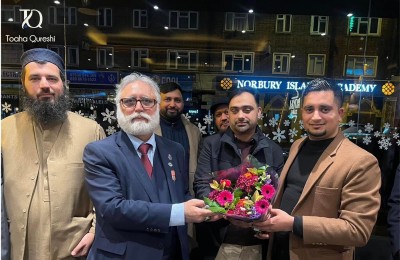
Toaha Qureshi MBE: A bridge between British-Pakistani communities through education, social welfare, conflict resolution
Celina Ali
Islamabad: From expanding educational opportunities for disadvantaged students to developing innovative approaches to counter radicalisation and promoting interfaith harmony, British-Pakistani community leader Toaha Qureshi MBE has built a career around connecting institutions, communities and policymakers in pursuit of social cohesion, education and humanitarian welfare.
Recognised for his services to the community with the Member of the Order of the British Empire (MBE), conferred by Queen Elizabeth II, Qureshi has established a multifaceted professional profile spanning education, conflict resolution, social housing, philanthropy and community development in the United Kingdom and internationally.
As chief executive officer of the School of Economics and Law (SOEL), formerly known as LCBMIT, and chairman and founder of the Forum for International Relations Development (FIRD), a UK-based conflict-resolution think tank, he works across academic, policy and community platforms. He also chairs a London-based social housing association managing a portfolio of 250 properties, adding housing and social welfare to his areas of engagement.
His career reflects a sustained focus on addressing challenges affecting vulnerable and marginalised communities, including poverty, educational disadvantage, social exclusion, extremism and the reintegration of former offenders. Through institutional leadership, charitable engagement and cooperation with public-sector bodies, Qureshi has sought to develop practical responses to problems that require coordination between government, civil society, educational institutions and local communities.
Education has been a central pillar of Qureshi’s professional work. Through his leadership of private academic institutions, he has been involved in educational provision for more than 5,000 students since their inception, with a particular emphasis on widening access for students from disadvantaged backgrounds.
At SOEL, the educational mission incorporates a social welfare dimension, with scholarships reportedly exceeding £1.5 million awarded to support academically promising students who might otherwise face financial barriers to higher education. Students from Pakistan have been among the beneficiaries of these opportunities.
The scholarship programme reflects an approach that places educational access alongside academic achievement, recognising that financial constraints can prevent talented young people from reaching their potential. By supporting students from less privileged backgrounds, such initiatives can help widen participation in higher education and improve access to professional opportunities.
SOEL has also sought to strengthen academic quality and institutional standards. According to the institution’s profile, it received a commendable rating from the Quality Assurance Agency for Higher Education (QAA). Such recognition forms part of its stated commitment to maintaining academic standards, improving teaching and learning, and developing institutional capacity.
Qureshi’s educational initiatives have extended beyond the United Kingdom through links between British and Pakistani universities. These partnerships have focused on quality enhancement, institutional collaboration, academic exchanges and arrangements intended to strengthen educational cooperation between the two countries.
Among the initiatives associated with his academic leadership is a master’s programme in international commercial law developed in partnership with Buckinghamshire New University. Described as a pioneering programme in the UK, it reflects an effort to connect legal education with the demands of international commerce and cross-border business relationships.
International commercial law has growing relevance as businesses increasingly operate across jurisdictions and face complex regulatory, contractual and dispute-resolution issues. Programmes in this field can help prepare graduates for work involving international transactions, commercial agreements and the legal frameworks governing global trade.
Through academic partnerships and institutional development, Qureshi has sought to create opportunities for students and strengthen links between education providers in Britain and Pakistan.
Another defining aspect of Qureshi’s work has been his involvement in community relations, conflict management and efforts to prevent radicalisation and extremism.
His engagement in this field began before the terrorist attacks of September 11, 2001, and the July 7, 2005, London bombings brought counterterrorism and radicalisation prevention to the forefront of international security policy.
Working with a range of partners, including UK government bodies, the Metropolitan Police, probation services, local authorities, universities, parliamentarians and multi-faith organisations, he has designed and delivered capacity-building, preventive and diversionary programmes aimed at addressing the factors that can contribute to extremism.
His work has included engagement with the Home Office’s Office for Security and Counter-Terrorism, the European Union and other institutions in the UK and abroad. These partnerships have involved developing approaches that connect community engagement with preventive interventions and support for individuals vulnerable to radicalisation.
According to his professional profile, Qureshi developed two models in 1999 that subsequently informed aspects of counter-radicalisation and deradicalisation work. He has also reported a 100 per cent success rate for a particular extremism-prevention project, claiming that the initiative helped avoid substantial costs for mainstream public services.
Such figures and assessments require evaluation against the methodology, scope and independently documented outcomes of the specific programme. Nevertheless, his longstanding engagement in prevention-focused work highlights the importance of involving community organisations and local stakeholders in efforts to address extremism.
The broader principle underlying such interventions is that security responses can be strengthened by identifying risks early, building trust with communities and addressing social and personal circumstances that may contribute to vulnerability.
Community-based prevention does not replace law enforcement or other security measures. Rather, it can complement them by improving communication, supporting early intervention and creating channels through which individuals and families can seek assistance before problems escalate.
Qureshi has also provided training and capacity-building programmes for public- and private-sector institutions, including the Metropolitan Police and the National Offender Management Service. His work has focused on strengthening institutional understanding, professional capabilities and community engagement in areas related to prevention, rehabilitation and social cohesion.
As chairman and founder of the Forum for International Relations Development, Qureshi leads an organisation focused on conflict resolution, international relations and policy engagement.
FIRD provides a platform through which issues involving community relations, social development, extremism and international cooperation can be considered from policy and practical perspectives. Its work reflects the premise that complex social and security challenges frequently require engagement across institutional and national boundaries.
The organisation’s activities are linked to Qureshi’s broader professional interests in education, poverty reduction, interfaith harmony, employment, counter-extremism and institutional development.
In Pakistan, Dr Ishtiaq Gondal serves as FIRD’s country director for its Pakistan chapter. A senior academic associated with the University of the Punjab and founder-director of the Ghazali Education Trust, Gondal brings experience in education and civil-society engagement. He has also been associated with other educational and social organisations.
The UK-Pakistan dimension of FIRD’s work provides a framework for linking professional experience, academic engagement and community-level perspectives across the two countries.
Such exchanges can help institutions learn from different approaches to social challenges, encourage dialogue among professionals and create opportunities for cooperation on shared concerns.
Professor Qureshi’s experience in both policy-oriented and community-focused initiatives places him in a position to engage with organisations seeking to connect research, institutional practice and public welfare.
Humanitarian support has also featured prominently in Qureshi’s community work. His professional profile records involvement in charitable initiatives assisting displaced people, orphans, prisoners, former offenders and other marginalised groups.
He has supported humanitarian and charitable organisations responding to emergencies and social needs, including assistance for victims of flooding in Pakistan and people affected by the typhoon in the Philippines.
Such initiatives reflect a commitment to extending community support beyond national boundaries and responding to the needs of people facing displacement, poverty and humanitarian crises.
For vulnerable populations, access to basic assistance and sustained social support can be critical to recovery and reintegration. Philanthropic organisations often help fill gaps by mobilising resources, connecting beneficiaries with services and supporting community-level relief efforts.
Qureshi’s involvement in social welfare has also extended into housing. As chairman of a London-based social housing association managing 250 properties, he is engaged in an area closely linked to poverty reduction, community stability and the welfare of disadvantaged households.
Secure housing is an important foundation for social and economic participation, particularly for people facing financial hardship or other forms of vulnerability. Effective housing management requires not only the maintenance of properties but also responsible governance, financial oversight and compliance with applicable standards.
His engagement in this sector complements his wider work on social inclusion by connecting community welfare with the provision and management of essential services.
Professor Qureshi’s professional responsibilities have extended to a wide network of educational, charitable, community and policy organisations. He has been invited to serve in leadership and advisory capacities, including voluntary positions, drawing on his experience in education, housing, poverty alleviation, counter-radicalisation and organisational development.
At one stage, his professional profile records board membership across 25 local, regional and national organisations. Such involvement reflects the breadth of his engagement with institutions working on issues that often overlap in practice.
His institutional leadership has encompassed strategic planning, governance, academic standards, financial management, safeguarding, equality and diversity, staff development and external partnerships.
In educational settings, these responsibilities include establishing institutional priorities, monitoring performance, maintaining appropriate academic standards and ensuring that programmes respond to learners’ needs. They also involve managing resources responsibly and maintaining compliance with relevant legislation and regulatory requirements.
Effective leadership in these areas is important to the sustainability of educational institutions, particularly those seeking to widen access while maintaining quality and financial stability.
Qureshi has also worked to establish relationships between educational institutions, awarding bodies, universities, local authorities, diplomatic organisations, charities and community groups. Partnerships identified in his professional profile include British and Pakistani universities and educational organisations, reflecting a cross-border approach to institutional cooperation.
A voice in academic and policy discussions
Beyond institutional management, Qureshi has contributed papers and professional commentary to conferences, journals and policy platforms addressing education, security and international relations.
His work has been associated with forums and organisations including the International Centre for Counter-Terrorism in The Hague, the South Asian Free Media Association (SAFMA), the Shaheed Zulfiqar Ali Bhutto University of Law and the Bow Group.
He has also delivered lectures and participated in discussions at institutions including the University of Oxford, the London School of Economics, Buckinghamshire New University, the University of the Punjab, Forman Christian College, the University of Peshawar and other British and Pakistani educational institutions.
These engagements have provided opportunities to discuss issues ranging from community relations and international security to education, social policy and the prevention of extremism.
The value of such platforms lies in bringing together academic research, professional experience and policy debate. Engagement between practitioners and scholars can help test ideas, share lessons from different settings and identify approaches that may be adapted to changing social and institutional circumstances.
Qureshi’s work has a particular relevance to relations between Britain and Pakistan, given his involvement in educational cooperation, community development and international policy discussions.
Academic partnerships can support the exchange of knowledge and professional expertise, while community initiatives can strengthen people-to-people connections. Cooperation in social welfare and conflict prevention can also provide opportunities to share experience in addressing challenges faced by diverse societies.
For Pakistan, stronger links with British educational institutions can create opportunities for academic development, international exposure and the improvement of teaching and institutional standards. For British institutions, partnerships with Pakistani counterparts can facilitate cultural exchange, research cooperation and engagement with a large and diverse academic community.
The effectiveness of such relationships ultimately depends on their ability to deliver tangible benefits, including improved educational opportunities, stronger institutional capacity and sustained cooperation between participating organisations.
Qureshi’s work across these areas reflects an effort to connect professional networks with practical initiatives intended to benefit students, communities and institutions.
A career centred on community service
The breadth of Toaha Qureshi’s professional activities illustrates how education, social welfare, conflict resolution and international engagement can intersect in a career devoted to community development.
His MBE recognises services to the community, while his subsequent and continuing work spans academic leadership, social housing, humanitarian assistance, policy engagement and efforts to prevent radicalisation.
His approach places particular emphasis on partnerships: between British and Pakistani universities, public authorities and community organisations, academic institutions and disadvantaged students, and policymakers and practitioners working on complex social challenges.
The long-term impact of these efforts depends on institutional sustainability, measurable outcomes and the ability to extend successful initiatives to those who need them most. In education, this means maintaining quality while widening access; in social welfare, ensuring that support reaches vulnerable groups; and in conflict prevention, evaluating programmes carefully and adapting them to changing circumstances.
For Qureshi, the different strands of his work share a common objective: using professional experience and institutional cooperation to create opportunities, strengthen communities and address social challenges.
Through SOEL, FIRD, social housing and charitable engagement, he continues to work at the intersection of education, public policy and community welfare, maintaining a strong focus on the connections between Britain and Pakistan and the role of local institutions in addressing wider social concerns.