
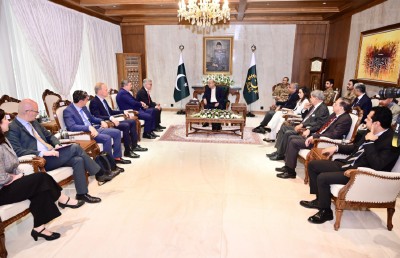
Pakistan, EU agree to expand legal migration and combat human smuggling
Celina Ali
Islamabad: Pakistan and the European Union this week agreed to strengthen cooperation against illegal migration and expand legal employment opportunities for skilled Pakistani workers, as European Commissioner for Home Affairs and Migration Magnus Brunner commended Islamabad’s efforts to reduce irregular migration to Europe by 64 percent.
The understanding was reached during a meeting between Interior Minister Mohsin Naqvi and Brunner in Islamabad, where the two sides discussed measures to dismantle human smuggling networks, improve border security and promote safer, legal pathways for people seeking employment in European countries.
“Pakistan’s effective measures have resulted in a commendable 64 percent reduction in illegal migration to Europe,” Brunner said, according to a statement issued by the Ministry of Interior.
The European commissioner praised the Federal Investigation Agency (FIA) for its professionalism and efforts despite limited resources, expressing confidence that sustained cooperation could help curb irregular migration while creating greater opportunities for people wishing to travel and work abroad through lawful channels.
“Reducing illegal migration will open up pathways for legal migration,” Brunner said, highlighting the connection between effective action against smuggling networks and the expansion of regulated migration opportunities.
Interior Minister Naqvi said Pakistan had adopted a zero-tolerance policy towards illegal migration and intended to build on the progress reflected in the reported decline in irregular departures.
“Following the 64 percent reduction in illegal migration, our next target is to eliminate it completely,” he said.
Emphasising the need for a coordinated international response, Naqvi said Pakistan and the European Union should deepen their collaboration to address the challenge, which involves criminal networks operating across national borders.
“Pakistan and the European Union need to work together to completely eliminate illegal migration,” he said.
The meeting also focused on expanding legal migration opportunities for skilled Pakistani workers seeking employment in EU member states. The discussions reflected a shared interest in facilitating regulated labour mobility while strengthening safeguards against human trafficking, migrant smuggling and the exploitation of vulnerable people.
Pakistan has intensified its campaign against human smuggling following several deadly migrant boat tragedies in recent years involving Pakistani nationals attempting to reach Europe through North Africa and Mediterranean routes. The authorities have also strengthened immigration checks at international airports to identify suspected cases involving forged documents, fraudulent travel arrangements and possible onward journeys organised by smuggling networks.
The enforcement measures have, however, raised concerns about the potential inconvenience faced by legitimate travellers. The FIA maintains that its screening procedures are intended to identify suspected smuggling and document fraud while facilitating lawful travel.
During the talks, the Pakistani and EU delegations agreed to enhance cooperation in immigration management, border security and institutional capacity-building. They also discussed collaboration under the EU’s Eastern Corridor initiative, which seeks to address migrant smuggling along routes connecting Asia and Europe.
The two sides further considered ways to strengthen the operational capacity of the Pakistan Coast Guards as part of broader efforts to prevent irregular departures and disrupt the activities of criminal networks involved in migrant smuggling.
Brunner assured Pakistan of the European Union’s support for its efforts to tackle irregular migration, according to the interior ministry’s statement.
The discussions underscored the importance of combining effective enforcement with accessible legal migration channels. For Pakistan, expanded opportunities for skilled workers could provide a more structured route to European employment, while closer cooperation with the EU could help reduce the risks associated with irregular journeys and strengthen action against transnational smuggling networks.