
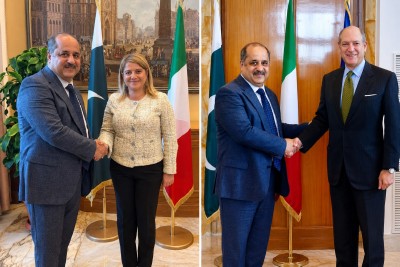
Pakistan, Italy agree to establish centres of excellence for marble, olive oil sectors
Celina Ali
Islamabad: Pakistan and Italy this week agreed to establish new Centres of Excellence for marble and other ornamental stones, as well as olive oil mechanisation, in a move aimed at expanding bilateral trade, promoting technology transfer and strengthening industrial and agricultural cooperation.
The understanding was reached during separate meetings between Advisor to the Prime Minister Dr Syed Tauqir Hussain Shah and Italian Undersecretary for Foreign Affairs Maria Tripodi and Secretary General of the Italian Foreign Ministry Ambassador Riccardo Guariglia in Rome, according to an official statement.
Dr Tauqir led Pakistan’s delegation to the Hand-in-Hand Investment Forum, hosted by the Food and Agriculture Organization (FAO) from October 12 to 14.
The discussions covered bilateral trade, investment, economic development, technological and scientific cooperation, as well as existing institutional mechanisms for strengthening relations between the two countries.
A key outcome was the agreement to establish a Pakistan-Italy Centre of Excellence for the extraction and finishing of granite, onyx, travertine and marble. The proposed facility is expected to support the development of Pakistan’s stone industry by introducing modern technologies, improving processing standards and enhancing the export potential of the country’s mineral resources.
Both sides noted the success of the Pakistan-Italy Centres of Excellence established in Faisalabad and Lahore in 2020 for the textile, leather and footwear sectors. Building on that experience, they agreed to extend cooperation to Pakistan’s marble industry, where improved processing and finishing capabilities could help add value to locally available raw materials.
During the meeting, Italian Trade Agency Director General Ambassador Galanati briefed the Pakistani delegation on the forthcoming visit to Pakistan of Mr Marone, Director General of the Italian International Institute for Marble. The visit is expected to provide further opportunities to explore technical cooperation and strengthen links between the two countries’ stone industries.
Dr Tauqir appreciated the Italian Trade Agency for fully financing the participation of an 18-member Pakistani marble industry delegation at the Marmomac Fair in Verona earlier this month. The delegation’s participation provided an opportunity to engage with Italian companies and examine technologies relevant to marble extraction, processing and finishing.
The meetings were attended by senior officials from the Italian Trade Agency and the Italian Agency for Development Cooperation, including representatives responsible for Asian affairs and development cooperation.
Agriculture emerged as another important area of cooperation, with the two sides expressing satisfaction over the recent finalisation of a memorandum of understanding on agriculture, with a particular focus on olive oil.
They agreed to establish an Agro-Tech Centre of Excellence dedicated to olive oil mechanisation, using Italian machinery and technology to improve productivity and strengthen Pakistan’s olive value chain.
Dr Tauqir praised the Olive Culture Scale-Up Project, implemented by the CIHEAM Bari Institute across 20,000 hectares in four provinces of Pakistan. He also thanked Italy for its support in developing Pakistan’s National Olive Value Chain Policy, which was launched by Prime Minister Shehbaz Sharif in August.
The initiative is intended to support the development of Pakistan’s olive sector by improving production practices and strengthening the links between cultivation, processing and marketing. Cooperation with Italian institutions could also facilitate the introduction of modern equipment and technical expertise.
The Italian side also outlined progress on a €20 million soft-loan agreement for technical and vocational education and training in agriculture, signed in June 2026. Under the agreement, Centres of Excellence are planned for citrus in Sargodha and dates in Turbat.
The programme envisages technology transfer, specialised training and improvements in processing, packaging and certification, with the broader objective of strengthening agricultural value chains and improving the competitiveness of Pakistani products.
The discussions took place against the backdrop of expanding economic relations between Pakistan and Italy. According to figures provided in the statement, bilateral trade reached a record $1.6 billion in 2026.
Pakistani exports to Italy rose to $1.16 billion, making Italy the eighth-largest global destination for Pakistani exports, compared with $1.15 billion in 2025. Remittances from Italy also increased to $1.55 billion, up from $1.3 billion a year earlier.
Italy remains an important destination within the European Union for Pakistani exports and remittances. The country is home to more than 300,000 Pakistani residents and approximately 3,500 Pakistani students, providing a substantial people-to-people foundation for bilateral engagement.
Dr Tauqir highlighted the longstanding relationship between the two countries, recalling Italy’s historic mountaineering achievement as the first country to summit K2 on July 31, 1954. He also referred to the contribution of Italian engineers to the construction of the Tarbela Dam between 1968 and 1976.
During the meetings, Dr Tauqir renewed invitations to Maria Tripodi, co-chair of the Pakistan-Italy Joint Economic Commission (JEC), and Ambassador Guariglia to visit Islamabad for the sixth session of the JEC and the seventh round of Bilateral Political Consultations, respectively. Both officials accepted the invitations.
He also welcomed the forthcoming visit of the Director General of the Italian International Institute for Marble and invited CIHEAM Bari to establish a home-country office in Pakistan to facilitate closer engagement with relevant institutions and stakeholders.
The proposed centres for marble processing and olive oil mechanisation, together with the agricultural training initiatives, reflect a shared interest in moving bilateral relations beyond conventional trade towards practical industrial cooperation, skills development and technology transfer.
The Pakistan Embassy in Rome said the cordial meetings demonstrated the shared commitment of Pakistan and Italy to deepening and diversifying bilateral relations. The initiatives discussed are expected to create further opportunities for cooperation in manufacturing, agriculture, vocational training and value-added exports.