
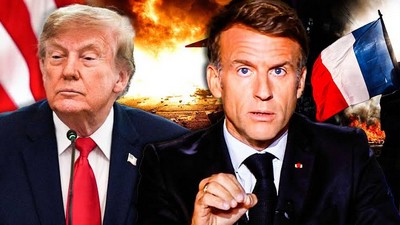
Macron hits back at Trump over France riots, rejects claims linking unrest to migration
Paris: French President Emmanuel Macron this week sharply criticised foreign leaders, including US President Donald Trump, for spreading what he described as “stupid comments” and misinformation about the wave of protests and riots sweeping France, firmly rejecting claims that migrants and Islamists were responsible for the unrest.
Macron’s remarks came amid escalating political tensions over the causes of the demonstrations, which began in September over concerns about the state of education and the rising cost of living but have since escalated into widespread violence, looting and clashes with security forces.
Speaking on Wednesday during a tour of Arab states in the Persian Gulf region, the French president dismissed claims that France had been overwhelmed by migrants and Islamist groups, accusing foreign leaders of making misleading statements that damaged his country’s image.
“We’ve had people claiming that we were invaded by hordes of migrants and Islamists, which is completely false,” Macron said.
He added that those speaking negatively about France did not have the country’s best interests at heart, expressing frustration over what he regarded as irresponsible commentary from abroad.
The controversy intensified after Trump claimed on Monday that France was being “conquered, looted and burned to the ground” by migrants, jihadists and communists allegedly hostile to Christianity and Western civilisation.
The US president offered no evidence to substantiate the claims, while dismissing the role of domestic concerns such as education and the cost of living in triggering the protests.
Trump reiterated his position at the White House on Tuesday, arguing that immigration, rather than economic or educational grievances, was driving the unrest.
“It’s not about education. It’s about immigration,” he said, alleging that undocumented migrants arriving in France hated the country and its people.
Macron’s response reflected growing concern in Paris over the international portrayal of the violence and the political narratives being attached to it, particularly as French authorities struggle to restore order.
Although Macron stopped short of naming individual leaders during his briefing, he made clear that his criticism extended to political figures in Europe and across the Atlantic.
Asked whether there was evidence of foreign involvement in the unrest, the French president said there was no visible foreign interference in the events themselves.
However, he warned that the spread of misleading information from abroad was contributing to an increasingly distorted account of the situation.
“There has been foreign manipulation of information, which has led to unacceptable and stupid comments from many people, including foreign leaders,” Macron said.
He stressed that France wanted order, respect and progress, while urging political leaders to refrain from making statements unsupported by facts.
The French government’s position distinguishes between direct foreign involvement in organising or sustaining the unrest and the dissemination of information that could influence public perceptions of the disturbances.
Macron’s comments suggest that, while Paris has not identified visible foreign interference in the protests themselves, it is concerned about the potential impact of misinformation on France’s international standing and domestic political debate.
US Vice President JD Vance has also linked the unrest to immigration and European integration policies, arguing that Western governments had failed to address questions of assimilation and cultural compatibility.
In a post on X, Vance wrote that Western liberals had “imported the third world into France and other countries in the name of diversity and compassion”.
He argued that governments had neglected fundamental questions concerning integration and compatibility.
Trump subsequently referred approvingly to Vance’s remarks, reinforcing the administration’s argument that immigration was central to the French crisis.
The comments have added an international dimension to France’s domestic turmoil, turning the unrest into a point of contention over migration policy, national identity and the political direction of Western societies.
Macron, however, rejected attempts to attribute the violence broadly to migrants and Islamists, maintaining that the claims circulating among foreign political leaders were false.
The dispute also illustrates differing approaches to immigration across the Western world, with some political leaders advocating tighter controls and stronger assimilation requirements, while Macron has challenged what he sees as the use of the French crisis to promote unsupported political narratives.
The French unrest has also become a subject of debate elsewhere in Europe.
Hungarian Prime Minister Peter Magyar linked the violence to immigration policies in a social media post on Sunday, arguing that the destruction reinforced the case for Hungary’s strict approach to migration.
“In the face of this senseless destruction and unjustified violence, perhaps it is now clear to everyone why Hungary advocates the strictest possible approach to migration,” he wrote.
His comments added to a wider European debate over whether migration and integration policies contribute to social tensions, although the statements cited in the controversy did not establish that migrants were responsible for the French disturbances.
The competing interpretations have highlighted the political sensitivity surrounding immigration in Europe, where governments face pressure to address public concerns about security and integration while avoiding generalisations about entire communities.
For Macron, the challenge is twofold: restoring public order at home and countering international claims that he believes misrepresent the causes of the crisis.
Meanwhile, French authorities have intensified security preparations as the country confronts one of its most serious episodes of rioting in years.
More than 2,000 people were arrested over the preceding weekend alone, according to the account provided, underscoring the scale of the unrest.
Localised curfews have been imposed in affected areas, while officials have promised a “massive” police presence ahead of further demonstrations expected on Saturday.
The authorities face mounting pressure to contain the violence, prevent additional looting and protect businesses and public infrastructure as demonstrations continue.
The unrest has raised broader questions about the underlying social and economic grievances that initially brought protesters onto the streets, including concerns about education and the cost of living.
While the protests have expanded into violence in several areas, the political debate over their causes remains sharply divided, with Macron rejecting attempts to reduce the crisis to immigration alone.
Macron’s comments came during a regional diplomatic tour that included an unannounced visit to Saudi Arabia on Wednesday.
According to the Élysée Palace, the French president held talks with Saudi Crown Prince Mohammed bin Salman before departing for Paris.
The visit formed part of Macron’s diplomatic engagements in the Gulf, but the escalating unrest at home and the ensuing dispute with foreign leaders placed France’s domestic crisis firmly in the international spotlight.
The confrontation with Trump has exposed differences between Paris and Washington over how to interpret the violence and the role of immigration in European societies.
As French authorities prepare for further demonstrations, Macron is seeking to defend France’s international image while insisting that the crisis should not be exploited to advance claims he considers unfounded.
The coming days will test the government’s ability to restore public order and address the grievances behind the protests, even as the political dispute over migration and misinformation continues to widen beyond France’s borders.