
EU strengthens Pakistan’s technical education with upgraded skills centres
Liaquat Ali
Islamabad: The European Union is expanding its investment in Pakistan’s human capital and future workforce through a major initiative to modernise technical and vocational education, inaugurating upgraded training facilities in Abbottabad and Haripur to equip young people, particularly women, with industry-relevant skills in energy transition, digital technologies and emerging sectors.
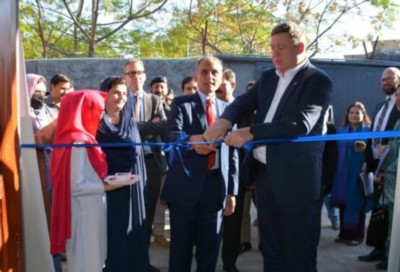
The European Union and Germany this week inaugurated the upgraded Technical and Vocational Education and Training (TVET) Centre of Excellence in Abbottabad, marking another milestone in Team Europe’s efforts to strengthen Pakistan’s skills development system and improve employment prospects for its growing youth population.
On the same occasion, the EU Ambassador, Raimundas Karoblis, joined British Council Deputy Country Director Ben Lawton to inaugurate the upgraded Government Technical and Vocational Centre for Women at KTS Haripur, highlighting the European Union’s commitment to expanding women’s access to advanced technical education and economic opportunities.
Both initiatives form part of the Team Europe TVET Sector Support Programme, co-financed by the European Union and the German Federal Ministry for Economic Cooperation and Development (BMZ), which is upgrading eight specialised technical and vocational training institutions across Pakistan.
The programme seeks to bridge the gap between conventional vocational education and the changing requirements of modern labour markets by providing students with practical competencies in emerging technologies, green industries and other sectors with growing employment potential.
The Abbottabad Centre has undergone substantial modernisation with support from the European Union and Germany. Eight laboratories have been equipped with contemporary, industry-standard machinery and equipment for solar photovoltaic (PV) systems, electrical installations and mechanical training. Several buildings and institutional blocks have also been rehabilitated to improve the overall learning environment.
The upgraded institution offers three-year diploma programmes in electrical, mechanical and civil disciplines and has secured international accreditation, strengthening the recognition and relevance of its qualifications.
Beyond classroom instruction, the centre is also being developed as a regional training hub for upgrading the professional capabilities of teachers and master trainers in modern technologies and green trades. More than 1,000 students are expected to receive training at the institution during the programme’s implementation period.
The investment is particularly significant as Pakistan seeks to accelerate its energy transition, expand renewable energy capacity and develop a skilled workforce capable of supporting the country’s evolving energy requirements.
EU Ambassador Raimundas Karoblis said a skilled workforce was essential for Pakistan’s energy transition and economic competitiveness, emphasising that the European Union’s partnership with Pakistan was focused on investing in people and creating opportunities for younger generations.
“Pakistan’s energy transition and economic competitiveness depends on a skilled workforce. Through our Team Europe partnership, we are investing in people and creating opportunities for the youth. This Centre will help young people gain practical, industry-relevant competencies that meet international standards, opening up better employment prospects,” he said.
GIZ Country Director Maria-Jose Poddey said strong vocational education systems must connect quality training with the actual requirements of industry.
She said the Abbottabad Centre’s modern facilities, skilled instructors and relevant qualifications would help prepare young people for careers in the energy sector while contributing to Pakistan’s sustainable development.
Dr Muhammad Irshad, Advisor for Technical Education, Government of Khyber Pakhtunkhwa, appreciated the cooperation extended by the European Union and Germany in strengthening technical and vocational education in the province.
He said access to quality technical education and practical skills aligned with labour market requirements was essential for preparing young people for professional opportunities, adding that the upgraded centre would play an important role in producing skilled professionals for the energy sector.
The European Union’s skills development initiative also places particular emphasis on women’s economic empowerment, with the inauguration of the upgraded Government Technical and Vocational Centre for Women at KTS Haripur.
The institution is being developed under a hub-and-spoke model linked to the Centre of Excellence for Digital and High-Tech Skills at the Institute of Management Sciences (IMSciences), Peshawar. It will also serve as a model vocational training institution for delivering advanced courses to women in Khyber Pakhtunkhwa.
The upgraded facility includes a modern smart laboratory and smart classroom, providing an improved environment for specialised training in digital and high-technology fields.
Under the programme, approximately 150 female students are expected to receive training at the Haripur centre in areas including data analytics, cybersecurity and game development.
The initiative is designed to bring advanced technical education closer to women in local communities, enabling them to acquire skills that can open pathways to formal employment, freelancing and entrepreneurship.
Speaking at the inauguration, British Council Deputy Country Director Ben Lawton said investment in modern training facilities needed to translate into practical skills and greater economic independence for women.
“Investing in modern training facilities is just the first step. What matters is women gaining practical skills and the confidence to turn them into livelihoods. Through this Programme, working with KP TEVTA, we’re bringing industry-relevant training closer to communities, helping women access jobs, pursue freelancing and start businesses that can transform their futures,” he said.
During the visit, the delegation also toured specialised beauty and hair laboratories and the newly established Career Counselling and Job Placement Centre. The facility is intended to connect female trainees with sustainable employment opportunities and provide guidance on professional development and career pathways.
Representatives of government institutions, development partners and the technical and vocational education sector attended the events, underscoring the importance of coordinated efforts to improve the quality and accessibility of skills training in Khyber Pakhtunkhwa.
The two inaugurations reflect the broader objectives of the Team Europe TVET Sector Support Programme, which runs from 2023 to 2028 with a total budget of €63 million.
Co-financed by the European Union and Germany’s BMZ, the programme is being implemented by the Deutsche Gesellschaft für Internationale Zusammenarbeit (GIZ) GmbH and the British Council in collaboration with national and provincial institutions, including the National Vocational and Technical Training Commission (NAVTTC) and provincial Technical Education and Vocational Training Authorities (TEVTAs).
Its central objective is to strengthen Pakistan’s technical and vocational education system, improve the quality and labour market relevance of training programmes, and expand employment opportunities for young people.
Through the modernisation of eight specialised Centres of Excellence, the initiative is seeking to establish stronger connections between educational institutions and industry, ensuring that graduates acquire skills that respond to actual market demand.
The programme also reflects the European Union’s Global Gateway investment strategy, which aims to mobilise up to €400 billion in public and private investment worldwide between 2021 and 2027.
Global Gateway focuses on developing smart, clean and secure connections in digital, energy and transport sectors while strengthening health, education and research systems. Its broader approach brings together the EU, member states and European development finance institutions to support sustainable infrastructure, economic growth and human development.
For Pakistan, the investment in Abbottabad and Haripur represents an important dimension of this cooperation, extending beyond conventional development assistance to focus on long-term skills, employability and economic participation.
By combining renewable energy training with advanced digital education and targeted opportunities for women, the European Union is supporting Pakistan’s efforts to prepare its workforce for the demands of a rapidly changing economy.
The initiative also demonstrates how international partnerships can translate investment in education into practical opportunities, helping young Pakistanis access emerging professions, participate in the digital economy and contribute to the country’s sustainable development.