
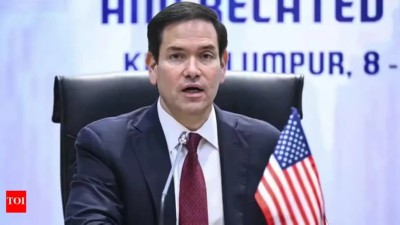
Rubio acknowledges Pakistan’s concerns over terrorism from Afghan soil, offers US role
Newswire
Atlanta: US Secretary of State Marco Rubio this week acknowledged Pakistan’s concerns over terrorist attacks originating from Afghan territory, saying Washington has taken note of Islamabad’s position and would be willing to play a constructive role if an opportunity arises.
Speaking at a press briefing in Atlanta, Georgia, Rubio said the United States was aware of Pakistan’s concerns that militant attacks inside the country were being sponsored from Afghanistan, adding that Washington did not want Pakistan to continue facing such threats.
“Pakistan is concerned about terrorist attacks that are being sponsored from the territory of Afghanistan,” Rubio said, noting that Islamabad believed the Afghan Taliban had not done enough to prevent such attacks and had consequently taken action against them.
“We obviously have heard those concerns on their part, we obviously don’t want them to be targeted,” he said.
The US secretary of state acknowledged that Washington did not necessarily have the closest relationship with the Taliban administration in Kabul, but said the United States had heard Pakistan’s concerns and had seen some of the attacks Islamabad had highlighted.
“If there’s a productive role for us to play, we’ll play it,” Rubio said, reiterating Washington’s opposition to terrorism regardless of its origin or intended targets.
“We’re against terrorism no matter where it emanates from and who it targets,” he added.
Rubio’s remarks come amid persistent tensions between Pakistan and Afghanistan over cross-border terrorism and Islamabad’s demand that the Afghan Taliban prevent militant groups from using Afghan territory to launch attacks inside Pakistan.
Pakistan has repeatedly called on the Taliban administration to honour its commitments and take effective action against terrorist organisations, particularly the Tehreek-e-Taliban Pakistan (TTP), which Islamabad accuses of operating from sanctuaries across the border.
Islamabad has maintained that assurances from Kabul have not translated into sufficient action on the ground. Pakistani authorities argue that the threat extends beyond the movement of militants across the border, alleging that terrorist networks also benefit from training facilities, weapons supplies and operational support inside Afghanistan.
Security officials have estimated that up to 70 per cent of militants infiltrating Pakistan belong to Afghan-origin groups. Pakistani security authorities have also alleged that weapons left behind by US and NATO forces in Afghanistan have reached militant organisations, including groups identified by Pakistan as Fitna al-Khawarij and Fitna al-Hindustan.
The Pakistani security establishment has repeatedly linked the escalation in terrorist attacks to the presence of militant infrastructure on Afghan soil. According to figures cited by Pakistani authorities, terrorism emanating from Afghanistan claimed 1,327 lives in Pakistan during 2026, while another 2,484 people were injured.
Rubio’s comments are significant as they publicly acknowledge Islamabad’s security concerns and leave open the possibility of a constructive American role, although he did not outline any specific initiative or mechanism for US engagement with Pakistan and Afghanistan.
In the same press engagement, Rubio also addressed the growing tensions with Iran, saying President Donald Trump had not yet made a decision on whether to launch fresh military strikes amid stalled peace negotiations.
“He hasn’t made a decision. I have no announcement in that regard with you today, and nor do we take any of it lightly,” Rubio said at a G20 press conference in Atlanta.
The US secretary of state maintained that Trump preferred a diplomatic settlement but stressed that Washington retained the military capability to act if required.
“We can achieve military objectives if we seek to,” Rubio said, adding that the administration would prefer to resolve the situation peacefully.
Rubio also criticised what he described as Iran’s threats to target commercial shipping and the energy infrastructure of neighbouring countries and the wider region.
He said the Iranian position appeared to be that, unless Tehran secured its demands, it could disrupt shipping and damage regional energy facilities.
The remarks reflected Washington’s continuing effort to keep diplomatic options open while maintaining pressure on Tehran amid uncertainty surrounding the stalled negotiations.
Taken together, Rubio’s comments on Pakistan-Afghanistan tensions and the Iran crisis highlighted the range of regional security challenges confronting Washington, while signalling that the United States remained attentive to Pakistan’s concerns over cross-border terrorism.