
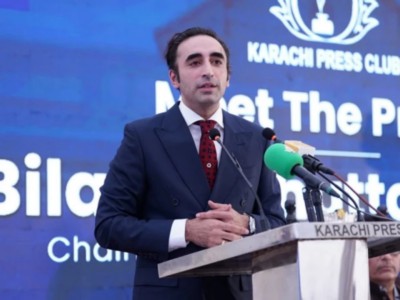
Bilawal Bhutto calls for national democratic reset
Liaquat Ali
Karachi: Pakistan Peoples Party (PPP) Chairman Bilawal Bhutto Zardari this week called for a comprehensive democratic and political reset through consensus among all political forces, stressing that Parliament, the judiciary, the Election Commission, the accountability system and the media must regain public confidence to steer the country out of its mounting political and economic challenges.
Addressing journalists at the Karachi Press Club and responding to their questions, Bilawal said the country’s institutional crisis had not emerged overnight but was the result of accumulated political mistakes and failures. He argued that restoring public trust required collective introspection, meaningful reforms and a renewed commitment to democratic principles.
He called for strengthening Parliament, ensuring media freedom, making the Election Commission credible, establishing an impartial accountability mechanism and reinforcing the judiciary through broader political consensus.
“The system did not collapse suddenly; it was brought down,” he said, observing that almost every national institution had lost public confidence. He maintained that the way forward was a political reset rooted in democracy rather than a non-political intervention, as elected representatives were ultimately responsible for addressing the people’s problems.
In a candid admission of collective political responsibility, the PPP chairman said the process of reform must begin with politicians acknowledging their own mistakes.
“I have a hand in this too, I share the responsibility, I have made mistakes, I am also at fault, I am also responsible,” he said, adding that political leaders must accept their shortcomings and demonstrate the willingness to correct them.
Bilawal expressed serious concern over the country’s economic situation, warning that rising poverty, unemployment and inflation could further intensify public hardships in the coming months. He regretted that political parties remained preoccupied with confrontation, hostility and mutual accusations instead of addressing the economic difficulties confronting ordinary citizens.
He said the debate about the possible collapse of the system should focus on identifying the reasons behind its deterioration and finding democratic solutions rather than encouraging further political confrontation.
Highlighting the deteriorating environment for journalists, Bilawal said the media and the journalist community had perhaps never been as weak as they were under the prevailing circumstances in Pakistan.
He stressed that freedom of expression was indispensable to democracy, arguing that meaningful political dialogue, dissent and debate on public issues were impossible without an independent media.
If journalists had to think twice before reporting the truth or highlighting public grievances because of the fear of action under PECA, ACTA or other laws, the media would be unable to perform its fundamental responsibility, he said.
Bilawal urged the Karachi Press Club and press clubs across the country to prepare comprehensive proposals concerning media freedom, journalists’ protection and the legal and professional challenges confronting the journalist community.
He assured journalists that the PPP would raise their concerns in Parliament and become their voice in the legislative process.
The PPP chairman described Parliament as the country’s principal decision-making forum, where disagreements should be resolved through debate, dialogue and consultation.
He said the opposition played an important and patriotic role in any parliamentary democracy, warning that questioning the patriotism of opposition lawmakers merely because they criticised government policies undermined Parliament and the democratic system.
Political differences between the government and opposition should be expressed through arguments and parliamentary debate rather than bullets, guns, arrests or threats of imprisonment, he maintained.
Bilawal Bhutto said democracy derived its strength from the ability of different political parties to present competing positions and subsequently find common ground through negotiations and consultation.
He specifically defended the democratic right of Jamiat Ulema-e-Islam-Fazl chief Maulana Fazlur Rehman to criticise the government, saying his objections should be answered through political engagement rather than arrests, National Accountability Bureau (NAB) proceedings or other pressure tactics.
The government, he said, must listen to the concerns of all political stakeholders and restore their confidence in Parliament.
He also acknowledged that former prime minister Imran Khan and his party, Pakistan Tehreek-e-Insaf (PTI), were political realities and important stakeholders whose participation could not be ignored in efforts to address national challenges.
Bilawal Bhutto said restoring the opposition’s confidence in Parliament would require serious efforts to address allegations of election rigging and other objections regarding the electoral process.
When elections remained disputed, he argued, questions were inevitably raised about the legitimacy and credibility of the Parliament emerging from them.
He called for comprehensive electoral reforms, saying public confidence in future elections could not be restored without addressing existing concerns. He also said the return of reserved seats to the opposition should be considered as part of efforts to rebuild parliamentary trust.
The PPP chairman stressed that political victimisation must end and criticised the use of NAB as an instrument of political revenge.