
28,000-year-old prehistoric couple’s burial goes on display at Italian museum
Newswire
Lecce: A remarkable glimpse into human life nearly 28,000 years ago was offered to visitors in southern Italy, where the skeletal remains of a prehistoric couple from the Upper Paleolithic period went on public display at the University of Salento’s Museum of History and Archaeology (MuSA).
The exhibition, inaugurated on November 5, showcased the remains of a Gravettian burial discovered inside the Grotta delle Veneri di Parabita, a cave in southern Italy. Dating back approximately 28,000 years, the burial provided an extraordinary insight into prehistoric human life, burial customs and the cultural practices of hunter-gatherer communities.
The remains were originally discovered in 1968 by Giuliano Cremonesi, a professor of prehistory and protohistory at the University of Salento. Following the discovery, Italy’s Ministry of Culture entrusted the material to the museum for preservation, scientific study and eventual public display.
A major scientific reassessment of the archaeological material was undertaken in 2020 under the supervision of researchers Elettra Ingravallo and Renata Grifoni Cremonesi. The multidisciplinary team included specialists from the University of Salento, who examined the remains through archaeological, anthropological, animal-bone and radiocarbon-dating studies.
The findings were subsequently published in a research volume titled La Grotta delle Veneri di Parabita (Lecce) by Edipuglia, providing the scientific foundation for the museum’s exhibition.
The project was developed under the leadership of Jacopo De Grossi Mazzorin and Grazia Maria Signore, director of MuSA. Signore coordinated the exhibition’s design, bringing together anthropologists, prehistoric archaeologists, scientific illustrators, videographers and 3D modelling specialists to present the ancient discovery in an engaging and accessible format.
The exhibition presented the burial through a combination of original archaeological remains, scientific illustrations, digital technology and multimedia displays.
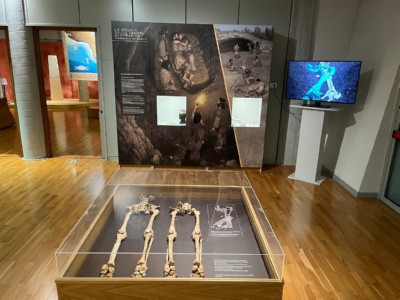
At its centre, a specially designed display case featured the couple’s skeletal remains arranged in their anatomical positions, allowing visitors to observe the burial in a form that closely reflected the original archaeological context.
Interactive QR codes placed alongside the display provided bilingual written and audio information about the individuals, including their estimated ages, biological sexes, health conditions and aspects of their way of life.
One of the exhibition’s most striking features was a detailed scientific illustration by Alberto Gennari, which reconstructed the burial scene and offered a visual interpretation of the hunter-gatherer community’s daily activities outside the cave approximately 28,000 years ago.
The exhibition also displayed objects discovered alongside the human remains, offering further clues about the customs and personal adornments of the prehistoric community.
Among the most significant finds were red deer teeth coated with ochre. Archaeologist Jacopo De Grossi Mazzorin interpreted these objects as components of a cap worn by the woman buried in the cave. A reconstruction of the presumed headpiece was included in the exhibition to help visitors understand how such prehistoric ornaments might have appeared.
A documentary film, complete with subtitles, retraced the original discovery and the subsequent decades of archaeological investigation. The presentation also featured a three-dimensional animation of the skeletons, produced by Fabio Andriani and Adriana Bandiera at the university’s 3D Laboratory.
The preparation of the exhibition presented considerable challenges because the skeletal remains were severely fragmented and damaged, making their interpretation and visual presentation particularly complex.
Signore explained that the team had sought to reconstruct and communicate the couple’s story as accurately and comprehensively as possible, ensuring that every element of the exhibition was grounded in the scientific findings of the 2020 reassessment.
Rather than presenting the remains simply as archaeological objects, the museum aimed to provide visitors with a broader understanding of the individuals, their burial practices and the prehistoric society in which they lived.
The exhibition also served as a tribute to two researchers whose contributions were central to bringing the discovery into public focus.
The opening was dedicated to Elettra Ingravallo, who promoted and coordinated the scientific study of the archaeological material recovered during Cremonesi’s excavation, and Jacopo De Grossi Mazzorin, who directed MuSA from 2019 to 2022 and played a leading role in designing the exhibition.
Through the display, the University of Salento transformed a decades-old archaeological discovery into an accessible scientific and cultural experience, allowing visitors to explore a remarkable chapter of human history preserved for nearly 28 millennia.
The exhibition demonstrated how modern archaeological research, scientific reconstruction and digital technology could bring distant prehistoric lives into sharper focus, offering a rare opportunity to connect with the people and traditions of an era long before written history.