
Recreating 30 Years of Artistic Exploration of the Leopard Cat: From Unfathomable to Endlessly fascinating
The Paper
Gu Cunyan | Six Impressions of the Stone Tiger
Shi Hu (1942-2023) was a landmark figure in the reform of Chinese painting since the 1980s. As early as the 1970s, his “Sketches of Africa” ??had a significant impact. In his later years, he lived in seclusion in a mountain village, constructing his artistic system through heavy color painting, ink wash painting, and calligraphy. On the third anniversary of Shi Hu’s death, how can we truly re-examine his work?
On October 20th, the “Unfathomable Yet Enduring: A Grand Exhibition of Shi Hu’s Art” opened at the Jinling Art Museum. This is the largest comprehensive art exhibition since Shi Hu’s death in 2023, bringing together more than seventy pieces (sets) of his works created over 30 years, starting in the 1990s, including heavy color paintings on paper, heavy color paintings on canvas, oil paintings on canvas, ink paintings on paper, and manuscripts. Two specialized academic seminars were held concurrently with the exhibition, discussing Shi Hu’s artistic explorations, calligraphic practices, and their profound significance for the modern transformation of Chinese art.
On-site | Recreating 30 Years of Artistic Exploration of the Leopard Cat: From Unfathomable to Endlessly fascinating
At the Jinling Art Museum exhibition hall, in front of the huge “Tianming Tu” painting
On-site | Recreating 30 Years of Artistic Exploration of the Leopard Cat: From Unfathomable to Endlessly fascinating
Shi Hu (1942-2023) spent his later years in a mountain village in Guangdong.
How did it go from “unfathomable after countless readings” to “endless enjoyment”?
Art scholar Peng De, over 80 years old, had already positioned Shi Hu as a “paradigm of Chinese modern art” during his lifetime, noting his immense exploratory nature and pointing out that he “opposed the new wave of art copying the West and the conservatives copying tradition.” The exhibition’s title, “Unfathomable After a Hundred Readings,” actually points to Shi Hu’s continuous artistic exploration. His 1978 work, “African Sketches,” grafted Chinese ink painting onto Western realism, already astonished and puzzled the art world at the time. In the 1980s and 90s, he turned to “character imagery” experiments, dissolving grammar and deconstructing Chinese characters, making his poems “completely unreadable.” The use of peacock feather brushes to write Chinese characters and the heavy color technique further concealed the objects beneath layers of lines and colors. Each exploration surpassed existing boundaries, naturally leading to a sense of “incomprehension” when faced with such works.
On-site | Recreating 30 Years of Artistic Exploration of the Leopard Cat: From Unfathomable to Endlessly fascinating
Exhibition opening scene
The phrase “never tires of looking at it” stems from its inherent artistic charm. Shi Hu’s lines are vigorous and powerful, intricately intertwined, sharp and sculpted, their colors mottled yet brilliant, like rosy clouds or radiant light. What appears to be an abstract, massive work reveals figures, animals, and plants vividly when viewed from a distance, as if brought to life by animation. This “unresolved yet understood”—the closer you get, the more enigmatic it becomes; the further you step, the clearer it becomes—makes viewing a continuous process of adjusting perception. The incomprehension breeds questioning, and questioning prolongs the viewing experience; the longer one views, the more inexhaustible its “primordial” energy becomes. Therefore, “never tiring of looking at it” is the entry point, and “never tires of looking at it” is the ultimate destination. Curator Liu Chunjie, specially appointed director of Jinling Art Museum, said: “Shi Hu spent his life searching for new ways, exploring his own artistic language, and establishing his own theoretical system. He sought theoretical basis and spiritual sustenance from folk art and traditional culture, taking the old as the new and transforming the old into his own. His art is self-expressive, conscious, and distinctive. Since the 1980s, Shi Hu has never lacked confidants and has never been lonely. It is fortunate that people understand him. He stands alone in the art world, vigorous, vibrant, intelligent, versatile, and profound. He is a warrior in the contemporary art world.”
On-site | Recreating 30 Years of Artistic Exploration of the Leopard Cat: From Unfathomable to Endlessly fascinating
Exhibition of “Swing Picture”
Wang Luxiang, the academic director of the exhibition and a renowned cultural scholar, began by discussing Shi Hu’s inscription at the exhibition: “Only calligraphy can drive away the vulgarity and oppression around us.” He believes that the enormous impact of Shi Hu’s death was not accidental. He was an artist who attempted to construct a “world painting” with a comprehensive civilization, based on a global consciousness, rooted in a sense of seeking roots, using “visualized land anthropology” as a method, and embracing “self-exile” as a life attitude. “His exploration highlights the free essence of art. He was a more intense, more far-reaching, and more extreme artist, and a huge presence in the history of modern Chinese art. Anyone who looks at it repeatedly will surely find a solution.”
Zhao Xucheng, honorary president of Jiangsu Provincial Academy of Chinese Painting, said: “I still remember when Shi Hu held an exhibition in Nanjing in the 1980s, I attended and gave a speech. The exhibition was very well received at the time. I am 86 years old this year, and like Shi Hu, I believe that Chinese calligraphy has extremely great artistic value. Shi Hu has a broad mind and his artistic attainments have reached a height that most people cannot reach.”
On-site | Recreating 30 Years of Artistic Exploration of the Leopard Cat: From Unfathomable to Endlessly fascinating
Wang Yiqiao, representative of Hengbang Art Center, donated the artwork “Duo Ning Tu” to Jinling Art Museum. Zhang Xueting, Vice President of Nanjing Academy of Painting and Calligraphy and Deputy Director of Jinling Art Museum, accepted the donation, and Liu Chunjie, Special Appointed President of Nanjing Academy of Painting and Calligraphy and Special Appointed Director of Jinling Art Museum, presented the collection certificate.
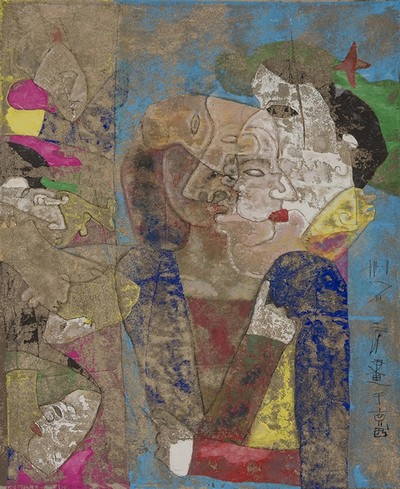
The exhibition list spans from “Jade Beauty” (paper painting, heavy color) in 1992 to “Overturning Basket” in 2022, juxtaposing works from three decades in the same space, rather than being displayed in separate halls according to “oil painting period – heavy color period – ink painting period”. This synchronic juxtaposition logic is precisely material evidence of Shi Hu’s “growth”.
On-site | Recreating 30 Years of Artistic Exploration of the Leopard Cat: From Unfathomable to Endlessly fascinating
A partial view of the painting “Jade Beauty”
Shi Hu himself said, “My creation actually has no stages; it’s a continuous process.” He has a very vivid way of putting it—”anti-sweeping”: “We spend our whole lives doing ‘anti-sweeping work’… so we have to fight against it, struggling back and forth painfully. That’s actually how the journey of art is.” Every time a style takes shape, it’s a danger of being captured by inertia for him; every “growth” is an active break free. In the exhibition, the 1995 oil painting on canvas “Emerald Pond” (75×75cm) and the 2018 heavy color painting on canvas “Clear Fragrance” (124×163cm) are compared side by side; the 1992 “Jade Beauty” and the 2017 “Indigo Looking Up” and the 2021 “Overturning Basket” are placed in the same room, and the boundaries between the media are intentionally blurred. Shi Hu did not “progress” from oil painting to heavy color painting, nor did he “return” from heavy color painting to ink painting, but rather he tore and activated each other between multiple media.