
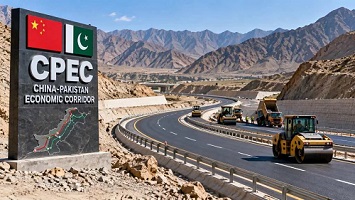
CPEC western route projects in Balochistan record Rs 54.9 billion in releases, expenditure
Celina Ali
Islamabad: Four ongoing road projects under the China-Pakistan Economic Corridor (CPEC) in Balochistan’s western zone have recorded a combined Rs54.9 billion in releases and expenditure against a total allocation of Rs83.2 billion, highlighting the scale of investment being channelled into strengthening road connectivity across the province and advancing Pakistan’s broader CPEC infrastructure network.
According to official documents covering the Public Sector Development Programme (PSDP) from fiscal year 2020-21 to 2026-27, the four projects span approximately 718 kilometres and include key sections of the M-8, N-30 and N-50 highways.
The projects are intended to improve connectivity across Balochistan’s western districts, linking remote areas with major road networks and supporting the wider objectives of CPEC.
The figures place the four schemes within the broader China-Pakistan economic cooperation framework, under which road infrastructure is a central component of efforts to improve regional connectivity, facilitate the movement of goods and people, and strengthen links between Pakistan’s less-developed regions and national and regional markets.
The four projects comprise the 146-kilometre Hoshab-Awaran section of the M-8, the 168-kilometre Awaran-Naal section of the same highway, the 106-kilometre Basima-Khuzdar section of the N-30 and the 298-kilometre Zhob-Kuchlak section of the N-50.
An analysis of the official figures shows that the combined Rs54.9 billion recorded under releases and expenditure represents approximately 66 per cent of the total allocation of Rs83.2 billion. The difference between the overall allocation and the amount recorded under releases and expenditure stands at approximately Rs28.3 billion.
The figures provide a project-wise picture of the financial position of the four road schemes under the specified PSDP period, while highlighting variations in the amounts recorded against their respective allocations.
Among the four projects, the Basima-Khuzdar section of the N-30 has recorded the highest proportion of releases and expenditure relative to its allocation, followed by the Awaran-Naal section of the M-8. The Hoshab-Awaran and Zhob-Kuchlak sections have recorded comparatively lower proportions against their approved allocations.
The 146-kilometre Hoshab-Awaran section of the M-8 has an allocation of Rs18.30 billion, against which Rs9.75 billion has been recorded under releases and expenditure. This represents approximately 53 per cent of the total allocation, leaving a difference of around Rs8.55 billion between the allocation and the recorded amount.
The 168-kilometre Awaran-Naal section of the M-8 has received an allocation of Rs27.28 billion, with Rs20.45 billion recorded under releases and expenditure. The amount represents approximately 75 per cent of its allocation, making it the second-highest project in terms of the proportion recorded against its allocated funding.
For the 106-kilometre Basima-Khuzdar section of the N-30, the official document records Rs12.97 billion against a total allocation of Rs13.75 billion. This translates into approximately 94 per cent of the allocated amount, the highest proportion among the four schemes. The difference between the allocation and the recorded amount is approximately Rs780 million.
The 298-kilometre Zhob-Kuchlak section of the N-50 has an allocation of Rs23.85 billion, while releases and expenditure stand at Rs11.707 billion. The recorded amount represents approximately 49 per cent of its allocation, leaving a difference of around Rs12.14 billion.
Taken together, the four projects account for a substantial road-building programme in Balochistan’s western zone, with the Zhob-Kuchlak section representing the longest of the four routes at 298 kilometres, followed by Awaran-Naal, Hoshab-Awaran and Basima-Khuzdar.
The differing financial ratios indicate that the four schemes are at different positions relative to their respective allocations. However, the figures on releases and expenditure alone do not establish the physical completion status of individual road sections or explain the reasons for variations in their recorded financial positions.
The road schemes form part of the wider CPEC connectivity framework, which includes four principal alignments identified in the accompanying CPEC alignment map: Common, Western, Central and Eastern.
According to the map, the Common Alignment extends over 983 kilometres, while the Western Alignment covers 1,511 kilometres. The Central Alignment extends over 1,440 kilometres and the Eastern Alignment over 1,709 kilometres.
The western route is particularly relevant to Balochistan’s connectivity requirements, given the province’s extensive geography and the importance of reliable road links between its districts, commercial centres and the wider national highway network. The four schemes identified in the official document contribute to the broader road infrastructure programme associated with CPEC in the province’s western zone.
From a China-Pakistan economic cooperation perspective, the development of road infrastructure is a key element of the corridor’s wider connectivity ambitions. Improved road links can help reduce transport constraints, facilitate access to markets, support the movement of agricultural and other locally produced goods, and strengthen connections between communities and economic centres.
For Balochistan, better road connectivity also has the potential to support commercial activity by improving access to public services, transport facilities and economic opportunities in areas that have historically faced geographical and infrastructure-related challenges. The extent to which these benefits materialise will depend on the completion, operational performance and effective use of the relevant infrastructure.
CPEC’s road network is also intended to strengthen connectivity between different parts of Pakistan, rather than serving solely as a collection of individual highway projects. The wider alignment framework provides the context for understanding how investments in provincial road links fit into the country’s broader transport infrastructure planning.
The official figures for the four Balochistan schemes therefore offer a snapshot of the financial allocations and amounts recorded under releases and expenditure during the specified PSDP period. With a combined allocation of Rs83.2 billion and approximately Rs54.9 billion recorded against it, the projects remain an important component of the road infrastructure programme associated with CPEC’s western zone.
The data, however, do not separately specify the amount of Chinese financing, the share of funding attributable to individual sources, the physical progress achieved on each section or the expected completion dates.
The reported allocations and releases/expenditure should therefore be understood as the financial position presented in the official document, rather than as a direct measure of construction progress or the overall economic impact of the projects.