
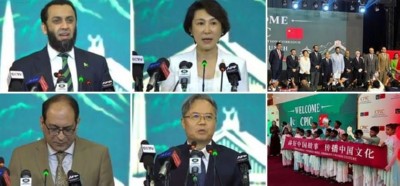
Pakistan, China launch information corridor with 18-media news exchange, fact-checking mechanism
Liaquat Ali
Islamabad: Pakistan and China this week launched a bilateral information corridor featuring an 18-outlet media exchange network and a dedicated fact-checking mechanism to strengthen media cooperation, counter misinformation and promote public understanding of their strategic partnership.
Information Minister Attaullah Tarar announced the initiative at its launch ceremony in Islamabad, describing the China–Pakistan Information Corridor (CPIC) as a platform designed to complement the China–Pakistan Economic Corridor (CPEC) by expanding cooperation beyond infrastructure, energy and industrial development into media, research, business and cultural exchanges.
“ A news exchange working group of 18 Pakistani and Chinese media organizations,” including state broadcasters and private television channels, “now share verified news on our cooperation,” Tarar said.
He added that a dedicated fact-checking mechanism would monitor misleading narratives and respond with verified information and concrete facts.
The media network includes prominent Chinese organizations such as Xinhua News Agency, China Media Group and People’s Daily, establishing a framework for information sharing between media institutions in the two countries.
Chinese Foreign Ministry spokesperson Mao Ning and Chinese Ambassador to Pakistan Jiang Zaidong attended the launch ceremony at the Pakistan–China Friendship Center.
Highlighting the need for closer information cooperation, Mao said misinformation, fake news and false narratives continued to pose challenges, making the launch of the corridor timely and important.
The Chinese ambassador said the initiative would help foster a favourable public opinion environment for practical cooperation between the two countries, particularly as they prepare for the next phase of CPEC.
The initiative builds on discussions dating back to March 2024, when Tarar and the Chinese ambassador considered establishing an information corridor and improving coordination to address what Pakistani officials described as misinformation surrounding CPEC.
The latest development reflects efforts by both countries to strengthen public communication and broaden institutional engagement alongside their economic partnership.
Beyond media cooperation, the information corridor encompasses business and enterprise, think tanks, and culture, tourism and youth exchanges.
Tarar said the business component had opened its first regional office in Karachi and was developing a digital portal to track trade, investment and foreign direct investment between the two countries.
The initiative also includes a podcast series featuring Chinese entrepreneurs operating in Pakistan and Pakistani entrepreneurs doing business in China, providing a platform to share commercial experiences and explore investment opportunities.
Under the research component, the Pakistan–China Institute will bring together Pakistani and Chinese think tanks and research institutions for joint discussions, collaborative research and publications.
The culture, tourism and youth pillar has nominated its first cohort of youth ambassadors from 13 Pakistani universities to encourage exchanges and strengthen people-to-people ties.
Plans also include a proposed Xinjiang–Gilgit-Baltistan tourism corridor aimed at extending Chinese travellers’ visits into northern Pakistan, alongside a Pakistan–China friendship rally.
Through its four areas of cooperation, the China–Pakistan Information Corridor seeks to build stronger links between media organisations, businesses, research institutions and young people, adding a public communication and cultural dimension to the longstanding bilateral partnership.