
Italy’s luxury tourism boom gathers pace as five-star hotel stays double in 17 years
Rome: Italy’s luxury tourism industry is experiencing a remarkable boom, with overnight stays in the country’s five-star hotels more than doubling over the past 17 years, highlighting the growing appeal of premium hospitality, high-end travel experiences and exclusive destinations among international visitors.
A study conducted by research institute Demoskopika has found that stays in Italy’s five-star hotels increased by 111.1 per cent between 2008 and 2025, compared with a modest 14.5 per cent increase in overall hotel stays during the same period.
The findings underline how luxury tourism has emerged as one of the most dynamic segments of Italy’s visitor economy, generating substantial revenues and attracting an increasingly international clientele.
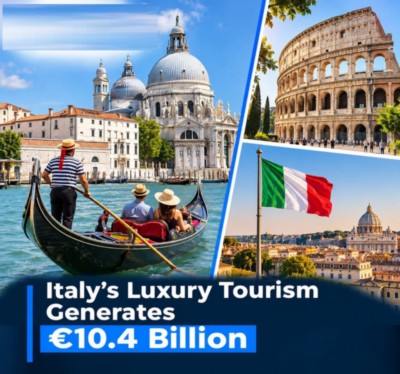
The expansion has also translated into significant financial gains for the hospitality industry. Five-star and luxury hotels generated an estimated €10.4 billion in revenue in 2025, accounting for more than 17 per cent of the country’s total hotel turnover.
According to the study, every overnight stay in a luxury hotel generates an average of €702, more than three times the revenue produced by an average hotel overnight stay.
The figures demonstrate the economic importance of attracting visitors willing to spend more on premium accommodation, exclusive services, fine dining and high-quality tourism experiences.
Foreign tourists are playing a particularly important role in the expansion of Italy’s high-end hospitality sector.
International visitors accounted for 77.7 per cent of overnight stays in the country’s five-star hotels, with their share increasing by 7.5 per cent year-on-year.
The growing presence of overseas travellers reflects Italy’s enduring international appeal as a destination combining cultural heritage, historic architecture, world-renowned cuisine, fashion, shopping and luxury accommodation.
While domestic tourism remains an important component of the country’s visitor economy, the luxury segment is increasingly dependent on international markets, whose travellers contribute significantly to hotel revenues.
The concentration of foreign guests also highlights the importance of strengthening international connectivity, improving tourism services and developing targeted promotional strategies to attract high-spending visitors from major source markets.
Despite the nationwide expansion of luxury hospitality, the economic benefits are distributed unevenly across Italy.
According to Demoskopika, the country’s premium accommodation market remains heavily concentrated in a relatively small number of major tourist destinations.
Rome alone accounts for almost 20 per cent of overnight stays in high-end hotels, while Bolzano, Venice, Florence and Milan are among the other leading destinations.
Together, these five major destinations account for 53.4 per cent of luxury overnight stays, demonstrating the dominance of Italy’s established tourism centres.
The concentration becomes even more pronounced when other leading destinations are included. A total of 17 major tourism hubs account for 79.2 per cent of overnight stays in luxury accommodation across the country.
At the regional level, Lazio, Trentino-Alto Adige, Campania, Valle d’Aosta and Sardinia are among the leading areas for premium tourism.
However, the sector’s geographical concentration also reveals considerable room for development. The study identifies 25 Italian provinces that do not have a single five-star hotel, indicating that several parts of the country have yet to benefit fully from the expansion of high-end tourism.
The growing popularity of premium travel is also encouraging investment in new accommodation facilities.
Italy added 38 luxury hotels in 2025 compared with the previous year, bringing the total number of five-star establishments to 809.
The expansion reflects increasing confidence in the country’s high-end hospitality market, with investors seeking to capitalise on international demand for exclusive travel experiences.
Despite concerns over overtourism in popular destinations such as Venice, Demoskopika believes Italy still has considerable potential to expand its tourism revenues, particularly by attracting more visitors to premium accommodation and distributing tourist flows more evenly across the country.
The study places Italy among Europe’s leading tourism destinations. According to Eurostat figures cited in the research, Italy recorded approximately 535 million overnight stays, followed by Spain with 513 million, France with 472 million and Germany with 440 million.
Together, these four countries account for around 60 per cent of all overnight stays across the European Union.
However, Italy’s tourism intensity remains below that of some of its major European competitors. The country records 9.1 visitor nights per inhabitant, compared with 10.4 in Spain.
This suggests that Italy still has opportunities to increase tourism activity, provided it can attract additional visitors while managing pressure on popular destinations and improving the distribution of tourism across different regions.
Demoskopika identifies Germany, the United States and the United Kingdom among the leading source markets in terms of tourism spending, highlighting their importance for Italy’s future luxury tourism strategy.
Attracting more visitors from these markets, particularly those interested in premium accommodation and high-value experiences, could generate additional revenues for the Italian hospitality industry.
However, the challenge is not simply to increase visitor numbers. Italy also needs to encourage longer stays, higher spending and travel beyond the traditional peak season.
The study therefore points to the importance of developing tourism products that appeal to affluent international visitors throughout the year, rather than concentrating activity in the busiest summer months.
One of the major opportunities identified in the study is extending Italy’s tourism season, particularly in the southern regions.
Although southern Italy offers considerable cultural, historical and natural attractions, luxury hotel occupancy in some areas can remain below the national average of 37.1 per cent.
Demoskopika suggests that encouraging visitors to travel outside the traditional high season could help address capacity imbalances, improve hotel occupancy and generate more consistent revenues for tourism businesses.
Achieving this, however, requires more than promotional campaigns.
Tourists need reliable transport connections, quality accommodation, accessible services and a year-round calendar of cultural and recreational activities.
Discussions at the Global Tourism Forum have similarly highlighted the importance of creating the infrastructure and visitor experiences necessary to attract international travellers beyond the conventional holiday season.
For southern Italy, this could mean greater investment in transport links, cultural events, heritage tourism, gastronomy, wellness facilities and other attractions capable of drawing visitors throughout the year.
The findings suggest that Italy’s luxury tourism success story is entering a new phase. While its historic cities and internationally recognised destinations continue to attract millions of visitors, the next opportunity lies in expanding premium hospitality beyond established tourism centres and making the country’s diverse regions more accessible.
With five-star hotel stays having more than doubled since 2008 and luxury accommodation generating billions of euros annually, Italy’s high-end tourism industry has demonstrated its considerable economic potential.
The challenge ahead will be to sustain that growth while addressing geographical imbalances, extending the tourism season and ensuring that the benefits of international travel reach a wider range of destinations.
For Italy, the future of luxury tourism may depend not only on attracting more affluent visitors but also on persuading them to discover the country’s lesser-known regions, remain longer and experience its cultural and natural attractions throughout the year.