

From New York to Islamabad: Ambassador Asim Iftikhar Ahmad’s UN tenure and the diplomacy ahead
Celina Ali
Islamabad: Ambassador Asim Iftikhar Ahmad left New York this week with a record shaped by war, confrontation and some of the most difficult diplomatic challenges facing the international system, returning to Islamabad to take charge as Pakistan’s new foreign secretary.
His departure marked the end of a two-year assignment as Pakistan’s permanent representative to the United Nations, a posting that placed him at the centre of Pakistan’s diplomacy during a particularly turbulent period.

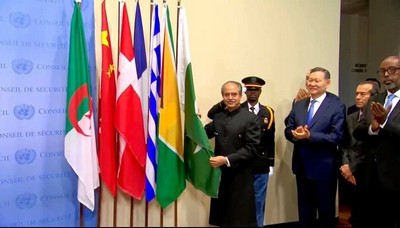
Ambassador Ahmad arrived in New York in October 2024, just as Pakistan was preparing to begin its latest two-year elected term on the UN Security Council. It was his third assignment at the United Nations and, significantly, his third consecutive stint as part of Pakistan’s Security Council teams, following earlier assignments during Pakistan’s terms in 2003-04 and 2012-13.
That experience gave Ambassador Ahmad an unusually long institutional memory of the council and its workings.
His latest tenure, however, was unlike his previous assignments. It unfolded against a succession of crises that tested both Pakistan’s diplomacy and the capacity of the international system to respond to conflict.
The most consequential challenge came in May 2025, when Pakistan and India fought a four-day military confrontation that brought the two nuclear-armed neighbours dangerously close to a broader conflict.
For Ambassador Ahmad, the crisis became a defining moment of his tenure.
As the confrontation unfolded, the UN repeatedly urged Pakistan and India to step back from the brink and offered its good offices to support de-escalation.
Ambassador Ahmad was responsible for keeping Security Council members and other UN delegations informed of Pakistan’s position and its assessment of the dangers posed by further escalation.
Pakistan and India agreed to a ceasefire on May 10, ending the immediate military confrontation.
But the episode left a lasting imprint on Pakistan’s approach to the Security Council. Ahmad subsequently presented the experience as a powerful argument for strengthening the international system’s mechanisms for preventing and peacefully resolving conflicts.
He also pointed to the fact that Pakistan was itself a member of the Security Council when the confrontation occurred, giving Islamabad an opportunity to take its case directly to the international body responsible for maintaining international peace and security.
In discussing the crisis, Ambassador Ahmad referred to what he described as Pakistan having inflicted a “crushing defeat” on Indian aggression in May 2025. That description reflected the Pakistani government’s position on the conflict.
More importantly for his diplomatic record, he highlighted what followed the confrontation: Pakistan’s effort to place greater emphasis within the Security Council on peaceful dispute settlement.
The clearest expression of that effort came in July 2025, when the Security Council unanimously adopted Resolution 2788 during Pakistan’s presidency of the council.
Sponsored by Pakistan, the resolution called for greater use of mechanisms available under the UN Charter for the peaceful settlement of disputes.
Ambassador Ahmad has described the resolution as one of the significant outcomes of Pakistan’s Security Council tenure.
He argued that its subsequent wide use and references demonstrated that it had acquired continuing relevance within the council’s work, describing it as the most widely referred-to Security Council decision since its adoption.
The unanimous vote was also noteworthy because it came at a time when the council was increasingly divided over major international crises.
For Ambassador Ahmad, the resolution offered a demonstration of what Pakistan could achieve through coalition-building and consensus-building, even in a highly polarised international environment.
It also reflected a theme that ran through his assessment of Pakistan’s Security Council role: that middle powers can still play an influential diplomatic role when they are able to build agreement around broadly accepted principles.
Ambassador Ahmad’s new assignment as foreign secretary gives his UN experience a new significance.
He is returning to Islamabad after spending two years dealing directly with the permanent members of the Security Council, navigating competing geopolitical interests and representing Pakistan during a period of serious regional instability.
His familiarity with the council is particularly notable because Pakistan’s foreign policy continues to be shaped by issues that frequently reach the UN, including relations with India, regional security, terrorism, Afghanistan and developments in the Middle East.
His three successive periods working with Pakistan’s Security Council teams have also given him a perspective few Pakistani diplomats possess.
He has seen the council evolve through different geopolitical periods, while gaining experience in negotiating resolutions, building alliances and managing disagreements among major powers.
That institutional experience is now likely to become an important asset in his new position.
Ambassador Ahmad leaves New York at a time when confidence in the international system is under considerable strain.
The war in Gaza, the conflict involving Israel and Iran, continuing regional instability and intensifying rivalry among major powers have exposed deep divisions within the international system.
Ambassador Ahmad’s tenure was also marked by the continuing crisis in Gaza and the wider instability in the Middle East.
The international response to the Gaza war became one of the most divisive issues confronting the United Nations, exposing sharp differences among major powers and repeatedly testing the Security Council’s ability to act collectively.
The subsequent war between Israel and Iran added another major crisis to an already unstable international environment.
Now, the diplomat who spent the past two years operating in the corridors of the United Nations is returning to Islamabad to assume responsibility for Pakistan’s foreign policy machinery.
The transition gives his New York tenure a practical significance beyond the diplomatic record he leaves behind.
As foreign secretary, Ambassador Ahmad will have to translate international experience into policy at home, while managing a foreign policy environment that remains exceptionally demanding.
Relations with India will remain a major challenge following the May 2025 confrontation. Afghanistan and counter-terrorism will continue to require sustained attention, while developments in the Middle East will carry implications for Pakistan’s diplomacy and wider regional interests.
At the same time, Islamabad will have to navigate increasingly complex relations among the major powers and protect Pakistan’s interests in a world where traditional diplomatic alignments are being tested.
Ambassador Ahmad’s experience at the UN has given him a front-row view of those changes.
For Ambassador Ahmad, the move from New York to Islamabad represents more than a routine diplomatic posting.
His two years at the United Nations were defined by a nuclear confrontation in South Asia, wars in the Middle East, deepening divisions among major powers and renewed arguments over the future of multilateral institutions.
He leaves the UN having represented Pakistan through some of the most difficult diplomatic moments of recent years and having helped steer the country’s Security Council diplomacy during its eighth elected term.
His advocacy of peaceful dispute settlement, his experience during the May 2025 Pakistan-India crisis and his sustained engagement with the Security Council will form an important part of the diplomatic experience he now brings to the Foreign Office.
As Pakistan’s new foreign secretary, Ambassador Asim Iftikhar Ahmad will no longer be speaking for Pakistan from the UN podium. He will be helping shape the policy behind that voice.