
Pakistan, Italy move to deepen defence and security cooperation
Celina Ali
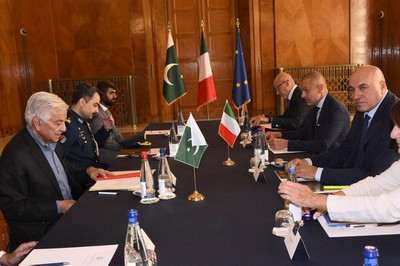
Islamabad: Pakistan and Italy moved to strengthen their defence and security relationship as Defence Minister Khawaja Muhammad Asif held bilateral talks with his Italian counterpart, Guido Crosetto, during an official visit to Rome this week.
The meeting brought the two defence ministers together for wide-ranging discussions on military and defence cooperation, regional security, international crises and opportunities to broaden engagement between the two countries.
Held at the historic Palazzo Aeronautica, the headquarters of the Italian Air Force, the meeting began with a formal reception for Khawaja Asif by Crosetto. An Italian Armed Forces contingent presented a guard of honour, while military bands played the national anthems of Pakistan and Italy.
The two ministers also visited the Air Force Museum at the venue, adding a ceremonial and institutional dimension to the bilateral engagement.
The talks centred on the existing defence and security relationship between Pakistan and Italy, with both sides expressing an interest in deepening and diversifying cooperation.
Particular attention was given to expanding military exchanges and maintaining close communication on matters affecting regional peace and security.
The ministers also discussed the role of the two countries in supporting United Nations peacekeeping missions and cooperation in countering terrorism.
The discussions extended beyond bilateral defence relations to some of the most pressing security challenges facing the international community.
The two sides exchanged views on major international crisis scenarios, with particular focus on developments in the Middle East and the wider implications for regional stability.
The security of maritime routes was another important element of the discussions, particularly the need to maintain safe navigation through the Strait of Hormuz, one of the world’s most strategically important waterways.
Crosetto stressed the importance of dialogue and continued diplomatic efforts to address outstanding disputes and contribute to long-term stability.
The discussions reflected the increasingly interconnected nature of security challenges, with developments in the Middle East carrying consequences well beyond the immediate region, including for international trade, energy supplies and maritime transportation.
As the two sides looked towards future cooperation, Khawaja Asif invited Crosetto to visit Pakistan for bilateral consultations.
The Italian defence minister accepted the invitation, opening the way for further high-level discussions in Pakistan and providing an opportunity to build on the understanding reached during the Rome meeting.
The two ministers were already familiar with each other, having met earlier in 2026 on the sidelines of the Munich Security Conference in February.
The latest meeting therefore provided an opportunity to continue their dialogue and develop the defence relationship between Islamabad and Rome.
Khawaja Asif’s visit also included a broader programme of engagements arranged by the Embassy of Pakistan in Rome.
The defence minister gave interviews to Italian broadcaster TG1 and the Italian newspaper Corriere della Sera, before taking part in an extended question-and-answer session with representatives of Italian, international and Pakistani media.
The embassy-hosted interaction brought together journalists from a wide range of organisations, including Italy’s Rai network, the Associated Press, Al Jazeera, the Rome Press Club, ANSA and Adnkronos, alongside representatives of Pakistani ethnic media and other print, electronic and online outlets.
The event also attracted representatives of Italian think tanks and academic institutions.
Among those participating were representatives of the Italian Institute for Asia and the Center for International Studies, as well as students and graduates associated with LUISS and La Sapienza universities.
The wide-ranging participation gave the minister an opportunity to outline Pakistan’s perspective on a number of sensitive regional and bilateral issues while engaging directly with journalists, researchers and students.
During the media and academic engagements, Khawaja Asif presented Pakistan’s positions on diplomacy and dialogue, the Indus Waters Treaty, cross-border terrorism and the military confrontation between Pakistan and India in May 2025.
The minister’s remarks on these issues reflected the position of the Pakistani government, particularly on matters involving relations with India and the interpretation of regional security developments.
The discussions provided an opportunity for the Pakistani side to communicate its position directly to an Italian and international audience at a time when questions of regional stability, terrorism and relations between the two South Asian neighbours continue to attract international attention.
The Indus Waters Treaty, in particular, remains a significant issue in Pakistan-India relations, given the importance of the shared river system to agriculture, water security and economic activity in both countries.
Pakistan’s Ambassador to Italy Ali Javed, Defence Attaché Air Commodore Imtiaz Rahim Shahzada and other embassy officials participated in the minister’s engagements throughout the visit.
Their involvement reflected the close coordination between Pakistan’s diplomatic and defence representatives in Italy, particularly in promoting bilateral cooperation and maintaining contacts with Italian political, military, media and academic circles.
The visit concluded with Khawaja Asif recording his impressions in the visitors’ book at the Pakistani Embassy in Rome.
He also thanked the embassy staff for their role in facilitating the visit and its extensive programme of official, diplomatic, media and academic engagements.
The Rome talks demonstrated that Pakistan and Italy are seeking to give greater depth to their defence relationship at a time of heightened international and regional security concerns.
While military cooperation remains at the heart of the relationship, the discussions showed that the two countries are increasingly connecting defence cooperation with wider questions of counter-terrorism, peacekeeping, maritime security, regional stability and international diplomacy.
The planned visit of the Italian defence minister to Pakistan could provide the next opportunity to translate those discussions into more concrete areas of cooperation.
For Islamabad, closer engagement with Italy also offers a channel into broader European discussions on security and regional stability. For Rome, maintaining dialogue with Pakistan provides an important connection with a strategically significant country at the intersection of South Asia, the Middle East and Central Asia.
The latest meeting in Rome thus represented not only another step in bilateral defence relations but also part of a broader effort by the two countries to maintain dialogue in an increasingly complex international security environment.