
Celina Ali
Islamabad: Pakistan has unveiled an ambitious national policy to transform its growing olive sector into a major agro-industrial engine, with Italy emerging as a key partner in the country’s efforts to reduce a multibillion-dollar edible-oil import bill and build domestic capacity in cultivation, processing and value addition.
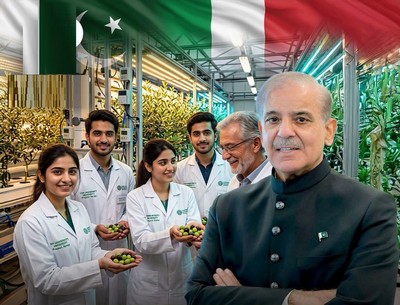
Prime Minister Shehbaz Sharif launched the Pakistan National Olive Value Chain Policy this week, describing the development of Pakistan’s olive industry as an important opportunity to strengthen the country’s agricultural economy, create employment and gradually reduce its dependence on imported edible oil.
The initiative also highlighted the depth of Pakistan-Italy cooperation in agriculture, skills development and technology transfer, with Italian expertise playing an increasingly important role in efforts to develop the country’s olive value chain.
Addressing the launching ceremony, Prime Minister Shehbaz said Pakistan currently spends around $4 billion annually on edible-oil imports, placing a substantial burden on the country’s foreign-exchange resources.
Even a relatively modest increase in domestic production, he said, could generate significant economic benefits. Saving around $400 million in a single year through increased local production would represent a major achievement and demonstrate the potential of the sector.
The prime minister expressed confidence that Pakistan could move towards self-sufficiency in edible oil within the next few years if olive cultivation, processing and related industries were developed on a sufficiently large scale.
He particularly acknowledged Italy’s contribution to Pakistan’s olive sector, saying the country had benefited from Italian cooperation and expertise in developing olive cultivation and associated technical capabilities.
The government, he said, was now prepared to take the partnership a step further by sending 100 young agricultural graduates to Italy at state expense.
The graduates would receive specialised exposure to olive cultivation, production, processing and marketing, enabling them to bring modern techniques and international best practices back to Pakistan.
The initiative is significant because Pakistan’s olive challenge is no longer simply about increasing the number of trees. The government is increasingly focusing on developing an integrated value chain that links nurseries and orchards with harvesting, oil extraction, quality control, packaging, branding and domestic and international marketing.
The prime minister emphasised that Pakistan must move beyond simply expanding cultivation and place greater attention on oil production, processing and value addition.
Such an approach could allow farmers to capture a greater share of the final value of olive products while helping create new opportunities for rural businesses, food-processing enterprises and skilled workers.
Italy’s involvement gives the initiative an important international dimension.
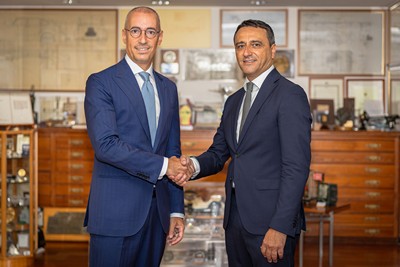
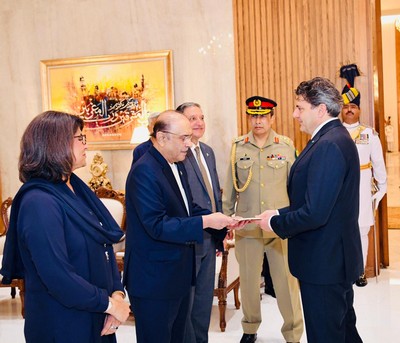
Speaking at the ceremony, Italian Ambassador to Pakistan Ugo Ciarlatani said the two countries had maintained a partnership for more than seven decades, with bilateral cooperation expanding beyond traditional areas into agriculture, science, education, trade and security.
He described the new olive policy as the product of years of cooperation between Pakistan and Italy and pointed to several Italian-supported initiatives that have helped lay the foundations for the emerging olive industry.
Among them is the $100 million Pakistan-Italy Debt Swap Programme, under which resources were channelled into development initiatives, including the establishment of olive orchards in different parts of Pakistan.
The programme has contributed to expanding the country’s olive plantation base and provided a foundation upon which the new national value-chain strategy can be built.
According to the Italian ambassador, Pakistan now has more than seven million olive plants, illustrating the rapid expansion of the crop and the growing importance attached to olives as an alternative source of edible oil.
Italy’s contribution, however, has extended beyond plantation development.
Through its Olive Culture Project, Italy has supported laboratories, nurseries and business groups while providing training to more than 700 stakeholders associated with the sector.
The emphasis on laboratories and technical training is particularly important for an industry seeking to move from small-scale cultivation towards commercial production. Quality testing, improved planting material, modern harvesting techniques and efficient processing are essential if Pakistani olive oil is to compete in domestic and international markets.
The Italian partnership is also being linked to Pakistan’s broader efforts to strengthen technical and vocational education.
Ciarlatani said Italy was supporting Pakistan’s skills-development agenda through a €20 million capacity-building programme focused on high-value agriculture, including olive cultivation.
The programme reflects a wider shift in development cooperation from infrastructure and financial assistance towards technical expertise, skills and human-resource development.
For Pakistan, this could prove particularly valuable because the long-term success of the olive industry will depend not only on the number of trees planted but also on the availability of farmers, technicians, agronomists, processors and entrepreneurs capable of operating a modern value chain.
The government’s decision to send young agricultural graduates to Italy is therefore being positioned as an investment in human capital as much as in agriculture.
Exposure to Italy’s established olive industry could help Pakistani professionals understand the complete production cycle, from orchard management and harvesting to extraction, packaging, marketing and export development.
The initiative comes as Pakistan confronts persistent pressure from its dependence on imported edible oil. A substantial portion of domestic consumption is met through imports, making the edible-oil sector vulnerable to international prices, foreign-exchange constraints and disruptions in global supply chains.
Developing olive production offers Pakistan an opportunity to diversify its sources of edible oil while simultaneously opening a new avenue for agricultural exports.
The potential benefits could extend well beyond the replacement of imported cooking oil. A mature olive industry can generate economic activity across nurseries, farming, machinery, irrigation, processing, packaging, logistics, marketing and tourism.
The government also sees the sector as a means of expanding economic opportunities in rural areas, particularly for young people and women.
The Italian ambassador expressed hope that the new policy would eventually transform Pakistan’s olive sector into a dynamic agro-industry capable of generating benefits for farmers, women and youth.
Such an outcome would also give a new economic dimension to the longstanding Pakistan-Italy relationship.
The partnership demonstrates how agricultural cooperation can evolve from individual development projects into a broader strategy involving technology transfer, professional training, investment and market development.
For Italy, Pakistan’s emerging olive industry also offers an opportunity to share expertise from one of the world’s established olive-producing economies. For Pakistan, Italian experience could help accelerate the transition from scattered orchards and experimental cultivation towards a commercially viable national industry.
The government’s immediate challenge, however, will be to convert the policy into measurable production gains. Expanding plantations must be matched by reliable irrigation, quality planting material, modern harvesting systems, processing facilities, farmer training, access to finance and effective marketing networks.
If these elements develop together, Pakistan could gradually reduce its dependence on imported edible oil while creating a new agricultural export sector.
The launch of the National Olive Value Chain Policy therefore represents more than an agricultural initiative. It signals an attempt to use international cooperation — particularly Pakistan’s longstanding partnership with Italy — to build domestic expertise, strengthen rural economies and turn an expanding crop base into a commercially sustainable industry.
For Italy-Pakistan relations, the olive initiative could become one of the most visible examples of how decades of development cooperation can evolve into a partnership focused on skills, technology, value addition and economic self-reliance.