
Celina Ali
Islamabad: Pakistan expects Washington to respond within the next couple of months to its request for a proposed $10 billion bilateral exchange stabilisation facility, as Islamabad seeks to deepen its economic and diplomatic engagement with the United States and strengthen confidence in its external financial position.
The proposed arrangement, which Pakistan has described as a stabilisation mechanism rather than a conventional loan or credit line, is currently under consideration by the US Treasury. Pakistani officials have indicated that discussions with Washington have been constructive and that a response could emerge as early as September.
Adviser to the Finance Minister Khurram Schehzad said the talks with the US had been “constructive”, stressing that the proposed facility could play an important role in strengthening market confidence and improving Pakistan’s ability to access international capital.
According to Schehzad, the facility would potentially act as a financial backstop while sending a positive signal to international investors about the stability of Pakistan’s currency and external accounts. Such a signal, he said, could help Pakistan regain stronger access to international markets and attract additional private investment.
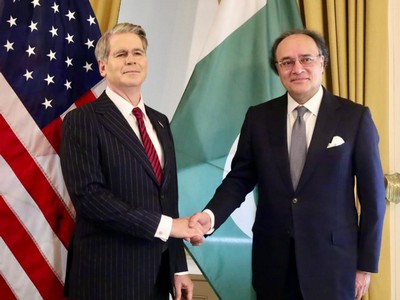
The proposal was formally taken up with US Treasury Secretary Scott Bessent during Pakistan’s recent economic engagement with Washington. Islamabad is seeking a Bilateral Exchange Stabilisation Support Facility of up to $10 billion, with a maturity period of as long as five years.
Finance Minister Muhammad Aurangzeb subsequently confirmed that Pakistan had made the request, while emphasising that the proposed arrangement should not be interpreted as another conventional borrowing facility.
“This is not about a credit line or a loan,” Aurangzeb said, explaining that the principal objective was to provide greater confidence in the stability of Pakistan’s currency and foreign-exchange market.
The finance minister said stronger confidence in exchange-rate stability would, in turn, improve Pakistan’s ability to approach international debt markets and raise financing on more favourable terms.
For Islamabad, the proposed US facility comes at a critical juncture. Pakistan has made progress in stabilising several areas of its economy after years of severe external financing pressures, but its foreign-exchange reserves, debt obligations and need for continued external financing remain significant challenges.
If approved, the US-backed mechanism could provide an additional layer of confidence for Pakistan’s reserves and currency market. It could also reduce some of the pressure on the country to rely exclusively on multilateral and bilateral financing arrangements at a time when the government is attempting to restore macroeconomic stability.
The proposal also comes against the backdrop of Pakistan’s continuing engagement with the International Monetary Fund. Islamabad remains committed to a $7 billion IMF programme that requires a range of politically difficult measures, including higher tax collection, spending restraint, structural reforms and tighter fiscal management.
The government hopes that a stronger external position, combined with improved investor confidence, will allow Pakistan to gradually move away from repeated cycles of balance-of-payments pressure and emergency financing.
The proposed US facility is also being viewed through the wider lens of a renewed improvement in Pakistan-US relations. Islamabad’s recent diplomatic engagement with Washington has increased expectations that closer political ties could eventually translate into greater economic cooperation.
Pakistan’s diplomatic role in efforts surrounding the Iran conflict has further raised its profile in Washington and other international capitals. The development has fuelled speculation that Islamabad could leverage its enhanced diplomatic relevance to secure greater economic and strategic support from international partners.
However, any US stabilisation arrangement would come with expectations that Pakistan would continue pursuing economic reforms and maintaining policy discipline.
The proposal is particularly significant because of its potential psychological impact on international markets. Unlike a conventional loan that would simply add to Pakistan’s external liabilities, the facility is being presented primarily as a confidence-building instrument designed to reassure investors and creditors about the country’s ability to maintain currency and external-sector stability.
Such a mechanism could become particularly valuable when Pakistan seeks to raise funds through international capital markets. A credible US financial backstop could lower perceived risks and potentially improve investor appetite for Pakistani debt.
The proposal nevertheless remains subject to Washington’s consideration, and Pakistani officials have stopped short of presenting approval as a certainty. The coming weeks are therefore expected to be important for determining whether the request progresses into a formal financial arrangement.
Meanwhile, Pakistan continues to face concerns over governance and institutional effectiveness despite signs of improvement in its macroeconomic outlook.
Moody’s recently upgraded Pakistan’s sovereign rating from Caa1 to B3, reflecting an improvement in its assessment of the country’s credit profile. The upgrade remains within the highly speculative category, however, indicating that Pakistan continues to face substantial credit risks.
The rating agency has also highlighted persistent weaknesses in areas including the rule of law, control of corruption and government effectiveness. These structural concerns remain important considerations for international investors assessing Pakistan’s longer-term economic prospects.
For Islamabad, securing the proposed US facility would therefore represent more than an injection of financial support. It would be an attempt to strengthen the credibility of Pakistan’s economic stabilisation programme, reassure international markets and demonstrate that the country is building a more sustainable external financing position.
A favourable response from Washington could consequently provide Pakistan with both financial breathing space and a potentially valuable vote of confidence at a time when the government is seeking to consolidate recent economic gains and move towards greater reliance on market-based financing and private investment.