
Abida Shaheen
Islamabad: Japan’s evolving diplomatic strategy and its growing role in shaping the Indo-Pacific order came under discussion this week at Quaid-i-Azam University (QAU), where a leading Japanese scholar highlighted Tokyo’s efforts to adapt its foreign policy to the changing regional and global environment.
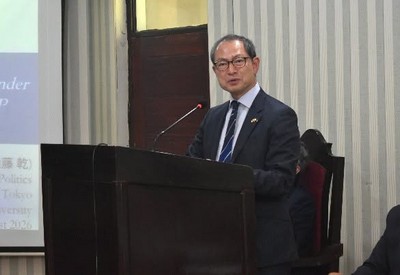
Professor Endo Ken, Chair and Professor of International Politics at the Faculty of Law, University of Tokyo, delivered a lecture on Monday at QAU focusing on Japan’s evolving Free and Open Indo-Pacific (FOIP) vision and the broader significance of middle-power diplomacy in the region.
The lecture, titled “Japan’s FOIP 3.0 and the Future of Middle-Power Diplomacy in the Indo-Pacific,” was organised at the SPIR Seminar Hall and was attended by senior university officials, faculty members and students, providing a platform for discussion on contemporary international and regional affairs.
QAU Vice-Chancellor Dr Zafar Nawaz Jaspal and Dr Muhammad Nadeem Mirza, Director of the School of Politics and International Relations (SPIR), attended the seminar and delivered welcoming remarks.
Japanese Ambassador to Pakistan Akamatsu Shuichi was also present at the event and delivered the opening address. He underscored the importance of academic engagement and intellectual exchanges in developing a deeper understanding of the political and strategic changes taking place across the Indo-Pacific.
In his lecture, Professor Endo examined the evolution of Japan’s foreign-policy thinking and its efforts to redefine its diplomatic role amid profound changes in the regional balance of power.
He discussed Japan’s approach to the Indo-Pacific through the development of the FOIP concept, which has increasingly become an important element of Tokyo’s diplomatic and strategic outlook.
The discussion also focused on the role of middle powers in addressing emerging regional challenges. Japan, as one of the region’s major advanced economies but not a traditional military superpower, has increasingly sought to work through diplomacy, economic partnerships, institutional cooperation and strategic engagement with like-minded countries.
Professor Endo’s presentation provided participants with an overview of how Japan’s Indo-Pacific policy has evolved and how Tokyo is seeking to respond to emerging geopolitical, economic and security challenges.
The FOIP framework has become an important pillar of Japan’s international engagement, reflecting Tokyo’s emphasis on a regional order based on openness, stability, connectivity and respect for international rules.
The concept has also provided Japan with a platform to deepen relations with countries across the Indo-Pacific while promoting cooperation on a wide range of political, economic and strategic issues.
The QAU seminar provided an opportunity for Pakistani academics and students to examine these developments from a Japanese perspective and consider their implications for countries such as Pakistan, which occupies an important geographical position connecting South Asia with the wider Asian region.
The participation of the Japanese ambassador and a senior University of Tokyo scholar also highlighted the growing importance of educational and intellectual exchanges between Pakistan and Japan.
The event reflected QAU’s continuing efforts to promote academic discussion on international politics and provide students and researchers with direct access to scholars and policymakers engaged with major global and regional issues.
The discussion on Japan’s FOIP strategy comes at a time when the Indo-Pacific has emerged as one of the world’s most consequential geopolitical regions, with developments in security, trade, technology, connectivity and maritime affairs increasingly shaping international relations.
Against this backdrop, Japan’s evolving approach is expected to remain an important subject of academic and policy debate as Tokyo seeks to balance its national interests with its broader vision for a stable, open and rules-based Indo-Pacific.