
Abdullah Jan
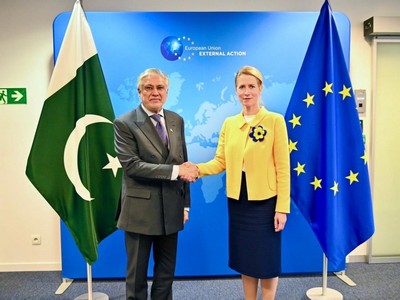
Islamabad: Pakistan is intensifying efforts to strengthen its economic and trade relationship with the European Union, with Islamabad placing renewed emphasis on preserving preferential market access, improving export performance and ensuring effective implementation of commitments under the EU’s GSP+ framework.
The issue came under detailed review at a meeting this week chaired by Deputy Prime Minister and Foreign Minister Ishaq Dar, as the government seeks to extract greater economic value from Pakistan’s longstanding trade relationship with the European bloc.
The meeting brought together senior officials responsible for foreign affairs, commerce, interior and economic coordination, reflecting the government’s recognition that Pakistan’s access to the European market requires coordinated action across several areas of policymaking.
Ishaq Dar stressed the need for effective follow-up on commitments and conventions linked to the GSP+ arrangement, calling for timely implementation of agreed measures and stronger coordination among relevant institutions.
The deputy prime minister directed the authorities concerned to prioritise initiatives aimed at increasing Pakistan’s exports and strengthening its overall trade performance, while ensuring that commitments made under the preferential trading arrangement are properly followed through.
For Pakistan, the EU market represents one of the most important destinations for exports, making the continuity and effective utilisation of preferential access a significant economic priority.
The GSP+ framework has provided Pakistani exporters with preferential access to the European market and has been particularly important for sectors such as textiles and garments, alongside a range of other manufactured and agricultural products.
As Pakistan confronts persistent pressure on its external account and seeks to increase foreign-exchange earnings through exports, maintaining and expanding its presence in the European market has assumed greater importance.
The government’s latest push comes ahead of the implementation of an updated GSP framework, which is scheduled to take effect from January 1, 2027.
The transition gives Islamabad a relatively narrow window to ensure that all relevant commitments are being addressed and that government institutions, exporters and other stakeholders are prepared for the requirements of the new framework.
The emphasis on follow-up reflects the fact that preferential market access is not simply a trade concession but is linked to a broader set of commitments and standards.
Pakistan’s ability to maximise the commercial benefits of the arrangement will consequently depend on effective coordination between government departments, diplomatic missions, regulators and the private sector.
The meeting was attended by the Minister for Commerce, Special Assistant to the Prime Minister Tariq Bajwa, Foreign Secretary Amna Baloch, federal secretaries for Commerce and Interior, Pakistan’s ambassador to Brussels, Capital Development Authority Chairman and senior officials from federal and provincial institutions.
The participation of such a broad range of officials underscored the government’s intention to approach the EU relationship as a comprehensive economic and diplomatic priority rather than a matter confined to the commerce ministry.
For Islamabad, the challenge is increasingly twofold: preserving preferential access while simultaneously improving the competitiveness and diversification of Pakistani exports.
Greater access to the European market alone cannot guarantee higher exports unless Pakistani producers are able to meet European standards, maintain consistent quality, improve productivity and develop products capable of competing in a highly sophisticated market.
The government is therefore seeking stronger coordination to identify opportunities for expanding exports and addressing bottlenecks that limit Pakistan’s ability to take full advantage of its existing market access.
The EU’s revised framework is also significant because it introduces an automatic safeguard mechanism for rice imports, designed to protect European producers from potential market disruption.
The provision could have particular relevance for Pakistan, which is an important rice-producing and exporting country and has sought to expand its agricultural exports to international markets.
The safeguard mechanism adds another dimension to Pakistan’s preparations for the new framework, requiring exporters and policymakers to closely monitor developments in the European rice market and understand how the new provisions could affect future shipments.
The broader EU-Pakistan trade relationship has considerable potential beyond traditional export categories. Islamabad is increasingly interested in moving towards greater value addition, diversifying its export base and developing products capable of generating higher foreign-exchange earnings.
For Pakistani policymakers, Europe offers not only a major consumer market but also access to advanced production standards, technology, investment and supply chains.
Closer economic engagement with the EU could therefore support Pakistan’s wider objective of shifting from an import-dependent economy towards one driven more strongly by exports and productive investment.
The government’s renewed focus also comes at a time when Pakistan is attempting to strengthen its macroeconomic position and reduce vulnerability to recurring external financing pressures.
Higher and more diversified exports would provide a more sustainable source of foreign exchange, reducing the economy’s dependence on borrowing and remittances to meet external financing requirements.
Against this backdrop, the effective implementation of GSP+ commitments is being treated as an economic imperative.
The coming months are expected to be particularly important as Pakistan prepares for the January 2027 transition. Islamabad will need to ensure that relevant institutions remain aligned, exporters understand the implications of the revised framework and diplomatic engagement with European partners remains active.
The government’s approach suggests that Pakistan wants to move beyond simply retaining preferential access and instead use the relationship to secure a stronger foothold in the European market.
If supported by improvements in domestic competitiveness, compliance, product quality and export diversification, closer engagement with the EU could provide Pakistan with an important avenue for expanding foreign-exchange earnings and strengthening its long-term economic resilience.
The latest high-level meeting therefore signals a renewed effort by Islamabad to place the EU at the centre of its trade diplomacy — combining diplomatic engagement with domestic reforms in an attempt to turn preferential access into sustained export growth.