
Celina Ali
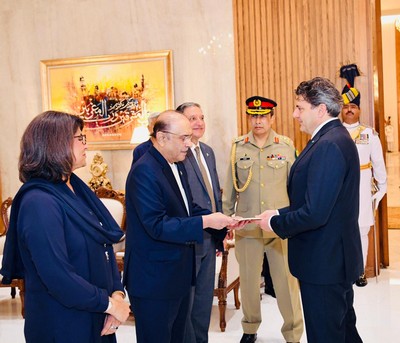
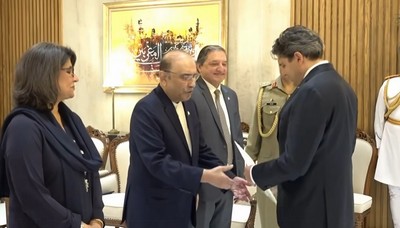
Islamabad: President Asif Ali Zardari this week received the credentials of Italy’s Ambassador-designate Ugo Ciarlatani at Aiwan-e-Sadr, calling for further expansion of Pakistan-Italy relations with particular emphasis on trade, investment, diplomatic cooperation and stronger people-to-people links.
Welcoming the Italian envoy, President Zardari expressed confidence that Ciarlatani’s tenure would contribute to consolidating the longstanding friendship between Islamabad and Rome and opening new avenues of cooperation.
The meeting came at a time when Pakistan and Italy are seeking to build greater economic substance into their bilateral relationship. While the two countries have maintained cordial diplomatic relations for decades, trade, investment, migration and the large Pakistani community in Italy have increasingly emerged as important pillars of the partnership.
President Zardari specifically highlighted the steady growth in bilateral economic ties, noting that trade between Pakistan and Italy had crossed the $1 billion mark. He stressed the importance of maintaining this momentum and identifying additional opportunities for businesses and investors on both sides.
Official Pakistani figures show that the economic relationship has in fact developed considerably in recent years. Bilateral trade reached about $1.46 billion in fiscal year 2024-25, while Pakistan recorded a trade surplus of around $816 million. Pakistani exports to Italy stood at approximately $1.14 billion, making Italy one of Pakistan’s significant export destinations. Textiles remain a major component of Pakistani exports to the Italian market.
The figures underline the considerable potential for further economic engagement. Pakistan has sought greater access to European markets while Italian companies have continued to show interest in opportunities in Pakistan, particularly in sectors where Italian expertise, technology and investment can complement Pakistan’s industrial and development needs.
For Islamabad, Italy is also important within the broader European context. Italy is regarded by Pakistan as a key political and economic partner within the European Union, giving bilateral relations significance beyond the volume of direct trade.
The relationship between Pakistan and Italy is not confined to commerce. The two countries have maintained diplomatic relations for more than seven decades, with cooperation extending to political, economic, cultural, educational and international issues.
Bilateral consultations between the two countries have covered a broad range of areas, including trade and investment, development cooperation, culture, higher education and cooperation within the United Nations framework.
Pakistan also values Italy’s role in European institutions and international diplomacy. During his meeting with Ambassador Ciarlatani, President Zardari specifically appreciated Rome’s support for Pakistan’s candidature for a non-permanent seat on the United Nations Security Council for the 2025-26 term.
The reference to Italy’s support at the UN underscores the political dimension of the relationship. For Pakistan, maintaining constructive relations with influential European countries remains important as Islamabad seeks greater diplomatic cooperation on multilateral issues.
President Zardari also welcomed the signing of an agreement between Pakistan and Italy abolishing visa requirements for holders of diplomatic passports.
The agreement was signed in Rome in June 2026 by Pakistan’s Ambassador to Italy Ali Javed and Italian Secretary General of Foreign Affairs Ambassador Riccardo Guariglia. It removes a procedural hurdle for official travel by diplomatic passport holders and is intended to facilitate exchanges between senior officials of the two countries.
Although the arrangement applies specifically to diplomatic passport holders and does not constitute a general visa-free travel agreement, it carries diplomatic significance. Easier official travel can facilitate consultations, government-to-government contacts and high-level visits, particularly as both countries seek to broaden their bilateral agenda.
The agreement also fits into a wider effort to strengthen institutional links between Islamabad and Rome.
Another major component of Pakistan-Italy relations is the large Pakistani community residing in Italy.
President Zardari highlighted the community’s role as a bridge between the two countries, recognising its contribution to strengthening people-to-people contacts and maintaining social and economic links between Pakistan and Italy.
Pakistan’s Foreign Ministry has described Italy as home to the country’s largest Pakistani diaspora in the European Union, with the community numbering around 300,000. The diaspora also makes a substantial contribution through remittances. Pakistani official figures show remittances from Italy reaching approximately $1.121 billion in 2024.
The community gives the bilateral relationship a distinctive human dimension. Pakistanis living and working in Italy maintain close links with their families and communities in Pakistan while contributing to Italy’s economy and society. Their presence has also created networks that facilitate business, cultural exchanges and educational links between the two countries.
For Islamabad, the diaspora is consequently more than a source of remittances. It is increasingly viewed as an important instrument of people-to-people diplomacy.
Despite the growth in bilateral trade, officials on both sides see considerable room for expansion.
Pakistan’s exports to Italy have traditionally been dominated by textiles and other manufactured goods, but Islamabad has increasingly sought to diversify its export base and encourage Italian investment in sectors with higher value addition.
Italian expertise could potentially contribute to Pakistan’s industrial development, machinery, engineering, renewable energy, agriculture, food processing, infrastructure, technology and other sectors.
The challenge, however, is to convert the existing goodwill into sustained investment and broader commercial partnerships. Trade figures show that a foundation already exists, but a deeper relationship would require stronger business-to-business contacts, improved market access, investment facilitation and greater awareness among companies on both sides.
The Pakistani government has therefore continued to emphasise trade and investment as central elements of its engagement with Italy.
For Ambassador Ciarlatani, the presentation of credentials marks the formal beginning of a new diplomatic assignment at a potentially important moment in Pakistan-Italy relations.
His tenure will come against the backdrop of growing bilateral trade, a sizeable Pakistani community in Italy, expanding official contacts and a recent agreement facilitating diplomatic travel.
President Zardari’s message was therefore broader than a routine welcome to a newly appointed envoy. By placing trade, investment, the diaspora, multilateral cooperation and diplomatic facilitation at the centre of the discussion, he effectively outlined the areas in which Pakistan wants the relationship to advance.
The emphasis on economics is particularly significant. With bilateral trade already above the billion-dollar threshold and Pakistan enjoying a sizeable export surplus, the next objective is likely to be qualitative as well as quantitative — attracting greater Italian investment, diversifying exports and building partnerships that can generate technology transfer and industrial cooperation.
At the same time, the strong human connection provided by the Pakistani community offers an additional foundation for the relationship.
As Islamabad and Rome look towards the next phase of their partnership, the task will be to translate longstanding political goodwill into a broader and more commercially ambitious relationship.
The credentials ceremony at Aiwan-e-Sadr thus provided an opportunity to reaffirm a relationship that has evolved well beyond traditional diplomacy. For Pakistan, Italy represents an important European partner, a major destination for Pakistani exports and home to a substantial Pakistani community. For Italy, Pakistan offers a large market, a strategic South Asian partner and growing opportunities for economic engagement.