
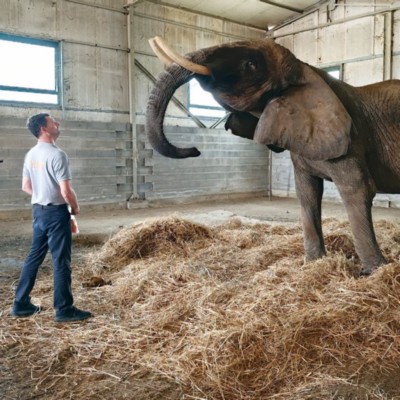
Julie’s journey to freedom: Portugal’s former circus elephant finds a new home in Europe’s pioneering sanctuary
After decades of captivity, Portugal’s last circus elephant is enjoying a remarkable new chapter of life in a vast natural sanctuary in the Alentejo region, where freedom, space and the ability to make her own choices have transformed her daily existence.
Nearly four months ago, Julie, Portugal’s last circus elephant, embarked on a journey that would fundamentally change her life. After spending decades in captivity, the elephant was transferred to a sprawling sanctuary in southern Portugal, where she is now discovering the joys of freedom, independence and a more natural existence.
Julie is the first resident of Pangea Sanctuary, a 400-hectare estate in the Alentejo region that represents one of Europe’s most ambitious initiatives dedicated to providing elephants with a more humane and natural environment. The sanctuary is designed to offer a permanent refuge to elephants rescued from circuses, zoos and other captive settings, giving them an opportunity to experience a life far removed from the restrictions of traditional captivity.
For Julie, the transition has been both gradual and remarkable.
When she first arrived, the elephant was understandably hesitant, unfamiliar with her surroundings and uncertain about the people responsible for her care. However, as days passed, her apprehension began to give way to curiosity and confidence, allowing her to gradually explore the vast landscape that is now her home.
“Julie, when she arrived, was shy. It is like anyone who comes to a new place, who does not know anyone and does not know the surroundings,” elephant keeper Johnny Nascimento recalls.
“Slowly, about a week later, she began to trust and to decide what she wanted to do outside. There are many trails, so she has been tidying up the house and, in this case, making it her own home.”
The transformation is evident in Julie’s behaviour. Rather than remaining confined to a limited space, she now has the freedom to roam across extensive grounds, explore different habitats and spend time wherever she feels comfortable.
One of her favourite activities is wallowing in muddy pools, an instinctive behaviour that elephants enjoy for cooling their bodies, protecting their skin and simply having fun.
Julie’s new environment stands in sharp contrast to the conditions in which she spent much of her life.
Captured in Africa approximately 40 years ago, she was brought to Portugal at a young age before joining the Victor Hugo Cardinali circus in 1988. For decades, her life revolved around the routines and restrictions associated with circus captivity.
Although Julie received care during those years, her previous living conditions offered limited opportunities for physical activity and independent movement.
At Pangea, the situation is entirely different.
“She has been with us for just over three months and has already gained about 100 kilos in that time, which is perfectly normal,” says Ryan Hockley, manager of the sanctuary.
“Where she was before, she did not really have the opportunity to exercise. She was just in a shed most of the time. Whereas now she has free access 24 hours a day. She can be in the shelter, she can be in any habitat. She literally owns everything; she makes her own choices.”
The freedom to make decisions about her daily routine is perhaps the most significant change in Julie’s life.
She can choose when to venture outdoors, where to walk, when to rest and which areas of the sanctuary to explore. There is no fixed schedule dictating where she must spend her time, allowing her to develop a routine according to her own preferences.
The sanctuary’s philosophy centres on providing animals with the space and autonomy they need to express natural behaviours, rather than simply replacing one form of confinement with another.
Julie’s growing confidence, increased weight and willingness to explore are seen as encouraging indicators of her adjustment to the new environment.
Julie’s relocation is closely linked to Portugal’s decision to prohibit the use of wild animals in circuses.
The country adopted legislation banning wild animals from circus performances in 2018. However, the law was given a transition period and only came fully into force in 2024, allowing circus operators time to adapt and arrange suitable destinations for animals that had spent years in captivity.
Julie was transferred to Pangea Sanctuary in June following a voluntary agreement with the Victor Hugo Cardinali circus.
Her arrival has become an important milestone in the effort to provide captive elephants with a more appropriate environment, while also highlighting the challenges associated with finding permanent homes for animals affected by changing animal-welfare legislation.
The sanctuary was established precisely to address this growing need.
Its founders recognise that the end of circus performances involving wild animals does not automatically resolve the question of where those animals should live or how they should be cared for throughout the remainder of their lives.
Providing a safe, spacious and permanent environment is therefore central to Pangea’s mission.
Julie may be the sanctuary’s first resident, but she is unlikely to be its last.
According to estimates cited by the sanctuary, more than 600 elephants, including both African and Asian species, are currently living in captivity across Europe. Many remain in zoos, circuses and other facilities where their opportunities to move freely and display natural behaviours may be restricted.
For elephants, which are highly intelligent, social and physically active animals, the quality of their living environment is particularly important.
In the wild, elephants can travel considerable distances, explore changing landscapes, search for food and water, and interact with other members of their species. Captive environments, even when providing basic care, cannot always replicate these conditions.
Pangea Sanctuary hopes to offer an alternative for elephants whose circumstances make relocation to a more natural environment desirable or necessary.
“I think it is extremely important that someone has done what we are doing, that someone has created an elephant sanctuary,” Hockley says.
“There are more than 600 elephants in Europe, Asian and African, and a proportion of those elephants are not in ideal conditions.”
The sanctuary’s long-term vision is to create a refuge where elephants can spend the remainder of their lives in surroundings that prioritise their physical and psychological well-being.
The choice of Alentejo as the location for the sanctuary was far from accidental.
Situated in southern Portugal, the region is known for its relatively warm climate, expansive countryside, open landscapes and distinctive natural environment. These characteristics make it particularly suitable for an initiative seeking to recreate some of the conditions elephants might encounter in their native habitats.
For Hockley, Portugal offers an especially attractive combination of climate and geography.
“I think Portugal is the ideal choice,” he says, explaining that the region’s weather and landscape can evoke the atmosphere of parts of Africa.
“The climate gives me that feeling of being in Africa.”
The vast estate also provides the space necessary for elephants to move around without being restricted to small enclosures. Its extensive trails, open areas and natural features create opportunities for exploration and activity throughout the day.
The Alentejo landscape, with its broad horizons and comparatively mild winters, offers a setting that stands in striking contrast to the confined environments in which many captive elephants have spent their lives.
For now, Julie enjoys the privilege of being the sole resident of a sanctuary built around her needs.
Her days are increasingly shaped by her own choices, whether exploring the estate, resting in sheltered areas or indulging in her favourite mud baths.
The change may appear simple, but for an animal that spent decades under human control, the ability to decide where to go and how to spend her time represents a profound departure from her previous existence.
Pangea Sanctuary, meanwhile, is looking beyond its first resident.
Its ambition is to gradually expand its operations and welcome more elephants in need of a permanent home. The estate is expected to have the capacity to accommodate between 20 and 30 elephants once its development reaches the intended scale.
Such an expansion would place the sanctuary among the significant elephant-refuge initiatives in Europe, providing a potential lifeline for animals whose circumstances require a different approach to captivity.
The challenge will be to ensure that growth remains consistent with the sanctuary’s commitment to spacious habitats, individual care and an environment that allows elephants to exercise greater autonomy.
Julie’s experience offers an encouraging glimpse of what that future might look like.
After decades spent living according to the demands of a circus, she is now free to explore a landscape of her own, to rest when she chooses and to enjoy the simple pleasures of an expansive natural environment.
At Pangea, she is no longer merely an animal being accommodated in a facility. She is the first inhabitant of a place designed around the idea that elephants deserve more than survival in captivity.
And as she continues to discover the trails, pools and open spaces of Alentejo, Julie is gradually turning a sanctuary into something far more personal: a home.
Her story is also a reminder that the end of an era of animal performances can mark the beginning of another, one in which compassion, freedom and the welfare of animals take centre stage.
For Portugal’s former circus elephant, the greatest spectacle is no longer performed before an audience.
It is the quiet, everyday experience of living on her own terms.