
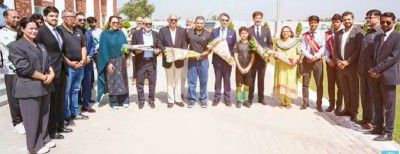
Portugal-Pakistan partnership gains momentum with Dragon Force Football Academy in Sialkot
Celina Ali
Islamabad: The establishment of the Dragon Force Football Academy in Sialkot has emerged as a promising example of the growing potential for Pakistan-Portugal cooperation, bringing together Portugal’s internationally recognised football expertise and Pakistan’s established strength in sports manufacturing to create new opportunities for youth development, skills training and international collaboration.
Ambassador of Portugal to Pakistan Paulo Domingues has welcomed the initiative, describing the academy as a practical demonstration of what the two countries can accomplish through partnerships that combine international experience with local talent and industrial capabilities.
Congratulating FC Porto, one of the world’s leading football clubs, and Forward Sports, a renowned Pakistani manufacturer of footballs, on joining hands to establish the academy in accordance with high international standards, the Portuguese envoy expressed optimism that the collaboration could pave the way for similar ventures in other fields and contribute to strengthening bilateral relations.
“This is just an example of what Portugal and Pakistan can do together — Portuguese expertise with Pakistani talent,” Ambassador Domingues remarked, highlighting the potential of combining the two countries’ respective strengths to develop sustainable and mutually beneficial partnerships.
The initiative represents an important step towards broadening Pakistan-Portugal engagement beyond traditional diplomatic and commercial interactions, demonstrating how cooperation in sports can create opportunities for knowledge transfer, professional training and the development of young talent.
At the heart of the project is the convergence of Portugal’s established footballing expertise and Sialkot’s longstanding reputation as a global centre for sports manufacturing. While Portugal has developed a strong international standing in football through its clubs, coaching systems and player-development structures, Sialkot has earned recognition worldwide for its production of footballs and other sporting goods.
The academy seeks to bring these complementary strengths together, creating a platform through which international football practices and professional training standards can be introduced in Pakistan. The collaboration also highlights the potential for local enterprises to move beyond manufacturing and play a more active role in developing sports infrastructure, training facilities and youth-focused initiatives.
For Pakistan, the project carries significance beyond the establishment of a football academy. It offers an opportunity to strengthen the foundations of grassroots football by exposing young players to structured training and internationally informed development methods. Such initiatives can help nurture emerging talent, encourage greater participation in organised sports and create pathways for young people aspiring to pursue football at professional levels.
The involvement of FC Porto adds an international dimension to the initiative, while Forward Sports brings local industrial experience and a connection to Sialkot’s globally recognised sporting-goods sector. The partnership illustrates how collaboration between international sports institutions and Pakistani businesses can generate opportunities that extend beyond the immediate objectives of a single project.
The academy has been facilitated by the Special Investment Facilitation Council (SIFC), reflecting the council’s broader role in promoting international partnerships and helping create an enabling environment for investment and economic cooperation.
By facilitating linkages between foreign expertise and domestic capabilities, the SIFC aims to help unlock opportunities that can contribute to Pakistan’s economic development, strengthen international business relationships and showcase the country’s potential in diverse sectors.
The Dragon Force Football Academy provides an example of how such facilitation can translate into a tangible initiative with potential benefits for sports development, youth engagement and international cooperation. It also underscores the importance of partnerships that bring together governments, businesses and international institutions to pursue shared objectives.
Ambassador Domingues’s remarks further point to the possibility of extending the Pakistan-Portugal partnership into other areas where the two countries possess complementary strengths. While football provides a visible starting point, the broader principle of combining Portuguese expertise with Pakistani talent could offer a foundation for cooperation across a range of economic and professional fields.
For Pakistan, developing such partnerships can help diversify international engagement, attract specialised knowledge and strengthen the capacity of local institutions and businesses. For Portugal, collaboration with Pakistan offers opportunities to engage with an established manufacturing base and a young population with considerable potential for sports and professional development.
The project also carries a wider message about the role of sports diplomacy in building closer relations between nations. Sporting initiatives can provide a common platform for cultural exchange, professional interaction and people-to-people engagement, complementing formal diplomatic contacts and economic cooperation.
In this context, the academy represents more than a football training facility. It reflects the possibilities that emerge when international expertise is connected with local resources, supported by institutional facilitation and directed towards long-term development objectives.
The success of the initiative will ultimately depend on its ability to provide sustained training opportunities, develop young players and establish a durable framework for cooperation between the participating organisations. If developed effectively, the model could encourage further partnerships between Pakistani sports businesses and international clubs, training institutions and technical experts.
Concluding his message on a note of friendship and goodwill, Ambassador Domingues reaffirmed the spirit of cordial relations between the two countries with the words: “Pakistan-Portugal friendship Zindabad!”
His endorsement of the Dragon Force Football Academy highlights the potential of practical, results-oriented cooperation to strengthen bilateral ties while creating opportunities for Pakistan’s youth and sports industry.
As Pakistan continues to explore avenues for international collaboration, the Sialkot-based initiative offers a compelling example of how local industrial strengths and global expertise can be brought together in pursuit of shared ambitions. By placing youth development, professional knowledge and partnership at the centre of the project, the academy could serve as a foundation for broader engagement between Pakistan and Portugal in the years ahead.