
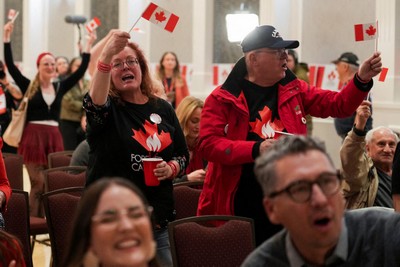
Alberta votes to remain in Canada, handing Carney a boost amid separatist push
Ottawa: Residents of Alberta this week voted to remain part of Canada in the province’s first-ever separation referendum, delivering a political boost to Prime Minister Mark Carney as he seeks to strengthen national unity amid an escalating trade dispute with the United States.
CBC News, Canada’s public broadcaster, projected the outcome late Monday after approximately 33 per cent of the votes had been counted. At that stage, 76 per cent of the ballots counted supported remaining in Canada, while 23 per cent backed moving towards a binding vote on separation.
The referendum was non-binding, meaning its outcome did not itself trigger a legal process to separate Alberta from Canada.
“Albertans made a clear choice,” Carney said in a statement following the announcement of the preliminary results.
“They chose unity, to build together, and to take care of each other.”
“Canada is greater than the sum of its parts,” he added.
The result offered Carney an important political opportunity to reinforce his message of national solidarity at a time when Canada is confronting economic uncertainty and pressure on its trade relationship with Washington.
Alberta, a resource-rich western province and a major centre of Canada’s oil and gas industry, has long expressed dissatisfaction with federal policies that some residents believe constrain its economic potential and limit the development of its energy sector.
Although separatist campaigners have struggled to demonstrate majority support for independence, their movement has gained visibility by arguing that Alberta contributes disproportionately to the national economy while receiving insufficient consideration from the federal government.
Alberta Premier Danielle Smith announced the referendum in May, saying a vote would allow residents to express their views on separation and enable the province to move forward with greater clarity.
Smith said she wanted Albertans to have an opportunity to understand the level of public support for the issue rather than allowing the debate to continue indefinitely.
Following the release of the preliminary results, she said on social media that she was “very pleased” with the early indication of widespread support for remaining in Canada.
She said she would address residents on Tuesday to discuss the outcome and outline the province’s next steps.
The result appeared to contradict the ambitions of a small but vocal separatist movement that has campaigned for months to establish an independent Alberta.
Supporters of independence argue that the province’s substantial energy wealth is used to subsidise less prosperous parts of Canada and that Alberta could achieve greater prosperity outside the federal system.
They also contend that decisions made by the federal government in Ottawa have restricted the development and transportation of the province’s oil and gas resources.
However, pollsters and political analysts had repeatedly questioned whether the separatist movement could secure majority support, pointing to surveys indicating that roughly one-third of residents favoured holding a future referendum on leaving Canada.
The preliminary results suggested that support for remaining in the federation was substantially stronger than support for advancing towards a binding separation vote.
Nevertheless, the outcome is unlikely to end the independence debate, as some separatist leaders have indicated that they intend to continue their campaign regardless of the referendum result.
Carney had personally intervened in the debate in the days leading up to the vote, using a rally in Calgary last week to warn residents against supporting separation.
He described the prospect of leaving Canada as a dangerous bluff that could produce years of political conflict and deepen divisions within the country.
The prime minister urged Albertans to consider the wider national consequences of their decision, appealing to them to vote as though Canada’s future depended on the outcome.
Carney, who spent much of his childhood in Alberta, acknowledged that many residents of the province have historically felt neglected or unfairly treated by successive federal governments.
He sought to address those concerns by pointing to his government’s approval of a proposed new pipeline, presenting energy infrastructure as an area where federal and provincial interests could converge.
He also argued that Alberta would play a critical role in helping Canada reduce its economic dependence on the United States.
The prime minister’s message linked the question of national unity with the country’s broader economic strategy, particularly as Ottawa seeks to diversify trade relationships and strengthen domestic economic capacity amid tensions with Washington.
For Carney, the referendum outcome provides an opportunity to argue that Alberta’s concerns can be addressed within the Canadian federation rather than through separation.