
Celina Ali
Islamabad: A US-supported initiative this week introduced smart monitoring technology to help Islamabad better understand, monitor and manage its increasingly stressed groundwater resources, highlighting the potential of innovation and data-driven solutions to strengthen the capital’s climate resilience.
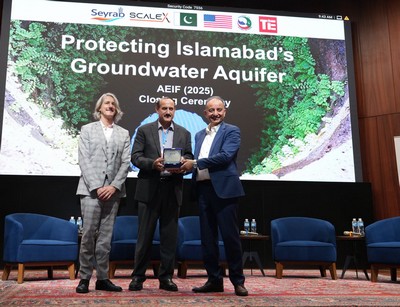
ScaleX Technologies Pvt Ltd on September 1 marked the completion of its Alumni Engagement Innovation Fund (AEIF) 2025 project, “Protecting Islamabad’s Groundwater Aquifer,” at a ceremony attended by Federal Minister for Climate Change and Environmental Coordination Dr Musadik Malik and US Acting Deputy Chief of Mission Andy Halus.
The project, led by ScaleX team members and US exchange alumni Adnan Faisal and Sayaf Arbab, was supported by the US Mission to Pakistan in partnership with the Pakistan-US Alumni Network (PUAN).
Working with the Capital Development Authority (CDA), the team equipped two existing groundwater recharge sites with smart monitoring systems capable of tracking groundwater recharge, groundwater levels, rainfall and selected water-quality indicators in real time.
The technology is designed to make groundwater recharge more measurable and transparent, providing authorities and other stakeholders with data that can support better planning and management of one of Islamabad’s most important but largely invisible natural resources.
Presenting the project’s final report at the closing ceremony, the team highlighted the lessons learned from the initiative and called for a more systematic approach to groundwater recharge.
It stressed that effective groundwater management requires more than simply constructing recharge facilities, arguing that appropriate site selection, sound infrastructure, continuous monitoring and regular maintenance must work together to deliver sustainable results.
Water security and climate resilience
Speaking at the event, Climate Change Minister Musadik Malik underlined the importance of improving the management of both surface and groundwater, particularly as Islamabad faces increasing pressure from changing weather patterns and episodes of intense rainfall.
He noted that around 200 millimetres of rain had recently been recorded in the capital — the highest rainfall in three years — resulting in flooding in several areas.
The minister said better management of available water resources was essential for protecting communities while ensuring sustainable water availability in the future.
He also stressed the importance of encouraging innovative solutions and greater private-sector participation in tackling environmental challenges.
The project demonstrated how technology can help bridge the gap between groundwater infrastructure and the information required to manage it effectively.
US technology and expertise
US Acting Deputy Chief of Mission Andy Halus said the initiative demonstrated the practical value of American innovation and expertise in addressing Pakistan’s environmental challenges.
“This project reflects the best of American innovation,” Halus said, noting that cooperation between US water experts, ScaleX and the broader innovation community had shown how technology and expertise could contribute directly to securing Islamabad’s water future.
The project reflects a growing emphasis on using digital tools, real-time monitoring and locally driven innovation to address environmental and climate-related challenges.
Groundwater is particularly important because changes in aquifer levels are not immediately visible, making monitoring systems essential for identifying depletion, improving recharge planning and supporting evidence-based water management.
Building partnerships
The closing ceremony brought together representatives from government institutions, industry, donor and development organisations, academia and the private sector.
Participants discussed the need for stronger coordination among stakeholders and the development of future partnerships to ensure that Islamabad’s groundwater is treated as a shared and increasingly critical resource.
The project’s organisers said the experience had demonstrated the value of bringing together public institutions, private-sector innovators, international partners and technical experts around a common environmental challenge.
With Islamabad facing growing demands on its water resources and increasing climate-related pressures, the initiative offers a model in which technology can make underground water systems more visible, measurable and manageable.
The project’s completion is therefore being viewed not simply as the end of a pilot initiative but as a potential starting point for wider cooperation on groundwater monitoring, recharge and long-term water security in the capital.