
Celina Ali
Islamabad: The United States and Pakistan’s higher education and private-sector communities have stepped up efforts to strengthen the country’s entrepreneurship ecosystem, with a new forum in Islamabad bringing together entrepreneurs, startup founders, academics, university leaders and innovation specialists to explore pathways to international investment, market access and stronger university-industry partnerships.
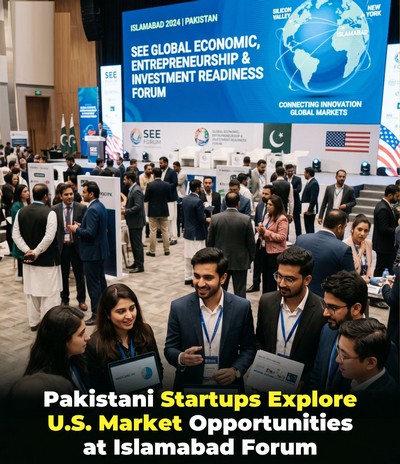
The SEE Global Economic – Entrepreneurship & Investment Readiness Forum, hosted by the US Embassy in Islamabad in collaboration with the Association of Private Sector Universities of Pakistan (APSUP), brought around 150 participants to the US Educational Foundation in Pakistan Auditorium.
The gathering reflected a growing recognition that Pakistan’s universities can play a much larger role in developing commercially viable technologies, nurturing startups and connecting young entrepreneurs with international markets.
The forum focused particularly on the challenges Pakistani startups face when attempting to move beyond the domestic market, including access to foreign investment, corporate governance, market knowledge, commercial networks and partnerships with established institutions.
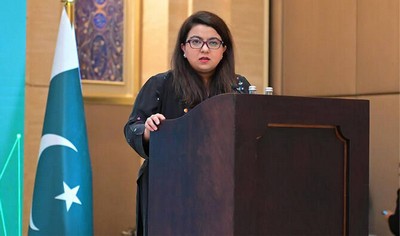
Opening the event, Heidi Smith, Director of Public Engagement at the US Embassy in Islamabad, welcomed participants and highlighted the potential for greater engagement between Pakistani entrepreneurs and the US business and innovation ecosystem.
An Entrepreneurship and Trade Spotlight followed, featuring presentations on US-Pakistan commercial engagement and resources available to Pakistani companies seeking to enter or expand their presence in the US market.
The discussions sought to move beyond the traditional emphasis on entrepreneurship as simply a means of creating employment, instead examining how startups and research-driven businesses can become vehicles for innovation, exports, investment and long-term economic growth.
Professor Iqrar, Chairman of the Punjab Higher Education Commission, formally opened the forum and stressed the importance of embedding entrepreneurship and innovation more firmly within Pakistan’s higher education system.
His remarks underscored the changing role of universities in economic development, particularly as institutions increasingly move beyond conventional teaching and research functions towards technology transfer, startup incubation and industry engagement.
A series of TED-style presentations provided the forum with perspectives from leading academics and innovation practitioners on the challenges of transforming ideas and research into commercially sustainable enterprises.
Professor Dr. Sumaira Rehman, Rector of Superior University, spoke about university-industry collaboration and the potential of entrepreneurship to empower young people.
She emphasised the importance of creating stronger links between academic institutions and the private sector so that innovative ideas emerging from universities can be developed into sustainable businesses and economic opportunities.
For Pakistan, where a large and increasingly educated young population is searching for new employment and income opportunities, the development of entrepreneurial skills and startup ecosystems could offer an important avenue for economic participation.
Air Vice Marshal Dr. Rizwan Riaz, Pro Rector of the National University of Sciences and Technology (NUST), focused on another critical part of the innovation chain: research commercialisation.
His presentation highlighted the gap that can exist between academic research and the marketplace, stressing the need to develop mechanisms through which scientific discoveries, technological innovations and university research can be transformed into commercially viable products and services.
The challenge is particularly significant for developing economies, where universities may produce valuable research but lack sufficient links with investors, corporations and international markets to take those ideas to scale.
The forum’s centrepiece was a virtual keynote address by American entrepreneur and angel investor Scott Fox, who offered practical guidance to Pakistani entrepreneurs seeking to build businesses capable of competing in international markets.
Fox addressed issues ranging from entering the US market and developing investor-ready ventures to strengthening corporate governance and transparency.
He also discussed ways entrepreneurs can position their companies to gain access to US-aligned capital and investor networks, areas that can prove decisive for startups seeking to move from early-stage operations to sustainable growth.
For Pakistani startups, internationalisation can provide access not only to capital but also to technology, expertise, customers and strategic partnerships. However, entering mature markets such as the United States requires businesses to meet higher expectations regarding governance, transparency, intellectual property, financial reporting and scalability.
The forum therefore placed considerable emphasis on investment readiness, suggesting that attracting international capital requires more than an innovative business idea. Entrepreneurs must also be able to demonstrate credible management structures, clear business models, transparent financial practices and the ability to operate in competitive global markets.
Addressing the gathering, Heidi Smith said the United States remained a global leader in entrepreneurship, venture capital and emerging technologies, pointing to Silicon Valley’s globally recognised startup ecosystem as well as American advances in artificial intelligence, digital innovation and high-growth businesses.
She said Pakistani entrepreneurs and researchers possessed significant talent but needed stronger international connections and a better understanding of how to access global markets.
“By linking Pakistani entrepreneurs with American investors like Scott Fox and U.S. innovation ecosystems, these engagements strengthen their global competitiveness and foster partnerships that will shape Pakistan’s innovation economy for years to come,” Smith said.
Her remarks pointed to a broader opportunity for cooperation between the two countries beyond traditional areas of bilateral engagement.
Pakistan has a growing technology and startup community, while its universities are producing increasing numbers of graduates and research initiatives. Yet converting that potential into globally competitive companies remains a challenge, particularly because many startups struggle to secure growth-stage financing and establish international commercial networks.
Greater interaction with US investors, universities and technology ecosystems could help address some of these gaps by exposing Pakistani entrepreneurs to international standards and business practices while opening potential avenues for partnerships and investment.
The forum also highlighted the potential role of private-sector universities in this transformation. With incubation centres, entrepreneurship programmes and research facilities becoming increasingly common within higher education institutions, universities are increasingly positioned to serve as bridges between young innovators and the business community.
The emphasis on university-industry collaboration also reflects a broader shift in the global higher education landscape, where universities are increasingly judged not only by academic output but also by their contribution to innovation, job creation and economic development.
For Pakistan, the ability to commercialise research could be particularly important in sectors such as artificial intelligence, information technology, biotechnology, engineering, agriculture and other technology-driven industries.
The Islamabad forum ultimately sought to connect different parts of this ecosystem — universities, researchers, entrepreneurs, investors and international markets — around a common objective of turning innovation into economic value.
Smith said the gathering provided an opportunity to showcase the US innovation landscape while demonstrating the United States’ commitment to inclusive economic growth and innovation worldwide.
The event also reinforced the idea that stronger international linkages could help Pakistani startups move beyond the limitations of the domestic market and compete for investment and customers abroad.
As Pakistan looks to diversify its economy, expand technology exports and create opportunities for its young population, building a stronger entrepreneurial ecosystem is likely to remain an important part of the national economic agenda.
The challenge now is to convert such forums and networking opportunities into sustained partnerships, investment flows, commercial ventures and measurable outcomes — allowing promising Pakistani ideas to move from university laboratories and startup incubators into international markets.