
Abdullah Jan
Islamabad: Pakistan this week renewed its call for an immediate end to hostilities between Russia and Ukraine and urged both sides to return to diplomacy and direct dialogue, warning that the continued escalation of drone and missile attacks is inflicting mounting suffering on civilians and deepening wider global security concerns.
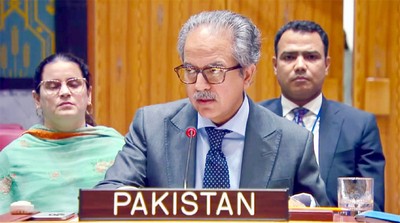
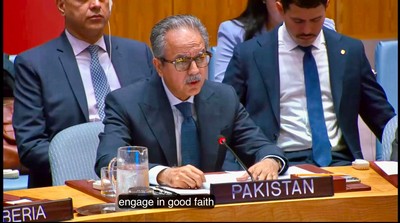
Speaking at a United Nations Security Council debate on the deteriorating situation in Ukraine, Pakistan’s Permanent Representative to the UN, Ambassador Asim Iftikhar Ahmad, expressed deep concern over the growing scale and intensity of attacks across multiple fronts of the conflict.
He called for an “immediate and complete” cessation of hostilities, followed by a return to diplomacy and the resumption of meaningful negotiations aimed at establishing lasting peace and stability.
“We deplore the escalation — the scale and intensity of attacks carried out by the parties on multiple fronts, upending lives and livelihoods in the affected regions,” Ambassador Ahmad said.
His intervention came amid continuing reports of drone and missile strikes affecting civilian areas and critical infrastructure, underscoring Pakistan’s longstanding position that the conflict cannot ultimately be resolved through military means.
The Pakistani envoy voiced particular concern over reported attacks on infrastructure associated with energy and food supplies.
Such attacks, he warned, could have consequences extending well beyond the immediate conflict zone by placing additional pressure on already fragile global food and energy security.
“Reports of attacks targeting critical infrastructure related to energy and food supply are also deeply concerning,” he told the 15-member Council.
The war, which began with Russia’s full-scale invasion of Ukraine in February 2022, has evolved into one of the most consequential conflicts in Europe in decades, producing extensive civilian suffering, displacement and damage to infrastructure while generating repercussions for international food, energy and security systems.
Pakistan has consistently advocated a diplomatic resolution of the conflict, stressing the importance of dialogue, respect for international law and the protection of civilians.
At the Security Council, Ambassador Ahmad reiterated that the protection of civilians, humanitarian workers and civilian infrastructure constitutes a fundamental obligation under international humanitarian law.
He stressed that military operations and attacks must not undermine these basic protections, particularly as the conflict continues to affect densely populated areas and essential infrastructure.
The Pakistani position reflects Islamabad’s broader emphasis on negotiated settlements to international disputes and its call for greater reliance on diplomacy rather than prolonged military confrontation.
The Security Council meeting was convened at the request of its five European Union members, Denmark, France, Greece, Latvia and the United Kingdom, amid renewed concern over the intensity of attacks and the deteriorating humanitarian situation in Ukraine.
Danish Foreign Minister Lars Løkke Rasmussen presided over the session.
Pakistan’s intervention comes as international efforts to bring the conflict back towards a diplomatic track remain a major concern for the international community.
Islamabad has repeatedly maintained that a durable settlement requires engagement between the parties and a process capable of addressing the underlying issues through diplomacy.
The Pakistani envoy’s appeal also highlighted the wider consequences of the war. Damage to energy infrastructure can disrupt electricity and heating supplies for civilians, while attacks affecting food-related facilities and supply chains can add to pressures on global commodity markets.
For developing countries, Pakistan has stressed, disruptions to global food and energy supplies can be particularly damaging because higher import costs can translate into increased inflation and greater pressure on national economies.
Against this backdrop, Islamabad views an end to hostilities not only as a humanitarian imperative but also as an important step towards restoring stability in the broader international economic system.
The appeal for renewed negotiations also comes as the war continues to place significant pressure on the international diplomatic system, with the UN Security Council remaining a key forum for discussions on civilian protection, humanitarian access and international peace and security.
Pakistan’s call was therefore framed around a straightforward principle: an enduring peace cannot be achieved through continued escalation alone.
Ambassador Ahmad urged the parties to move away from further military confrontation and towards diplomacy, dialogue and negotiations.
He emphasised that protecting civilians and civilian infrastructure must remain a central priority while international efforts continue to seek a political pathway out of the conflict.
For Islamabad, the immediate objective is an end to the violence, followed by sustained diplomatic engagement capable of producing a peaceful and durable settlement.
Pakistan’s latest intervention at the Security Council reinforces its position that the continuation of attacks risks further humanitarian suffering while also creating economic and security consequences that extend far beyond Russia and Ukraine.
The message from Islamabad was consequently a renewed appeal for both sides to step back from escalation and give diplomacy another chance before the conflict produces still deeper and more lasting regional and global consequences.