
Celina Ali
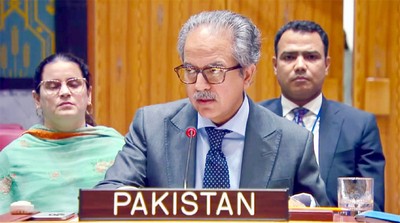
Islamabad: Pakistan this week called for stronger international action to combat conflict-related sexual violence, with Ambassador Asim Iftikhar Ahmad, Pakistan’s Permanent Representative to the United Nations, urging the Security Council to ensure the full and impartial implementation of its resolutions aimed at protecting women and holding perpetrators accountable.
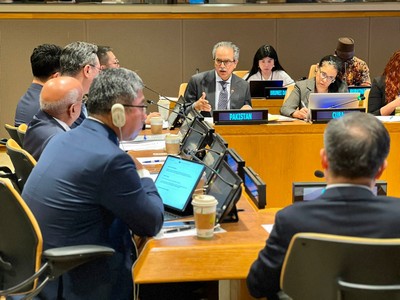
Addressing a high-level debate of the 15-member UN Security Council, Ambassador Asim said the international community must move beyond commitments and ensure that existing mechanisms are implemented consistently across all conflicts without exception.
“The true test of this Council’s commitment lies in the full, faithful and non-selective implementation of its resolutions, including those on women, peace and security,” he told delegates during the session, which was convened by the Democratic Republic of the Congo, the Council’s President for July.
The debate focused on the United Nations Secretary-General’s latest report on conflict-related sexual violence, presented by Pramila Patten, the UN Special Representative on Sexual Violence in Conflict. More than 70 national delegations participated in the discussions.
According to the report, the United Nations verified 9,788 cases of conflict-related sexual violence in 2025 across 21 situations of concern, representing more than double the number recorded the previous year. However, UN officials cautioned that the true scale of the crime is likely far greater, with many cases remaining unreported because of fear, stigma and limited access to support services.
In his address, Ambassador Asim described conflict-related sexual violence as one of the gravest consequences of war, saying it devastates individuals, tears apart families, terrorises communities and leaves lasting trauma across generations, including for children born as a result of wartime rape.
He emphasised that accountability must remain at the centre of the international response and urged the Security Council to ensure that its listing mechanism, which identifies perpetrators of conflict-related sexual violence, applies equally to all situations on the Council’s agenda.
“No situation should be shielded from scrutiny, and no perpetrator should be allowed to treat sexual violence as cost-free,” the Pakistani envoy said.
He also called for the more effective use of UN sanctions against persistent offenders where appropriate and advocated justice systems that place victims and survivors at the centre of legal processes through trauma-informed and accessible mechanisms.
Ambassador Asim stressed that survivors require comprehensive and timely support extending beyond legal accountability. He said medical treatment, psychosocial care, legal assistance, livelihood opportunities and reparations should form an integral part of international efforts to assist victims.
Highlighting the importance of prevention, the Pakistani envoy argued that lasting progress would require strict compliance with international humanitarian and human rights law, greater participation of women in peace processes, stronger early warning systems, sustained financial support and responsible arms control measures.
He further maintained that addressing the underlying causes of armed conflict—including foreign occupation and the denial of the right to self-determination—remains essential to preventing future violations.
The Security Council debate took place 17 years after the adoption of the landmark UN resolution recognising conflict-related sexual violence as a threat to international peace and security. The discussion also marked continued efforts by the United Nations to strengthen accountability and improve protection for civilians caught in armed conflicts worldwide.
Pakistan reiterated its support for a victim-centred and impartial international approach, calling on the Security Council to ensure that its resolutions are implemented consistently and without political selectivity in every conflict situation.