
Liaquat Ali
Islamabad: The United Nations Security Council was cautioned this week that the prospects of a viable two-state solution are deteriorating rapidly amid escalating violence, accelerating settlement activity, and worsening humanitarian conditions across the occupied Palestinian territories.
The Council session reviewed the latest report of the UN Secretary-General on Resolution 2334 and received a briefing from Deputy UN Special Coordinator for the Middle East Peace Process Ramiz Alakbarov, who highlighted a deepening humanitarian catastrophe in Gaza alongside rising tensions and instability in the West Bank.
The report reiterated that Israeli settlements in territories occupied since 1967, including East Jerusalem, constitute a “flagrant violation” of international law and have “no legal validity,” reaffirming a long-established position of the international community.
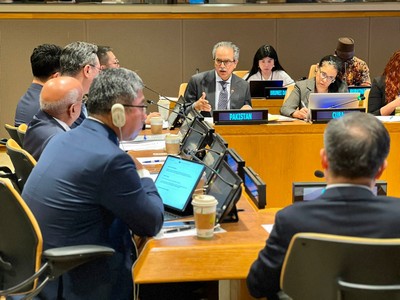
Pakistan’s Permanent Representative to the United Nations, Asim Iftikhar Ahmad, told the Council that the situation on the ground reflects a “systemic pattern” of expansion, displacement, and restriction rather than isolated or incidental developments.
He warned that the West Bank is experiencing what he described as the “largest and deadliest wave” of settlement expansion in recent history, citing the approval and advancement of thousands of housing units as well as new policy measures that, in his view, risk accelerating dispossession of Palestinian communities. He specifically flagged concerns over administrative mechanisms such as digital land registration systems in Area C, which he said could further entrench land loss.
Ambassador Asim Iftikhar Ahmad also raised alarm over the E-1 settlement project, warning that it could fragment the West Bank into disconnected enclaves and severely undermine the territorial continuity required for an independent Palestinian state.
On Gaza, he noted that despite ongoing ceasefire arrangements and international diplomatic efforts, the humanitarian situation remains catastrophic, with widespread shortages of food, clean water, and medical supplies affecting the vast majority of the population.
Several European members of the Security Council, including France, the United Kingdom, Greece, Latvia, and Denmark, issued a joint statement ahead of the meeting condemning settlement expansion and calling for an immediate halt to all related activities.
UN Secretary-General António Guterres, in a quarterly report referenced during the session, similarly warned that the expansion of settlements is driving the most severe displacement crisis in the West Bank since 1967. He further cautioned that planned development in the E-1 area could have “existential consequences” for the two-state solution and undermine the territorial integrity of the Occupied Palestinian Territory.
The meeting concluded with renewed appeals from multiple delegations for urgent international action to prevent further erosion of the two-state framework, amid what diplomats described as an increasingly constrained political and territorial environment.