

Liaquat Ali
Islamabad: Pakistan this week called on the United Nations to uphold its Responsibility to Protect (R2P) doctrine without “selectivity,” urging the international community to apply the principle consistently to prevent genocide, war crimes, ethnic cleansing and crimes against humanity.
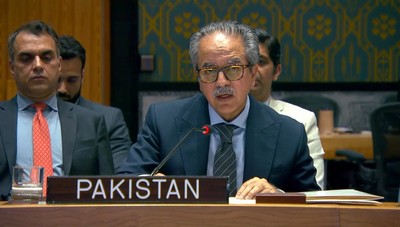
Addressing the annual debate of the United Nations General Assembly on the Responsibility to Protect doctrine, Pakistan’s Permanent Representative to the UN, Asim Iftikhar Ahmad, said the international community’s collective commitment to preventing mass atrocities had been weakened by inconsistent implementation, inaction and a lack of accountability.
He noted that with conflicts increasing across the world, the credibility of the Responsibility to Protect framework was under growing strain.
“Our shared objective to protect fundamental human rights, and to prevent the recurrence of mass atrocities is often obfuscated by inaction, denial, selectivity and paralysis,” Ahmad told the General Assembly.
The Pakistani envoy said the shortcomings of the doctrine were particularly evident in situations involving prolonged conflicts and foreign occupation, where atrocities had continued with impunity despite sustained international attention.
“Nowhere is this void more evident than in situations of prolonged conflict and foreign occupation, where atrocities have been committed with impunity, in full glare of international attention,” he said, adding that the international community’s promise of “Never Again” remained unfulfilled in the absence of responsibility, protection and accountability.
Calling for renewed global commitment to the doctrine, Ahmad urged member states to place greater emphasis on conflict prevention, mediation and diplomacy rather than responding only after atrocities had occurred.
He also stressed the need for the peaceful resolution of protracted disputes in accordance with international law and relevant UN Security Council resolutions, while emphasizing the importance of strengthening accountability mechanisms to protect vulnerable populations.
The ambassador further called on the international community to confront hate speech, xenophobia, Islamophobia and other forms of intolerance that contribute to discrimination, violence and the risk of atrocity crimes.
He said investing in prevention, peacebuilding, effective peacekeeping and accountability remained the most practical way to honour victims of mass atrocities, protect future generations and restore confidence in multilateral cooperation and the international rules-based system.
The Responsibility to Protect doctrine, endorsed by world leaders at the 2005 UN World Summit, affirms that every state has the primary responsibility to protect its population from genocide, war crimes, ethnic cleansing and crimes against humanity, while the international community has a collective responsibility to act through the United Nations when states fail to fulfil that obligation.