
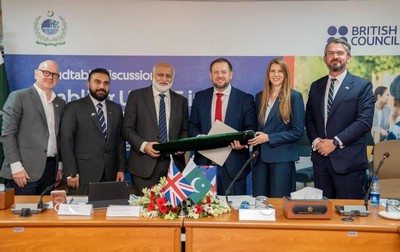
UK Minister Stephen Doughty visits Pakistan focussing on trade, education and security
Celina Ali
Islamabad: UK Minister of State for the Middle East, North Africa, Afghanistan and Pakistan Stephen Doughty concluded his first official visit to Pakistan this week with discussions focused on strengthening bilateral cooperation in economic growth, trade, education, regional security, migration and counter-terrorism.
The visit brought the British minister into talks with senior Pakistani political, military and civil society figures, as London and Islamabad explored ways to deepen their longstanding relationship and expand cooperation on issues of mutual interest.
Doughty’s visit also placed considerable emphasis on education, particularly the growing relationship between British and Pakistani universities and the rapid expansion of UK qualifications being delivered in Pakistan.
During his meetings, the minister discussed opportunities to expand university partnerships, improve access to British qualifications and strengthen collaboration in areas including science, technology, engineering and mathematics, healthcare and technology.
The growing scale of educational cooperation was highlighted by figures showing that more than 15,000 Pakistani students studied for UK qualifications in Pakistan through transnational education programmes during the 2024-25 academic year.
That figure represented an 83 per cent increase over the previous decade, making Pakistan the fourth-largest host country in the world for UK transnational education. British institutions currently account for approximately 65 per cent of Pakistan’s transnational education market.
The expansion of educational links has emerged as one of the most significant areas of people-to-people cooperation between the two countries, providing Pakistani students with greater access to internationally recognised qualifications while creating new opportunities for British universities to establish partnerships with institutions in Pakistan.
During the visit, Doughty held discussions with Pakistan’s Higher Education Commission, university leaders and the British Council on the future direction of transnational education and ways of strengthening institutional ties.
The British Council is also planning to bring a delegation of British universities to Pakistan in March next year to explore further opportunities for collaboration. The longer-term ambition is to see more than 100 British universities working in partnership with Pakistani institutions by the end of the decade.
Economic cooperation was another central theme of the minister’s visit.
Doughty met Pakistan’s Deputy Prime Minister and Foreign Minister Ishaq Dar, Interior Minister Mohsin Naqvi, and Minister for Law, Justice and Human Rights Azam Nazeer Tarar.
The discussions covered economic growth and trade, as well as broader regional and security concerns.
Trade between Britain and Pakistan is currently worth approximately £5.5 billion annually, with both sides seeking to expand commercial ties and identify new opportunities for businesses in the two countries.
The UK sees Pakistan as an important economic partner in South Asia, while Pakistan continues to regard Britain as a major market, investment source and development partner.
The minister’s meetings therefore provided an opportunity to discuss not only existing commercial ties but also ways of encouraging further investment and business cooperation.
Security issues also featured prominently in Doughty’s discussions with Pakistani officials.
The talks included regional stability, the situation in Afghanistan and counter-terrorism cooperation, alongside efforts to reduce the risk of further escalation in the region.
Pakistan’s geographical position and its close relationship with Afghanistan make regional security a particularly important area of cooperation with Britain.
For London, Pakistan remains a significant partner in efforts to address terrorism and instability in the region, while Islamabad continues to face direct security and economic consequences from developments in neighbouring Afghanistan.
The discussions reflected the broader security relationship between the two countries and the importance both governments attach to maintaining dialogue at a time of continuing regional uncertainty.
Doughty also met representatives of civil society during his visit and reaffirmed Britain’s commitment to human rights and democratic freedoms.
He met politicians from across Pakistan’s political spectrum, providing an opportunity to discuss the wider UK-Pakistan relationship and hear different perspectives on the country’s political and social environment.
The inclusion of civil society and political representatives in the programme demonstrated the breadth of issues covered during the visit, extending beyond government-to-government relations.
The minister’s visit also underscored the extensive human connections between Britain and Pakistan.
Approximately 1.7 million people of Pakistani heritage live in the United Kingdom, creating one of the most substantial and enduring people-to-people links between Britain and any country outside Europe.
Those connections underpin a relationship that extends well beyond diplomacy and trade, encompassing education, business, culture, family ties and professional networks.
Doughty described the relationship between the two countries as one built on deep and historic connections between their people, businesses and institutions.
He said his first visit to Pakistan had focused on strengthening cooperation across a range of issues that directly affect people in both countries, including economic growth, trade, education, security and regional stability.
He also pointed to the potential for further cooperation in education, particularly the expanding partnerships between British and Pakistani universities and the role these links can play in helping young people acquire the skills required for the future.
The minister’s visit came at a time when both Britain and Pakistan are seeking to broaden their relationship beyond its traditional areas of cooperation.
Education appears likely to be one of the most promising areas for future expansion. The rapidly growing number of Pakistani students pursuing British qualifications without leaving the country, combined with plans for further university partnerships, points towards a deeper and more integrated higher education relationship.
Trade and investment are also expected to remain important priorities, particularly as both countries look for new avenues of economic growth.
At the same time, security cooperation, Afghanistan, counter-terrorism and regional stability will continue to shape the strategic relationship.
Doughty’s first visit therefore provided an opportunity to reinforce a partnership that is already supported by substantial economic, educational and people-to-people ties.
With bilateral trade standing at around £5.5 billion a year, more than 15,000 Pakistani students pursuing UK qualifications through transnational education and approximately 1.7 million people of Pakistani heritage living in Britain, the relationship between the two countries extends across a wide and increasingly diverse range of interests.
The challenge for both governments will now be to turn that foundation into deeper cooperation, particularly in education, trade, investment, technology and regional security.