
Abdullah Jan
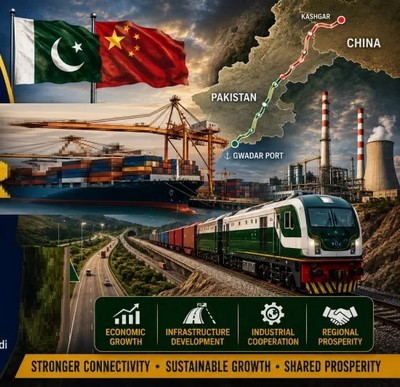
Islamabad: Pakistan has called for a stronger role for the private sector in the second phase of the China-Pakistan Economic Corridor (CPEC), with the government seeking to transform the mega bilateral initiative from an infrastructure-centred programme into a platform for industrial expansion, exports, agricultural modernization, technology transfer and business-to-business cooperation.
Federal Minister for Planning, Development and Special Initiatives Ahsan Iqbal, while chairing a detailed review meeting on implementation of the CPEC Action Plan 2025–2029 this week, said Pakistan’s economic future depended on converting the strategic gains achieved through cooperation with China into sustainable economic growth and export earnings.
The meeting reviewed progress during the first year of implementation of the action plan, which was finalized during Prime Minister Muhammad Shehbaz Sharif’s visit to China in August 2025. The minister also examined measures required to accelerate implementation of the agreed priorities and directed relevant ministries to ensure timely execution of projects and initiatives under the second phase of CPEC.
Ahsan Iqbal emphasized that Pakistan-China cooperation had remained resilient through difficult periods and recalled China’s role in helping Pakistan address its acute energy shortages through major investments during the first phase of CPEC.
He said CPEC Phase-I attracted around $25 billion in Chinese investment and contributed nearly 8,000 megawatts to Pakistan’s power generation capacity, helping the country overcome a serious energy crisis and improving its overall energy security.
The minister said the development of Thar coal resources and establishment of the fibre-optic network were among the important achievements of the first phase, providing Pakistan with infrastructure and strategic foundations on which the next stage of bilateral economic cooperation could be built.
With CPEC now entering a more economically focused phase, he said the emphasis would increasingly be placed on business-to-business linkages, industrial cooperation, agricultural development, minerals, human capital, technology and innovation.
Ahsan Iqbal said the priorities of CPEC Phase-II were closely aligned with the government’s broader URAAN Pakistan framework and its five proposed corridors—Growth, Livelihood, Innovation, Green Economy and Openness.
The Growth Corridor, he explained, would focus on expanding Pakistan’s industrial and agricultural productive capacity and enhancing exports, while the Livelihood Corridor would seek to generate wider social and economic opportunities, particularly in less-developed areas.
The Innovation Corridor, linked with the government’s E-Pakistan vision, would focus on strengthening the country’s information technology capabilities and developing modern skills among millions of young Pakistanis.
The minister described Pakistan’s young population as its greatest economic asset, stressing that the country needed to equip its youth with skills relevant to the modern digital economy.
The Green Economy Corridor would focus on climate resilience, water and food security and agricultural modernization, areas where Pakistan sees significant scope for greater cooperation with China.
In this context, Ahsan Iqbal highlighted the government’s programme to send 1,000 Pakistani agricultural experts to China for specialized training in modern farming technologies.
He said the initiative was designed to create a critical mass of trained agricultural professionals capable of transferring modern techniques to Pakistan and helping lay the foundations for what he described as a “Green Revolution 2.0.”
The proposed agricultural transformation would involve improved seeds, greater farm mechanization, efficient irrigation and water management, and the adoption of climate-resilient crops.
The minister stressed that the next stage of Pakistan-China economic cooperation should ultimately result in stronger productive capacity inside Pakistan rather than merely expanding imports.
He said the private sector must take the lead in translating the opportunities created under CPEC Phase-II into investment, industrial production, employment and exports, while the government’s role would be to provide an enabling policy and regulatory environment.
Ahsan Iqbal described export expansion as a “national emergency”, arguing that Pakistan must dramatically increase its presence in international markets if it is to achieve long-term economic stability.
He reiterated the target of taking Pakistan’s exports to US $100 billion by 2035, calling it essential for the country’s economic survival and self-reliance.
The minister called for closer cooperation between the government and business community to improve competitiveness, attract investment and develop internationally competitive Pakistani products.
He said the ultimate objective should be to establish “Made in Pakistan” as a globally recognized brand, with Chinese cooperation playing an important role in technology, industrial development, skills and market access.
The shift towards business-to-business cooperation represents a significant evolution in the CPEC model. While Phase-I focused heavily on energy, transport and physical connectivity, Phase-II envisages greater participation by businesses, industries, farmers, technology companies and other private-sector stakeholders.
The minister also linked successful implementation of CPEC Phase-II with political and economic stability, warning that Pakistan could not afford prolonged instability while attempting to undertake a major economic transformation.
He said recent strategic and diplomatic achievements needed to be converted into tangible economic benefits through national unity, structural reforms, effective governance and an uninterrupted focus on development.
“Pakistan does not need to heat its roads; Pakistan needs to heat its economy,” Ahsan Iqbal said, urging political forces to prioritize economic development over confrontation.
He said the objective of the next phase of Pakistan-China cooperation should be to build a more productive, competitive and export-oriented Pakistani economy capable of generating opportunities for the country’s growing young population.
The minister directed the concerned ministries to maintain momentum on the CPEC Action Plan 2025–2029 and ensure that agreed projects and programmes moved from policy commitments to practical implementation.
The review meeting thus underscored Pakistan’s evolving approach towards CPEC, with the second phase increasingly being viewed not simply as an infrastructure initiative but as a broader vehicle for industrialization, technology cooperation, agricultural transformation and integration of Pakistan into regional and global value chains.