
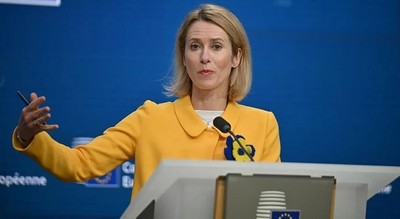
Wicklow: European Union foreign ministers are increasingly concerned that Russian nationals could exploit tourist visas to enter the bloc and potentially support sabotage or other hostile activities, EU foreign policy chief Kaja Kallas said this week.
The issue emerged prominently during an informal meeting of EU foreign ministers in Wicklow, where several ministers called for tighter restrictions on visas issued to Russian citizens amid growing security concerns across Europe.
Kallas said there was broad support among member states for tougher measures, including restrictions targeting Russian tourists and an EU-wide entry ban for former Russian combatants.
The discussion reflects a widening European concern that the migration and travel systems of the EU could be exploited for activities linked to the war in Ukraine and Russian intelligence or security operations.
Asked about reports that a suspect potentially connected to a drone incident in Leipzig, Germany, may have entered the EU using an Italian tourist visa, Kallas said that, if confirmed, the case would demonstrate the security risks associated with the continued use of tourist visas by Russian nationals.
She said visas could potentially become a means for individuals intending to cause harm to enter European territory.
“There was broad support” for moving towards an EU entry ban for Russian ex-combatants and imposing tougher restrictions on Russian tourists, Kallas said.
The debate comes as European governments have increasingly warned of hostile activities allegedly linked to Russia, including suspected sabotage, cyberattacks, espionage and other forms of hybrid warfare.
EU governments have already introduced extensive sanctions against Russia following its invasion of Ukraine, while restrictions on travel and visa issuance have become another element of the bloc’s broader response.
However, the issue remains politically sensitive because visa policy also affects ordinary Russian citizens, businesses, students and families. Any further restrictions are therefore likely to involve a debate over how to distinguish legitimate travel from potential security threats.
Kallas said EU countries were also working with the European Commission on new proposals designed to strengthen enforcement of sanctions against Russia.
The meeting also revived discussion over the possible use of immobilised Russian assets. Billions of euros in Russian state assets have been frozen in Europe since the beginning of the war, and EU governments have repeatedly debated how far they can go in using those funds to support Ukraine while addressing legal and financial concerns.
Kallas said the issue remained under discussion among member states.
Beyond Russia and Ukraine, the foreign ministers used the informal meeting to examine the effectiveness of EU foreign policy and the bloc’s ability to respond quickly to international crises.
Kallas said ministers discussed areas where EU foreign policy was producing results, where decision-making remained too slow and how the bloc could make more effective use of its considerable economic and political influence.
There was broad support for retaining the EU’s existing institutional framework, she said, but ministers also acknowledged the need to use the system more effectively.
Kallas called for greater use of mechanisms already provided under EU treaties, including “constructive abstention”. Under the mechanism, a member state can refrain from blocking a foreign-policy decision without being obliged to implement it.
Greater use of such procedures could, in theory, help the EU overcome disagreements among its 27 members and respond more rapidly to international developments.
The deteriorating situation in Gaza and the West Bank was another major issue on the ministers’ agenda.
Kallas accused Israeli settlers of continuing violence against Palestinians at an increasing rate and criticised what she described as a lack of accountability for such acts.
She also warned that planned Israeli settlement activity in the E1 area could further damage the prospects of a two-state solution.
According to Kallas, development of settlements in the strategically sensitive area would effectively create a barrier across the West Bank, making the establishment of a viable Palestinian state more difficult.
The EU foreign policy chief reaffirmed the bloc’s support for the Gaza peace plan, as European governments continue to grapple with how to exert greater diplomatic influence over the conflict.
The discussions in Ireland underline the increasingly security-driven character of European foreign policy.
For the EU, the challenge is no longer limited to conventional military threats. Concerns about espionage, sabotage, cyber operations, disinformation and the possible exploitation of legitimate travel arrangements have expanded the definition of security across the bloc.
The push for tighter Russian visa restrictions is therefore part of a wider European effort to close potential loopholes while maintaining coordination among member states.
At the same time, the EU faces pressure to demonstrate that its foreign-policy machinery can respond quickly to crises ranging from the war in Ukraine to the conflict in Gaza.
The ministers’ discussions suggest that Brussels is seeking to combine tougher security measures with more efficient decision-making — an approach that could shape the bloc’s foreign policy in the months ahead.