
Abdullah Jan
Islamabad: The Government of Japan this week provided grant assistance of ¥21 million (approximately $142,500) to the Dopasi Foundation to strengthen tuberculosis screening and basic healthcare services for vulnerable communities in Islamabad, Rawalpindi and Chakwal.
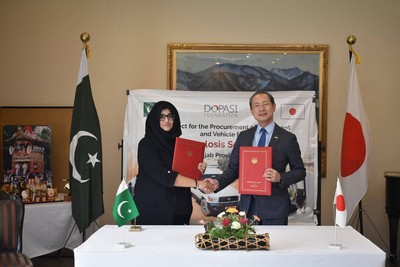
The assistance has been extended under Japan’s Grant Assistance for Grassroots Human Security Projects (GGP) programme, with the grant contract signed at the Embassy of Japan in Islamabad on September 1 between Japanese Ambassador to Pakistan Akamatsu Shuichi and a representative of the Dopasi Foundation.
The project, titled “The Project for the Procurement of Equipment and Vehicle for Tuberculosis Screening in Two Districts of Punjab Province and Islamabad City,” is aimed at improving access to early diagnosis and basic health services for underserved communities.
Under the initiative, the Dopasi Foundation will deploy a fully equipped Mobile Health Unit in Islamabad, Rawalpindi and Chakwal to take screening services closer to communities that face difficulties in accessing conventional healthcare facilities.
The mobile unit will provide digital chest radiography, tuberculosis screening, family planning counselling and basic health checks, with particular attention to marginalized groups, including daily wage earners, women and families facing financial or other barriers to healthcare.
The project is expected to provide medical screening to around 20,000 people every year, helping promote early detection of tuberculosis and other health conditions while reducing the burden of communicable diseases on vulnerable households.
The initiative also features significant Japanese private-sector technological support.
Toyota Tsusho Corporation, in collaboration with Fujifilm, is supporting the development of a specially equipped Land Cruiser fitted with a compact X-ray system and artificial intelligence technology for tuberculosis screening.
The companies will also support a local maintenance system for the equipment and provide technical training to help ensure its effective and sustainable operation.
The use of mobile diagnostic technology is expected to enable healthcare teams to reach communities that may otherwise delay seeking medical assistance because of distance, cost or other access barriers.
The project also carries a broader economic and social dimension. By facilitating earlier diagnosis, the initiative is expected to help families avoid the potentially severe financial consequences associated with delayed treatment and catastrophic health expenditure.
The Dopasi Foundation, a Pakistani humanitarian organisation with more than 200 staff members, has been working to address the needs of underprivileged communities and has expanded its healthcare initiatives across the country.
Speaking at the signing ceremony, Ambassador Akamatsu said human security begins with protecting every individual life, describing the principle as a fundamental element of Japan’s development cooperation.
He emphasised that access to early diagnosis and basic health services was directly linked to saving lives and helping vulnerable families overcome hardship.
The ambassador’s remarks underscored Japan’s approach of combining grassroots development assistance with practical healthcare interventions aimed at improving the daily lives of communities.
The Japanese government reaffirmed its commitment to supporting capable local non-governmental organisations in Pakistan through grant assistance designed to advance human security.
The latest initiative adds a new dimension to longstanding Pakistan-Japan cooperation by combining Japanese financial assistance, private-sector technology and technical expertise with local implementation through a Pakistani humanitarian organisation.
The project is expected not only to expand access to TB screening in Islamabad, Rawalpindi and Chakwal but also to strengthen community-level healthcare outreach and contribute to the long-term resilience of vulnerable families.
Japan and Pakistan have maintained longstanding cooperation in development and human security, with grassroots projects providing assistance in areas where improved access to essential services can have a direct impact on local communities.