
Celina Ali
Islamabad: Pakistan and the European Union this week reaffirmed their shared commitment to democratic values, the rule of law and the protection of human rights, while agreeing to further strengthen bilateral cooperation and parliamentary engagement.
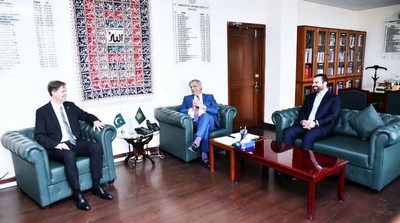
The understanding was reached during a meeting between Federal Minister for Law, Justice and Human Rights Senator Azam Nazeer Tarar and Member of the European Parliament Ondrej Dostál, during which the two sides discussed the importance of maintaining positive and constructive Pakistan-EU relations and expanding parliamentary interaction.
The meeting assumed significance against the backdrop of Pakistan’s longstanding engagement with the European Union, a relationship that extends beyond conventional diplomatic ties to encompass trade, development cooperation, governance, human rights, migration, climate change and regional stability.
During the meeting, both sides emphasised the importance of democratic principles and effective institutions as essential foundations for sustainable political and economic cooperation. They agreed that continued engagement could help strengthen mutual understanding and create greater space for cooperation on issues of common interest.
Senator Tarar highlighted Pakistan’s commitment to democratic values, constitutional governance and the rule of law, while stressing the importance of effective institutions in ensuring political stability and protecting citizens’ rights.
The discussions also placed particular emphasis on parliamentary engagement. The two sides agreed that closer interaction between Pakistan’s Parliament and the European Parliament could provide an important platform for exchanging views on legislation, democratic governance, constitutional matters, human rights and institutional development.
Parliamentary diplomacy has increasingly become an important component of international relations. Unlike traditional government-to-government engagement, parliamentary interaction allows elected representatives to establish direct relationships, exchange legislative experiences and discuss issues that may not always feature prominently in formal diplomatic negotiations.
For Pakistan, stronger engagement with European lawmakers also offers an opportunity to explain its political, constitutional and legal perspectives directly to European policymakers. At the same time, European parliamentarians can gain a better understanding of Pakistan’s institutional environment and the challenges confronting its democratic and legal systems.
Pakistan and the EU have maintained diplomatic relations for decades, with their partnership gradually expanding into a broad-based relationship.
Trade remains one of its most important pillars. The European Union is among Pakistan’s largest trading partners and a major destination for Pakistani exports, particularly textiles and garments.
The EU’s Generalised Scheme of Preferences Plus, commonly known as GSP+, has played an important role in facilitating Pakistani exports to European markets. The preferential trade arrangement has helped strengthen Pakistan’s export capacity and contributed to the expansion of commercial relations between the two sides.
The importance of the European market means that Pakistan has a strong economic interest in maintaining stable and constructive relations with the EU. At the same time, European engagement with Pakistan extends beyond trade and includes development, humanitarian assistance, education, climate cooperation and institutional strengthening.
The political relationship has consequently acquired greater complexity, with economic interests existing alongside discussions on democracy, human rights and the rule of law.
The reaffirmation of democratic values during the latest meeting is particularly significant because these issues remain an important part of the EU’s engagement with Pakistan.
The European Union places considerable emphasis on democratic governance, human rights, labour standards and the rule of law in its external partnerships. Pakistan, meanwhile, has repeatedly stressed its commitment to constitutional democracy and the protection of fundamental rights.
The two sides therefore have both shared principles and areas where continued dialogue remains necessary.
Rather than allowing differences to overshadow the broader relationship, sustained institutional engagement can provide a mechanism for addressing concerns while preserving cooperation in areas of mutual interest.
The emphasis on dialogue is particularly important in a relationship in which economic and political considerations are closely interconnected.
The EU’s preferential trade framework has become one of the most important economic dimensions of Pakistan-EU relations.
For Pakistan, access to European markets is critical for its export-oriented industries, particularly the textile and apparel sectors. The arrangement has helped Pakistani businesses compete more effectively in one of the world’s largest consumer markets.
However, the trade relationship also carries wider obligations. The GSP+ framework is linked to Pakistan’s implementation of a range of international conventions covering human rights, labour rights, environmental protection and good governance.
This has made the EU’s economic relationship with Pakistan closely connected to discussions about institutional reforms, legal protections and human rights.
For Islamabad, maintaining constructive engagement with Brussels is therefore important not only from a diplomatic perspective but also because of the economic benefits associated with access to European markets.
The latest discussions also highlighted the potential for parliamentary diplomacy to become a stronger component of Pakistan-EU relations.
Parliamentarians can play a valuable role in creating sustained channels of communication, particularly when relations encounter difficult or sensitive issues. Regular exchanges can help lawmakers compare legislative practices, discuss democratic institutions and explore ways of strengthening governance.
Such interaction can also complement formal diplomatic channels by creating relationships that extend beyond changes in governments or political circumstances.
For Pakistan, closer engagement with the European Parliament could help convey the country’s perspective on legislation, constitutional development, human rights and democratic institutions.
For European lawmakers, dialogue with Pakistani counterparts can provide first-hand insight into the country’s political and legal environment and help promote a more informed understanding of developments in Pakistan.
While trade remains central to the relationship, there is considerable potential to broaden economic cooperation.
Pakistan has sought to attract greater European investment in areas including renewable energy, information technology, agriculture, manufacturing, infrastructure and other emerging sectors.
European companies, meanwhile, can potentially benefit from Pakistan’s large domestic market, strategic location and expanding pool of young workers and entrepreneurs.
Greater investment could also contribute to technology transfer, skills development and integration into international value chains.
For this potential to be fully realised, however, sustained attention to regulatory predictability, institutional capacity, ease of doing business and investor confidence will remain important.
The meeting between Tarar and Dostál demonstrated that Pakistan-EU relations are increasingly shaped by a combination of economic interests and shared discussions on governance and democratic values.
Both sides have a clear interest in maintaining constructive engagement. Pakistan benefits from access to European markets, investment, development cooperation and political engagement, while the EU has an interest in maintaining strong relations with an important South Asian country with a significant role in regional stability.
The reaffirmation of democratic values, the rule of law and human rights provides an important framework for that engagement.
At the same time, the agreement to strengthen parliamentary interaction offers a practical mechanism for deepening mutual understanding.
As Pakistan and the European Union look towards the future, the challenge will be to ensure that their relationship continues to expand despite differences on individual issues. Regular political dialogue, stronger parliamentary contacts and greater economic cooperation can help create a more resilient partnership.
The latest meeting therefore represents more than a routine diplomatic interaction. It reflects a broader effort to strengthen the institutional foundations of Pakistan-EU relations and ensure that economic cooperation is accompanied by meaningful political and parliamentary engagement.
With trade, democratic governance, human rights and parliamentary diplomacy increasingly intertwined, the future of the Pakistan-EU partnership will depend on the ability of both sides to maintain dialogue, manage differences constructively and identify new areas of common interest.