
Lahore: The Lahore Chamber of Commerce and Industry (LCCI) has stepped up efforts to expand Pakistan’s commercial engagement with Germany, with a high-level business delegation visiting the Bergische Chamber of Industry and Commerce Wuppertal-Solingen-Remscheid during its ongoing trade mission to Europe.
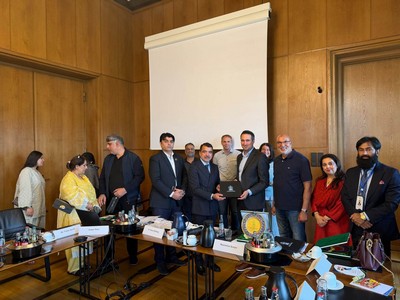
Led by LCCI President Faheem Ur Rehman Saigol, the delegation held detailed discussions with Arft Jasper Rust, Officer of the International Division at the Bergische Chamber of Industry and Commerce Wuppertal-Solingen-Remscheid, focusing on opportunities to expand bilateral trade, strengthen business-to-business contacts and create new avenues for investment and industrial cooperation.
The engagement reflects the LCCI’s efforts to develop stronger institutional links with European chambers of commerce and establish direct connections between Pakistani and German businesses.
Germany, as Europe’s largest economy and one of the world’s leading industrial and technological powers, offers significant opportunities for Pakistani companies seeking to expand their presence in European markets. The country has a highly developed manufacturing base, advanced technology sector and strong network of small and medium-sized enterprises, creating potential avenues for cooperation with Pakistani businesses.
During the meeting, Saigol highlighted the importance of strengthening institutional and private-sector cooperation between Pakistan and Germany, stressing that closer engagement between chambers of commerce could help identify commercially viable opportunities and translate them into long-term partnerships.
He said German businesses could find opportunities in Pakistan across a wide range of sectors, while Pakistani exporters could benefit from stronger connections with German buyers, distributors and industrial partners.
The LCCI president particularly pointed to the potential for cooperation in exports, industrial development, technology, investment and joint ventures, describing Germany as an important market and potential partner for Pakistan’s business community.
He stressed that the relationship should move beyond conventional trade and develop towards deeper forms of economic cooperation involving technology transfer, manufacturing partnerships, investment and value-added production.
Saigol said Pakistan possessed a diverse range of products and services with potential for international markets and emphasised the need to improve access to European buyers and strengthen direct business contacts.
He highlighted the importance of introducing Pakistani companies and products to German businesses and creating platforms through which exporters from both countries could explore commercial opportunities.
For Pakistan, Germany represents not only an important European market but also a potential source of technology, expertise, investment and industrial partnerships.
Greater interaction with German companies could help Pakistani businesses gain exposure to advanced production techniques, quality standards and international supply chains. At the same time, German companies could benefit from Pakistan’s large domestic market, growing entrepreneurial base and opportunities in sectors requiring investment and technological expertise.
The LCCI believes that closer engagement between business organisations can play an important role in bringing these opportunities together.
Arft Jasper Rust shared his perspective on foreign trade and business opportunities during the meeting and discussed the prospects for greater interaction between companies in Pakistan and businesses operating in the Bergische region of Germany.
The discussions provided an opportunity for both sides to exchange views on the business environment, international trade, market opportunities and potential areas of mutual cooperation.
The Bergische region, encompassing Wuppertal, Solingen and Remscheid, has a strong industrial and manufacturing tradition. Its business community includes companies with expertise in engineering, manufacturing, tools, machinery and other industrial sectors, making the region potentially relevant to Pakistan’s efforts to expand industrial and technology partnerships with Germany.
The meeting therefore provided a platform for the Pakistani delegation to gain a better understanding of the regional German business environment while introducing German counterparts to the capabilities and commercial interests of Pakistani companies.
Members of the LCCI delegation actively participated in the discussions and presented the potential of their respective sectors.
They expressed interest in establishing direct contacts with German companies and exploring opportunities for trade, investment, technology cooperation and joint ventures.
Such business-to-business engagement can be particularly important for expanding bilateral commerce because it allows companies to identify specific products, services and projects rather than relying solely on broader government-level agreements.
The LCCI delegation emphasised the need for sustained interaction between private-sector representatives, chambers of commerce and business institutions in both countries.
Regular exchanges, business meetings and sector-specific cooperation could help identify reliable partners, develop commercial relationships and eventually lead to concrete investment and trade agreements.
Germany occupies a strategically important position in Pakistan’s European economic engagement.
As a major industrial economy, Germany has global strengths in engineering, automobiles, machinery, chemicals, pharmaceuticals, renewable energy, digital technologies and advanced manufacturing.
For Pakistan, closer economic interaction with German companies could contribute to industrial modernisation and technology transfer while helping Pakistani businesses integrate into European and international value chains.
At the same time, Pakistani companies have opportunities to supply European markets with textiles, garments, leather products, sporting goods, surgical instruments, agricultural products, information technology services and other goods and services.
The challenge is to expand the range of Pakistani exports and move towards greater value addition.
The LCCI’s emphasis on business-to-business engagement reflects an understanding that developing long-term commercial partnerships requires more than simply increasing the volume of traditional exports.
The visit to the Bergische Chamber forms part of the LCCI’s broader Europe trade mission, aimed at expanding Pakistan’s international trade and investment connections.
Through direct engagement with European chambers, institutions and companies, the delegation is seeking to create new opportunities for Pakistani businesses and strengthen their access to international markets.
The mission also provides an opportunity to showcase Pakistan’s private sector, identify potential investors and explore partnerships that can generate employment, technology transfer and export growth.
For the LCCI, expanding international linkages is particularly important as Pakistani businesses seek to diversify markets and become more competitive in an increasingly demanding global trading environment.
The discussions in Germany highlighted the potential for Pakistan-Germany relations to evolve from a predominantly trade-oriented relationship into a broader economic partnership.
Investment, technology cooperation and joint ventures could provide a more sustainable foundation for bilateral economic relations, particularly in areas where German expertise and Pakistani market opportunities complement each other.
Closer cooperation between chambers of commerce could serve as an institutional bridge connecting businesses from both sides.
The LCCI delegation’s engagement with the Bergische Chamber is therefore part of a wider effort to create those connections and ensure that Pakistani businesses have greater access to German partners and European markets.
As the Europe trade mission continues, the LCCI hopes that direct engagement with European business institutions will translate into concrete opportunities for Pakistani exporters, investors and industrialists.
The Germany visit has reinforced a central message of the mission: Pakistan’s economic relationship with Germany has significant untapped potential, and stronger business-to-business engagement could help convert that potential into trade, investment, technology partnerships and long-term industrial cooperation.