
Sofia: Pakistan and Bulgaria have agreed to explore new avenues of bilateral cooperation in skilled labour mobility, trade, tourism, business and student exchanges, as Islamabad seeks to expand opportunities for its young and increasingly skilled workforce in European markets.
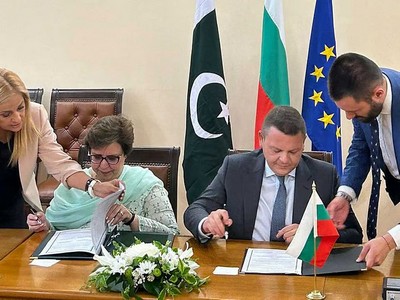
The understanding was reached during a meeting between Director General at Pakistan’s Ministry of Labour Dr Syed Shahbaz Hussain Shamsi and President of the Bulgarian Chamber of Commerce and Industry (BCCI) Tsvetan Simeonov in Sofia this week.
The meeting focused primarily on the potential for greater movement of skilled Pakistani professionals and workers to Bulgaria, while also examining broader opportunities to strengthen economic and people-to-people links between the two countries.
Shamsi told the Bulgarian business leader that Pakistan possessed significant potential in skilled human resources and had a large pool of young professionals who were prepared to seek employment opportunities abroad.
He highlighted Pakistan’s exceptionally young demographic profile, noting that around 70 per cent of the country’s population of approximately 240 million is under the age of 30.
This large youth population, he said, represented a substantial reservoir of human capital that could contribute to the labour requirements of countries facing shortages of skilled workers.
The Pakistani delegation is visiting Bulgaria with the objective of strengthening bilateral cooperation in the exchange of specialists and workers across different sectors, with the support of the Pakistani government and based on its extensive experience in overseas employment.
The visit comes at a time when labour mobility has become an increasingly important component of economic relations between countries, particularly as European economies seek qualified workers to address shortages in several industries.
During the meeting, Simeonov outlined the more than 130-year history of the Bulgarian Chamber of Commerce and Industry in supporting the country’s business community and promoting commercial activity.
He said the Chamber continued to cooperate with the Bulgarian government in facilitating the issuance of work visas for qualified workers and specialists from third countries.
The development could create an important avenue for Pakistani professionals and skilled workers seeking employment opportunities in Bulgaria, particularly if appropriate mechanisms are established to match the requirements of Bulgarian employers with Pakistan’s available workforce.
For Pakistan, expanding legal and regulated labour mobility can provide employment opportunities for its young population while strengthening the skills and experience of workers exposed to international markets.
For Bulgaria, access to a larger pool of qualified foreign workers could help address labour shortages and support businesses in sectors where employers face difficulties in finding suitable personnel.
While the exchange of workers was a central focus of the discussions, both sides agreed that the relationship should not be limited to labour cooperation.
The Pakistani and Bulgarian sides agreed to organise an online meeting in the near future to introduce Bulgarian businesses to investment and commercial opportunities in Pakistan.
The proposed interaction is expected to provide Bulgarian companies with greater insight into Pakistan’s market, business environment and potential investment opportunities.
Potential areas of cooperation identified during the meeting include trade, tourism, business exchanges and student exchanges.
The broader agenda reflects an effort to develop a more comprehensive Pakistan-Bulgaria partnership, combining economic engagement with greater people-to-people interaction.
The Pakistani delegation also drew attention to the country’s considerable export capacity.
Pakistan is a major producer and exporter of agricultural and textile commodities, including mangoes, rice and cotton, among a wide range of other products.
Greater commercial engagement with Bulgarian businesses could provide opportunities for Pakistani exporters to access new markets in Bulgaria and potentially use the country as a gateway for wider engagement with European markets.
At the same time, stronger business ties could open opportunities for Bulgarian companies to explore Pakistan’s large domestic market and investment potential.
The proposed online business meeting could therefore become an important follow-up to the Sofia discussions by allowing companies from both sides to identify specific commercial opportunities and potential partners.
The Pakistani side also briefed the Bulgarian representatives on the country’s visa arrangements, highlighting that applications submitted from Sofia are processed entirely online, with approved visas issued electronically.
The digital process could facilitate travel for Bulgarian businesspeople, investors, students and tourists seeking to visit Pakistan, while also supporting greater people-to-people contact.
Ease of travel is particularly important for expanding commercial relations. Regular movement of business representatives, students and professionals can help create the personal networks often required to develop sustainable bilateral partnerships.
Pakistan’s young population was one of the most significant themes emerging from the discussions.
With around seven out of every 10 Pakistanis under the age of 30, the country possesses a large potential workforce that could contribute to international labour markets if equipped with appropriate technical skills and qualifications.
The Pakistani government has increasingly focused on skills development and overseas employment as part of efforts to provide young people with opportunities in international markets.
The participation of Farooq Ali Khalid, coordinator of the Pakistani Prime Minister’s Youth Programme, in the delegation further highlighted the importance attached to youth development and international employment opportunities.
The delegation also includes Wajiha Khan, Deputy Head of the Office of the Pakistani Embassy in Sofia, reflecting the diplomatic mission’s involvement in strengthening bilateral cooperation.
The Pakistani experts are also scheduled to visit the Bulgarian Employment Agency, where they are expected to gain further insight into Bulgaria’s labour market requirements and employment mechanisms.
Such institutional engagement could help identify sectors facing shortages and determine how Pakistani workers and specialists could potentially meet those needs through legal and regulated channels.
The Sofia meeting demonstrated that labour cooperation could provide a new dimension to Pakistan-Bulgaria relations while also serving as a catalyst for broader economic engagement.
For Pakistan, Bulgaria represents an additional European destination where skilled workers and professionals could potentially find employment opportunities.
For Bulgaria, Pakistan offers access to a large and youthful labour force, as well as a growing market and a diverse export base.
The two sides’ decision to pursue a follow-up online meeting on business opportunities indicates a desire to transform the discussions into practical cooperation.
Trade, tourism, education and business exchanges could complement labour mobility and create stronger links between the two societies.
The emerging Pakistan-Bulgaria engagement reflects a broader trend in international economic relations, where labour mobility, skills development and private-sector cooperation are increasingly becoming important components of bilateral partnerships.
The Sofia discussions brought these elements together, with both sides recognising the potential benefits of closer cooperation.
For Pakistan, the priority will be to ensure that its young workforce is equipped with internationally recognised skills and can access overseas employment through transparent, regulated and sustainable mechanisms.
For Bulgaria, the opportunity lies in tapping into international pools of qualified workers while strengthening its business and economic links with Pakistan.
The proposed online business forum could provide the next practical step in this process.
If followed by sustained institutional and business-level engagement, the latest discussions could pave the way for a broader Pakistan-Bulgaria partnership encompassing skilled labour, trade, investment, tourism and education.
At the heart of the engagement is a simple but potentially powerful proposition: Pakistan’s youthful workforce and Bulgaria’s demand for qualified workers can complement each other, while stronger commercial and people-to-people links can give the bilateral relationship a broader economic foundation.