
Celina Ali
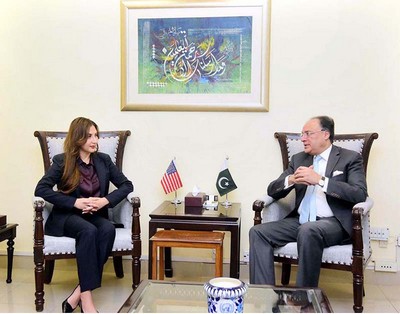
Islamabad: Federal Minister for Finance and Revenue Senator Muhammad Aurangzeb this week held detailed talks with US Chargé d’Affaires to Pakistan Natalie Baker, with the two sides exploring ways to deepen Pakistan-US economic relations, expand bilateral trade and attract greater American investment into key sectors of Pakistan’s economy.
The meeting at the Finance Division came as Islamabad seeks to strengthen its economic engagement with Washington and broaden the range of financing, investment and trade opportunities available to Pakistan.
Baker’s participation in the discussions assumed particular significance as the United States remains an important economic and strategic partner for Pakistan. The talks focused not only on immediate trade and financing priorities but also on creating conditions for greater long-term participation by US companies and financial institutions in Pakistan’s economy.
During the meeting, Aurangzeb briefed Baker on his recent visit to Washington, where he held a series of high-level meetings with senior US economic and financial officials and institutions.
The finance minister outlined his discussions with the US Secretary of the Treasury, senior management of the International Monetary Fund, the US International Development Finance Corporation and the US Export-Import Bank.
He described the engagement with American institutions as constructive and said the discussions had opened opportunities for further cooperation in financial matters, investment and project financing.
Particular attention was given to commercially viable projects in Pakistan that could attract international capital and generate sustainable economic returns. The finance minister emphasised that Islamabad wanted to move beyond conventional financial assistance and develop investment partnerships capable of supporting long-term economic growth.
Baker appreciated Pakistan’s efforts to navigate the economic consequences of the recent regional conflict, particularly the pressures created by rising energy prices.
Her assessment comes at a sensitive time for Pakistan, where external shocks, energy costs, foreign exchange pressures and global economic uncertainty continue to influence domestic economic policymaking.
The US envoy acknowledged the steps taken by Islamabad to preserve economic and financial stability despite the difficult environment and reaffirmed Washington’s interest in supporting Pakistan’s reform efforts.
Baker also expressed continued US interest in strengthening bilateral trade, investment and wider economic cooperation, particularly by encouraging greater participation of American companies in important sectors of Pakistan’s economy.
Her remarks provided a strong indication that Washington sees opportunities for deeper commercial engagement with Pakistan at a time when Islamabad is actively seeking to diversify its investment and financing sources.
A major component of the discussion was the Pakistan-US reciprocal trade framework.
Aurangzeb briefed Baker on recent engagement with the Office of the US Trade Representative and said considerable progress had been achieved in discussions between the two sides.
Pakistan, he said, remained interested in taking the framework forward on a mutually beneficial basis, with greater market access and expanded export opportunities forming key elements of the proposed arrangement.
The finance minister stressed that enhanced access to each other’s markets could help increase bilateral trade and provide Pakistani exporters with opportunities to expand their presence in the US market.
For Islamabad, greater access to the American market is particularly important because the United States is among Pakistan’s largest export destinations. Expanding exports is also central to the government’s broader strategy of strengthening foreign exchange earnings and reducing external vulnerabilities.
The meeting also focused on the potential for increased involvement of US financial institutions, particularly the US International Development Finance Corporation, in Pakistan’s investment landscape.
Aurangzeb emphasised the need to identify specific projects that are ready for investment and develop appropriate financing structures capable of attracting American capital.
The approach reflects the government’s broader effort to shift towards investment-led economic growth. Rather than relying primarily on traditional borrowing or emergency financing, Islamabad wants to develop commercially viable projects that can attract private investors and international development finance institutions.
The finance minister stressed that Pakistan remained open to American investment and was working to create an environment conducive to private-sector participation.
The discussions extended beyond conventional finance and trade, covering several sectors with significant potential for future cooperation.
The two sides exchanged views on ports and logistics, energy, telecommunications, digital technology and artificial intelligence, along with other emerging areas.
The inclusion of these sectors highlights the changing nature of Pakistan-US economic relations. While traditional trade remains important, Islamabad increasingly wants foreign investment to contribute to infrastructure development, technological advancement, digital transformation and industrial growth.
Ports and logistics have particular significance for Pakistan because of the country’s geographical position and its potential to serve as a regional trade and transit hub.
Energy, meanwhile, remains a critical component of Pakistan’s economic stability, while telecommunications, artificial intelligence and digital technologies represent areas in which international investment and expertise could accelerate the country’s transition towards a more technology-driven economy.
Aurangzeb told the US envoy that the government was working to establish an enabling environment for private-sector investment and welcomed growing interest among American businesses and investors.
The finance minister also briefed Baker on Pakistan’s response to the economic impact of recent regional tensions.
Rising international energy prices have historically placed considerable pressure on Pakistan’s import bill, foreign exchange reserves and inflation outlook. Managing these pressures has therefore become an important component of the government’s economic strategy.
Aurangzeb highlighted the recent move towards a daily price revision mechanism for petroleum products, aimed at bringing domestic prices more closely in line with international market conditions.
The mechanism is intended to improve the responsiveness of domestic petroleum prices to fluctuations in global markets while reducing the risk of prolonged distortions between international costs and local prices.
The finance minister reiterated that the government remained focused on fiscal discipline, strengthening foreign exchange reserves, increasing exports and maintaining economic growth despite external pressures.
Aurangzeb also updated Baker on Pakistan’s engagement with international capital markets and its efforts to diversify sources of financing.
The government is seeking to strengthen the country’s sovereign credit profile and improve access to longer-term financing instruments as part of a broader strategy to reduce vulnerability to short-term external financing pressures.
The finance minister highlighted the importance of strengthening foreign exchange reserves and building investor confidence, both of which are considered essential for improving Pakistan’s external economic position.
He also emphasised structural reforms and the need to strengthen institutional frameworks to create a more predictable environment for investors.
The discussions reflected a broader shift in Pakistan’s economic priorities from immediate stabilization towards sustainable and export-led growth.
Following years of economic pressures, Islamabad has increasingly emphasised fiscal discipline, stronger reserves, improved revenue collection, structural reforms and expansion of the country’s export base.
Aurangzeb told the US envoy that the government remained committed to reforms aimed at strengthening the foundations of the economy and improving the overall business environment.
He also acknowledged the constructive role played by US partners in supporting Pakistan’s economic objectives and reiterated Islamabad’s willingness to facilitate American investment.
For Washington, greater commercial engagement with Pakistan could create opportunities for US companies in a large and strategically located market. For Islamabad, increased American investment could bring not only capital but also technology, expertise and access to international business networks.
The meeting between Aurangzeb and Baker points towards an effort by both countries to give greater economic substance to their bilateral relationship.
Pakistan is seeking expanded access to international markets, diversified sources of investment and financing, while the United States has indicated continued interest in supporting economic reforms and increasing commercial engagement.
Baker’s reaffirmation of US support for Pakistan’s economic reform agenda and her appreciation of the government’s efforts to maintain stability suggest that Washington remains closely interested in Pakistan’s economic trajectory.
For Islamabad, however, the challenge now is to translate diplomatic goodwill into concrete investment and trade outcomes.
That will require a steady pipeline of investment-ready projects, regulatory reforms, greater transparency, improved ease of doing business and stronger protection for investors.
The sectors discussed during the meeting — from ports and energy to telecommunications, artificial intelligence and digital technology — offer a potentially broad platform for such cooperation.
The engagement also highlighted the importance of the Pakistan-US reciprocal trade framework, which could become an important element of the economic relationship if negotiations continue to produce mutually acceptable arrangements.
As Pakistan works to move from economic stabilization towards sustained growth, stronger engagement with American financial institutions and private companies could become increasingly important.
For Baker, the meeting provided an opportunity to convey Washington’s continued interest in Pakistan’s economic potential. For Islamabad, it offered a platform to present its reform agenda and make a case for greater American participation in the country’s next phase of economic development.
The message emerging from the talks was clear: both sides see room for a deeper economic partnership, but the next stage will depend on converting policy discussions into investment, trade, financing and commercially viable projects that can deliver tangible benefits to both economies.